Key Points
-
This guideline focusses on the placement of patients in single rooms for infection prevention and control reasons (source and protective isolation).
-
Isolation facilities should be prioritised depending on the known/suspected infectious agent.
-
All patient placement decisions and assessment of infection risk (including isolation requirements) must be clearly documented in the patient notes and provided in communication with other healthcare/ care providers.
-
This guideline should be used as a supplement to the guidance within the National Infection Prevention & Control Manual for England.
This is a controlled document. If you are using a printed copy, check it against the guidelines site to ensure you are using the latest edition. Print copies must be destroyed after use.
Abbreviations
1. INTRODUCTION
There are four main reasons that patients are cared for in single room accommodation within the Trust:
-
To isolate a known or suspected infectious agent to reduce the risk of its transmission to between patients (source isolation)
-
To reduce the risk of infection transmission to patients susceptible to infection (protective isolation)
-
Clinical but not infection-related reasons
-
Non-clinical reasons (for example patient preference)
This guideline focusses on the placement of patients in single rooms for infection prevention and control reasons (namely source and protective isolation), to minimise the risk of infection transmission within the healthcare setting.
This guideline should be used as a supplement to the guidance within the National Infection Prevention & Control Manual for England.
2. RISK ASSESSMENT
2.1 The potential for transmission of infection must be assessed at the patient’s entry to the care area. Completion of the Communicable Disease screening tool on Epic will provide a record of the assessment of risk, and if the patient is hospitalised, this risk should be continuously reviewed throughout the inpatient stay/episode of care. The assessment should influence placement decisions in accordance with clinical/care need(s). Patients who may present a cross-infection risk in any setting includes those:
• with diarrhoea, vomiting, an unexplained rash, fever, or respiratory symptoms
• known to have been previously positive with a Multi-Drug-Resistant Organism (MDRO) eg. MRSA, CPE
• who have been an inpatient in any hospital in the UK or abroad or are a known epidemiological link to a carrier of CPE
• who have a known or suspected infection or colonisation
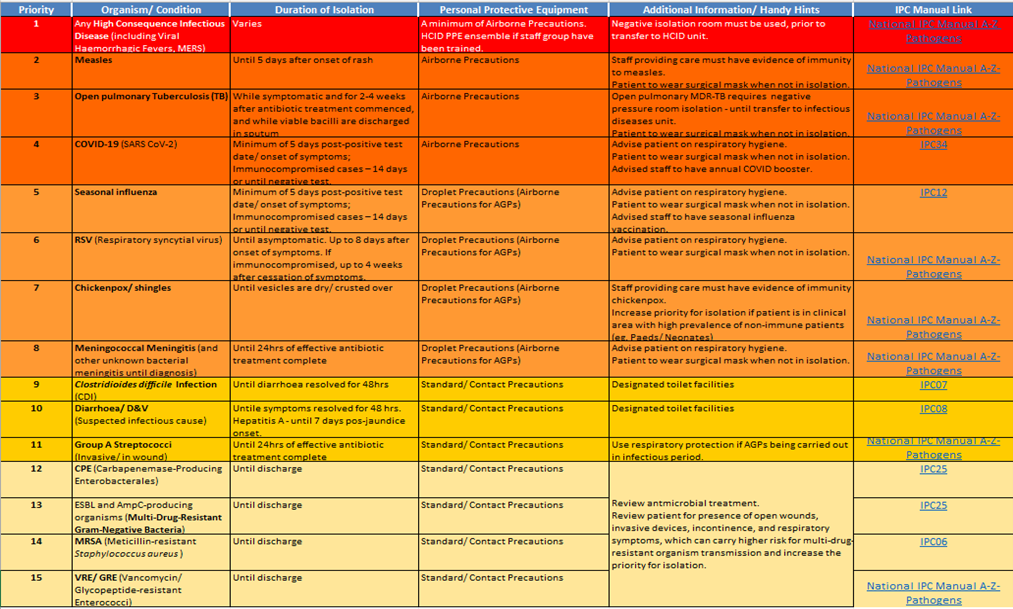
2.2 Isolation facilities should be prioritised depending on the known/suspected infectious agent (refer to NHS England IPC A to Z of Pathogens Resource, and Appendix B for local prioritisation). When there are competing demands for single rooms, the Site Managers and Infection Prevention & Control Team (IPCT) should jointly agree on the appropriate placement of patients.
2.3 All patient placement decisions and assessment of infection risk (including isolation requirements) must be clearly documented in the patient notes.
2.4 If single rooms are limited, patients who have conditions that facilitate the transmission of infection to other patients (eg. draining wounds, stool incontinence, uncontrolled cough, uncontained secretions) and those who are at increased risk of acquisition and adverse outcomes resulting from healthcare-associated infections (e.g. immunosuppression) should be prioritised for placement in a single rooms.
2.5 The clinical judgement and expertise of the staff involved in a patient's management and the IPCT should be sought particularly when there are competing demands for single room accommodation.
2.6 Patient records should be reviewed for information of current or historical infection risks.
2.7 Cohorting of patients with specific infections must not take place unless on advice from the IPCT.
2.8 Healthcare workers (HCWs) caring for patients in their own home must ensure they are aware why patient is in isolation and the precautions required for that scenario. The HCW must risk assess if any PPE is required. IPC precautions will be dependent on the reason for isolation, and standard IPC precautions apply for all care. Clear communication for all relevant parties is essential.
3. TYPES OF ISOLATION ROOM
3.1 Single room with no en-suite facilities
These rooms can be used for source isolation if rooms with en-suite facilities are unavailable. If enteric precautions are required, toilet facilities such as a commode will need to be designated for use in the room. These rooms are most appropriate for patients who require a single room for non-IPC reasons.
3.2 Single room with en-suite facilities
These rooms are suitable for isolation of infections spread by contact, enteric route, or respiratory route (if rooms with an anteroom are unavailable). These rooms are also suitable for patients requiring protective isolation.
3.3 Single room with en-suite facilities, plus anteroom (neutral pressure)
These rooms are prioritised for infectious diseases transmitted via the respiratory route, as the anteroom can be used for donning of PPE required.
3.4 Negative pressure isolation room (en-suite and positive pressure anteroom)
These rooms are prioritised for infectious diseases transmitted via the respiratory route (pulmonary tuberculosis, influenza, measles, novel coronaviruses), and High Consequence Infectious Diseases awaiting transfer to a High-Level Isolation Unit (eg. Viral Haemorrhagic Fever). There are a small number of negative pressure isolation rooms on the WPH (ICU and EAC) and FPH sites (ICU and ward G1).
3.5 Positive pressure isolation room
These rooms are prioritised for patients requiring protective isolation. This room type is not currently available at Frimley Health.
4. CATEGORIES OF ISOLATION
5. COHORTING IN HOSPITAL SETTINGS
5.1 Cohorting of infectious patients can be considered, under the advice of the IPCT, when:
• demand for single room capacity outweighs availability, and if there are two or more patients (a cohort) with the same confirmed infection. Confirmation of infection must include microbiological confirmation (eg. two patients with confirmed SARS-CoV-2-positive PCR tests)
• there are situations of service pressure (eg. winter), and patients may have different or multiple infections. In these situations, the Trust preparedness plan must be in place ensuring that Organisation/Board level assurance on IPC systems and processes are in place (eg. IPC Board Assurance Framework).
5.2 Infectious patients who must not be cohorted with others with different or multiple infections include:
• those at increased risk of acquisition and adverse outcomes resulting from infection (eg. immunosuppression)
• individuals who are unlikely to comply with transmission-based precautions.
5.3 In the event of infection cohorting, the isolation practices in Section 4, apply to the cohort area, including the door to the cohort room/ area being kept closed. A minimum of one metre spacing must be maintained between patients within the cohort area.
6. MONITORING
Monitoring of this guideline if through the annual Infection Prevention & Control Environmental Audit programme.
References
Ayliffe, G.A.J., Collins, B.J., Lowbury, E.J.L., and Wall, M. (1971) ‘Protective isolation in single-bed rooms: studies in a modified hospital ward’, Journal of Hygiene (London), 69(4), pp. 511-527. Available at: https://www.ncbi.nlm.nih.gov/pmc/articles/PMC2131037/pdf/jhyg00090-0006.pdf (Accessed: 18 January 2024).
Royal College of Nursing (2017) Essential practice for infection prevention and control: guidance for nursing staff. Available at: https://www.rcn.org.uk/-/media/royal-college-of-nursing/documents/publications/2017/november/pub-005940.pdf?la=en (Accessed: 18 January 2024).
Department of Health & Social Care (2022) The Health and Social Care Act 2008: code of practice on the prevention and control of infections and related guidance. Available at:
https://www.gov.uk/government/publications/the-health-and-social-care-act-2008-code-of-practice-on-the-prevention-and-control-of-infections-and-related-guidance/health-and-social-care-act-2008-code-of-practice-on-the-prevention-and-control-of-infections- (Accessed: 18 January 2024).
Department of Health (2013a) Health Building Note 00-09: infection control in the built environment. Available at:
https://www.england.nhs.uk/wp-content/uploads/2021/05/HBN_00-09_infection_control.pdf (Accessed: 18 January 2024).
Department of Health (2013b) Health Building Note 04-01: supplement 1: isolation facilities for infectious patients in acute settings. Available at:
https://www.england.nhs.uk/wp-content/uploads/2021/05/HBN_04-01_Supp_1_Final.pdf (Accessed: 18 January 2024).
Department of Health (2013c) In-patient care: Health Building Note 04-01: adult in-patient facilities. Available at:
https://www.england.nhs.uk/wp-content/uploads/2021/05/HBN_04-01_Final.pdf (Accessed: 18 January 2024).
NHS England (2023) National infection prevention and control manual (NIPCM) for England. Available at: https://www.england.nhs.uk/national-infection-prevention-and-control-manual-nipcm-for-england/ (Accessed: 18 January 2024).
Siegel, J.D., Rhinehart, E., Jackson, M., Chiarello, L., and the Healthcare Infection Control Practices Advisory Committee (2007) Guideline for isolation precautions: preventing transmission of infectious agents in healthcare settings. Available at: https://www.cdc.gov/infectioncontrol/guidelines/isolation/index.html (Accessed: 18 January 2024).
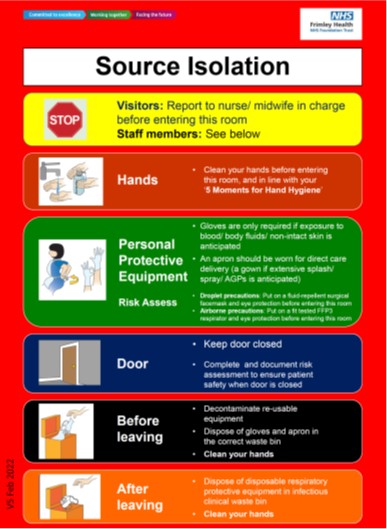
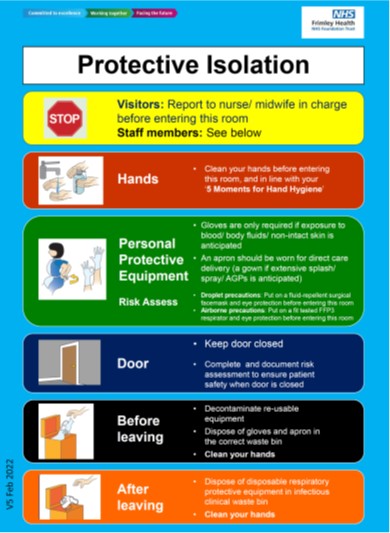
APPENDIX A: Isolation ‘Warning’ Signs
APPENDIX B: Essential Source Isolation Prioritisation & Actions
Full version control record
This guideline has been registered with the Trust. However, clinical guidelines are guidelines only. The interpretation and application of clinical guidelines will remain the responsibility of the individual clinician. If in doubt, contact a senior colleague or expert. Caution is advised when using guidelines after the review date.
This guideline is for use in Frimley Health NHS Foundation Trust hospitals only. Any use outside this location will not be supported by the Trust and will be at the risk of the individual using it.
Version History
Related Documents