Key Points
• The healthcare environment can represent an important source of pathogens that can cause infections or carry antimicrobial resistance.
• Management of the care environment is important to reduce the infection risks associated with healthcare ventilation, water and drainage systems, patient placement, and contaminated surfaces.
• Effective decontamination of the care environment and equipment (including medical devices) is essential to reduce the risk of cross infection.
• This guidance should be followed in conjunction with the guidance in the National Infection Prevention and Control Manual (NHSE 2024) (and references therein) Chapter 1: Standard infection control precautions.
This is a controlled document. If you are using a printed copy, check it against the guidelines site to ensure you are using the latest edition. Print copies must be destroyed after use.
Abbreviations
1.0 Introduction
Throughout healthcare, the physical environment can represent an important source of pathogens that can cause infections or carry antimicrobial resistance.
2.0 Reducing Risk from Ventilation SYSTEMS
Building ventilation is an important part of a healthy building environment as it brings a stream of outside air into the building and removes stale air.
Ventilation is also a very important way of diluting any respiratory-spread pathogens such as SARS-CoV-2, and there is good evidence showing that room occupants are more at risk of catching an illness in a poorly ventilated room than in a well-ventilated room. Ventilation standard should meet that of national guidance (NHSE 2021a) to also manage dilution and extraction of chemical agents as required by COSHH (HSE 2013), such as anaesthetic gases.
Appropriate environmental ventilation can be achieved by:
Mechanical Ventilation
Mechanical ventilation is used to describe the means of bringing air into a building by mechanical means, for example fans. Often air is moved through ductwork to deliver outside air into a building and there are several ways in which this can be achieved, such as:
• Supply and extract, or just extract ventilation (usually in place if you can see vents in the ceiling or walls)
• Air conditioning - Outside air is first ‘conditioned’ before being moved along ductwork to the room (this does not include stand-alone ‘air conditioning units’, that just warm or cool the room air, and recirculate).
Specialist ventilation is provided in some clinical areas of the Trust that were designed to accommodate patients with respiratory-spread infectious disease, such as negative pressure isolation rooms.
Natural Ventilation
The term natural ventilation is used to describe ways that outside air can enter the building without using fans or other mechanical means. For example, airflow through windows and doors:
• Openable windows and vents should be used more than normal during periods of high prevalence of acute respiratory virus infection (taking into consideration patient safety and security is considered).
• Open windows do not cause an infection risk to anyone moving outside (the concentration of microorganisms will be diluted substantially out in the open air).
• At the very least windows should be open a small amount all the time, intermittently during the day, or in rooms not always occupied, for at least 15 minutes prior to room occupation, and during cleaning of rooms.
• Where there are both high-level and low-level openable windows in a room, then it is recommended to open the high-level windows during colder weather, as incoming air will be warmed as it flows down into the room thereby reducing cold draughts. This also improves mixing of the outside air with air in the room before reaching the occupied zone.
• To maximise airflow when draughts are not a concern, both high and low windows should be opened. This does not just increase opening area but creates a more efficient flow, thereby increasing the dilution of pollutants.
3.0 Reducing Risk from PHYSICAL DISTANCING
The COVID-19 pandemic identified the importance of maintaining a distance between bed spaces, to reduce the risk of infection cross-transmission.
National guidance (DH 2013) for clear bed spacing is higher than this (3.6 metres minimum) to allow sufficient space to provide clinical care without encroaching on the neighbouring bedspace, and to enable staff to move themselves and patients in a safe manner.
To increase bed spacing in clinical areas:
• Place furniture in multi-bed bays in a way that enables patients to sit further away from each other.
• Keep the clinical environment uncluttered.
• Reduce disposable items stored in patient rooms.
• Do not store re-usable medical devices in rooms – place them away in a storeroom after decontamination.
4.0 Reducing Risk from Water SYSTEMS
The trust is responsible for ensuring that the facilities within which its patients are treated, and its staff and visitors occupy, are as safe as reasonably possible for risk arising from the water and drainage systems.
Hospital water is a recognised potential source of Pseudomonas aeruginosa and Legionella pneumophillia - microorganisms that can act as opportunistic pathogens and colonise and infect vulnerable patients. There is increasing global evidence that healthcare water and drainage systems act as ‘superhighways’ for gram-negative bacteria, including Carbapenemase-Producing Enterobacterales (CPE). Organisms colonising pipework in biofilms are able to travel through the drainage system (even upwards), leading to colonisation of other water outlets. Inappropriate use of hand wash basins for disposal of fluids such as drinks and washbowl water, and antimicrobials excreted in wastewater into drains, increases the likelihood of biofilm development and selective pressure in favour of resistant bacteria.
Potential transmission routes from water to patient include:
• Aerosolisation from contaminated shower outlets
• Preparing medications and intravenous fluids near sinks
• Splashes from sink drains (for example if water flows directly into the plug hole)
Factors that can increase the risk of these bacteria growing in the water system include:
• Water temperatures not being maintained (hot water running too cold, cold water too warm – creating a lovely warm spa for bacteria).
• Cleanliness of water outlets, and sanitary fixtures and fittings (sinks, baths, showers) – the more grime, the more nutrients and shelter for bacteria.
• Water age – the rate of water turnover and movement in a system, affected by:
-
Dead legs: A length of water system pipework leading to a fitting through which water only passes infrequently providing the potential for stagnation, and growth of biofilm (complex layer of microorganisms that attach and grow on a surface (such as the inner surface of pipes or faucets), producing a polysaccharide layer that keeps them cosy and safe).
-
Under-used water outlets
To reduce the infection risk of water systems, the trust has in place:
• A Water Safety Plan: A risk-management approach to the safety of water that establishes good practices in local water distribution and supply. It will identify potential hazards, consider practical aspects, and detail appropriate control measures.
• A programme of monitoring water temperatures in our buildings.
• A programme of regular testing of water outlets, for legionella and Pseudomonas aeruginosa – this is carried out more frequently in augmented care areas such as ITU and Neonatal Unit, where patients are more vulnerable to infection.
• A programme of maintenance of the trust water systems.
• Put in place control measures promptly if issues are identified (work such as investigation of water quality issues, disinfection of water systems, and application of point of use filters to outlets until the system is safe).
All trust staff can help reduce the risk by:
• Refer to the clinical hand wash basin standards described in IPC05: Hand Hygiene policy (section 5.2).
• Preventing patient exposure to contamination from drainage systems, by actions such as locating hand wash basins a minimum of 2 metres away from clean and sterilised equipment storage, medication preparation, and patients; and cleaning of wounds with sterile water.
• Turning off taps with elbows, not the hands you have just cleaned.
• Keeping sinks clean, and ensuring taps are descaled regularly.
• Ensuring under-used water outlets are flushed/ ran before use, and at least weekly.
• If any area with a sink, shower or bath has a change of use (eg. becomes a storeroom or office) please inform the Estates team immediately so that water supply can be turned off or removed.
• Reporting slow-running taps, and slow-draining sinks and showers promptly to the Estates team.
5.0 Reducing Risk from Surfaces
Surfaces contaminated with microorganisms can serve as reservoirs of potential pathogens.
Many of these microorganisms are continuously shed or spread by direct skin contact onto surrounding environment surfaces. Contamination of surfaces, including high-touch surfaces in the room (e.g., bedrails, over-bed tables, and call-buttons) and reusable patient care equipment can lead to cross-infection.
Therefore, cleaning and disinfection of environmental surfaces and patient equipment is fundamental to reduce potential contribution to healthcare-associated infections.
5.1 Definition of Terms
Contamination – The soiling or pollution of an object with harmful, potentially infectious or other unwanted substances, e.g. micro-organisms, organic matter, (blood and body substances), dust, chemical residues, etc. Contamination may have adverse effects on the function of the object or may be transferred to a susceptible host (patient or staff) during use, subsequent processing or storage.
Decontamination – A process or combination of processes which removes or destroys contamination, preventing micro-organisms or other contaminants reaching a susceptible site in sufficient quantities to cause infection or other harmful response. Decontamination includes effective cleaning, disinfection and/or sterilisation and is used to render reusable medical devices safe for further use.
Cleaning – The physical removal of organic matter and micro-organisms. This is the first level of decontamination and may be all that is required for certain items. Cleaning is an essential prerequisite for disinfection or sterilisation as the presence of any organic matter may render higher levels of decontamination i.e. disinfection or sterilisation ineffective.
Routine cleaning – The regular, daily or after use cleaning of equipment using Chlor-clean (or similar) or product specifically recommended by the manufacturer
Discharge clean – The routine cleaning of the bed space/room and all associated furniture, fixtures, and fittings on discharge of a patient.
Terminal clean – The final clean of the bed space/ room and all associated furniture, fixtures and fittings on discharge or transfer of patients with known or suspected infections, or on the advice of the Infection Prevention & Control team.
Enhanced clean – Twice daily (minimum) cleaning of the environment and patient care associated equipment during outbreaks or Periods of Increased Incidence of infection.
Disinfection – A process which reduces the number of viable micro-organisms on an object but is not necessarily effective against bacterial spores or some viruses. Disinfection can be achieved through the use of heat or chemicals. The aim is to reduce microbial contamination to safe levels. Chemicals that achieve this are known as disinfectants. (A disinfectant that can be applied to skin or mucous membranes is called an antiseptic).
Sterilisation- Means the complete destruction of all micro-organism, including bacterial spores. Equipment that comes into contact with broken skin or mucous membranes should be sterile, e.g. instruments, dressings, injections and irrigation fluids.
Sterilisation is best achieved by moist heat under pressure (autoclaving) in a Sterile Services Department.
5.2 Single-Use Equipment
These are medical devices manufactured with the intention to be used once only and then discarded. Current advice from the Medicines & Healthcare Products Regulatory Agency (MHPRA 2021) on equipment marked as single used is that such items of equipment must not be reused. The reuse of single-use items may contravene consumer protection legislation and render the user legally liable.
Items designated single use carry the following symbol:
Items designated single used carry the following symbol:

5.3 Single Patient Use
Devices marked for “single patient use” can be used again but only on the same patient.
The equipment must be clearly identified for use by that patient only.
Any equipment not designated as single use only must be decontaminated in line with the manufacturers’ guidance for the device.
5.4 Multi-Patient Use
Equipment (eg. commodes, mattresses) requires decontamination after each episode of use by a patient, in line with manufacturers’ instructions.
5.5 Decontamination of Patient Care Equipment
Care equipment is easily contaminated with blood, other body fluids, secretions, excretions and infectious agents. Consequently, it is easy to transfer infectious agents from communal care equipment during care delivery.
Refer to the NIPCM (NHSE 2024) Section 1.5 Safe management of care equipment.
Refer to the trust ‘Decontamination Policy’ for detailed decontamination information, including processes in the Sterile Services Department and Endoscopy.
5.5.1 General principles
Awareness of safe decontamination is vital to ensure the highest level of infection prevention and control, and to maintain the safety of patients and healthcare staff. The method of decontamination used must be one that is appropriate to the level of contamination of the item, achieves acceptable decontamination, and does not damage the item or any of its components therein.
Always adhere to Control of Substances Hazardous to Health (COSHH) risk assessments and manufacturers’ guidance for use and decontamination of all care equipment, and products used for decontamination.
The MHPRA has produced a risk assessment tool that categorises the risk the instrument/equipment being used poses to an individual based on the area of the body on/in which it has been used. The risk assessment tool is below:
New/ proposed medical devices must be reviewed by the trust Product Selection Group prior to use, so that feasibility and adequacy of reprocessing is known.
5.5.2 Decontamination of re-usable non-invasive care equipment
Decontamination must be undertaken:
• between each use/between patients
• after blood and/or body fluid contamination
• at regular predefined intervals as part of an equipment decontamination protocol
• before inspection, servicing or repair.
If providing community care, equipment should be transported safely and decontaminated as above before leaving the patient’s home.
General Principles
• Manufacturers’ guidance on decontamination must be adhered to.
• All reusable non-invasive care equipment must be decontaminated between each use, in line with manufacturers’ instructions, before being stored clean and dry.
• Re-usable patient equipment that is unable to be stored away in a clean storage cupboard/ room after decontamination (ie are stored in patient rooms/ bays/ ward corridors), must be cleaned again immediately prior to their next use. These items should not be labelled with ‘I am clean’ indicators, as their cleanliness while located outside of clean storage areas, cannot be guaranteed.
• Avoid where possible, the sharing of equipment for patients with known infections. If equipment has to be shared, it must be decontaminated thoroughly between every patient use.
• An equipment decontamination status certificate will be required if any item of equipment is being sent to a third party, eg for inspection, servicing or repair.
• Guidance should be sought from the IPC Team prior to procuring, trialling or lending any reusable non-invasive equipment.
• Medical devices and other care equipment must have evidence of planned preventative maintenance programmes.
• Equipment that is damaged or broken and can no longer be safely/effectively decontaminated must be condemned and discarded via the appropriate channels.
5.5.3 Disinfectants
Details of disinfection products (including disinfection wipes) and their safe preparation and use, are available in the Infection Prevention & Control microsite of the trust intranet (in the Decontamination folder).
General principles for the use of disinfectants
• Anyone using disinfectants must first receive appropriate training in their safe & effective use.
• Disinfectants, particularly concentrated solutions can be highly corrosive, therefore avoid contact with skin and splashing onto the skin, mouth, eyes or clothing and always follow the guidance on personal protective equipment and ventilation provided by the manufacturer’s safety data sheet for the product.
• Disinfectant products must be secured away from access by the general public/patients.
• Only use disinfectants approved by the trust.
• Always check the expiry date/ date prepared before use.
• Always replace the container cap securely after use.
• A sterile solution once opened should be regarded as non-sterile.
• Disinfectants must be used at their correct concentration or dilution (refer to manufacturers’ instructions).
• Disinfection solutions must be made up in the appropriately labelled container using fresh cold water.
• Diluted disinfectants may rapidly become inactive over time; therefore, always use freshly prepared solutions.
• Some disinfectants can be inactivated by other chemicals including detergents, therefore never mix disinfectants with other products.
• Partially used containers of disinfectant should never be topped-up.
5.5.4 Sterilisation
Refer to FHFT ‘Decontamination Policy’ for information on the sterilisation processes used in the Sterile Services Department and Endoscopy.
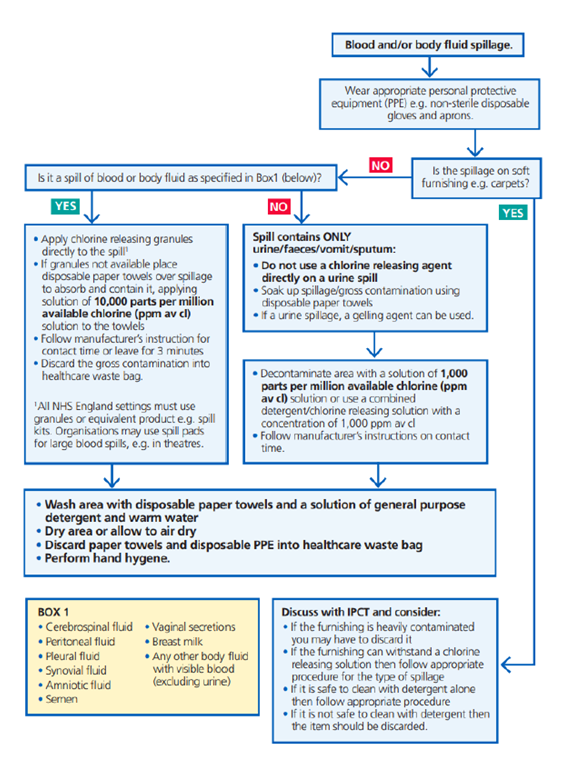
5.6 Spillages of Blood or Body Fluids
Always wear appropriate PPE before dealing with a spillage. Any spillage must be dealt with immediately to minimize risk to staff, patients or visitors. If the spillage contains broken glass do not touch it with your hands (use stiff card or a plastic scoop to remove the glass and discard it into a sharps container).
The use of carpet is not appropriate in clinical areas as it is difficult to decontaminate spillages of body fluids or blood (DH 2013).
Refer to the NIPCM (NHSE 2024) section 1.8 Safe management of blood and body fluids spillages.
5.6.1 Follow the NIPCM (NHSE 2024) Appendix 9: Management of blood and body fluids spills, summarised below:
5.7 Decontamination of Patient Care Environment
Refer to the trust ‘Cleaning Policy’ for roles and responsibilities of Trust staff.
• The environment should be routinely cleaned in accordance with the National Standards of Healthcare Cleanliness (NHSE 2021b).
• The Facilities Team assess environmental cleanliness against the national specifications for cleanliness, using an electronic audit tool.
• Staff groups should be aware of their environmental cleaning schedules for their area and clear on their specific responsibilities.
• Cleaning protocols should include responsibility for, frequency of, and method of environmental decontamination.
Further information can be found in the NIPCM (NHSE 2024) safe management of the care environment literature review.
5.7.1 Terminal Clean
Terminal cleaning is carried out in the trust when:
• A patient who is source-isolated is discharged from a single room or transferred to another ward (i.e. at the end of their period of care in that area).
• A patient who has been source-isolated no longer requires isolation (eg. infection has resolved) and is transferred from the single room.
• An area of a ward/ department which has been closed to admissions and transfers for an IPC reason (e.g. diarrhoea & vomiting), is ready for re-opening.
Principles for Terminal Cleaning
• The housekeeping team are informed that a terminal clean is needed and have the procedure explained if necessary. Nursing staff will advise if any transmission-based precautions (such as respiratory protective equipment) is required while working in the area to be cleaned, in addition to standard IPC precautions.
• Remove from the vacated isolation room/cohort area, all:
-
healthcare waste and any other disposable items (bagged before removal from the room)
-
bedding/bed screens/curtains and manage as infectious linen (bagged before removal from the room); and
-
reusable non-invasive care equipment (decontaminated in the room prior to removal).
• Yellow (disposable) colour-coded cleaning equipment must be used (NHS England 2021). Ensure the cloth is rinsed regularly and the water changed if dirty. Bucket and mop to be kept in the room (mop head to be laundered daily and following terminal cleaning).
• The IPCT will advise on whether the curtains need to be removed and replaced.
• Decontaminate surfaces, working from highest to lowest points and towards the bathroom. Include all equipment used in the area. Attention must be paid to frequently touched surfaces (for example: lockers – both inside and out, tables, bed frame, chairs, door handles and bin and curtain rails, window ledges, blinds). Dry horizontal surfaces and allow floor to dry naturally.
• Clean all sanitary areas using separate cloths for this area. Do not forget handles, taps, and dispensers.
• Walls do not require washing unless stains or splashes visible. The Deep Cleaning Team is not required for routine terminal cleans. Please contact a member of the Infection Prevention & Control Team if in doubt.
• Surfaces must be dry prior to occupation by the next patient.
5.8 Additional Environmental Decontamination
5.8.1 UVD Robot Disinfection
The Trust has four UVD robots that are used by the Central Housekeeping Teams as an adjunct to the deep cleaning programme.
5.8.2 Deep Cleaning
Deep Cleaning is carried out on a planned programme (co-ordinated by the Facilities Team), as a rolling programme for side-rooms and other clinical spaces, and also for cleans for specific infection risks (ordered through the IPC Team). Examples are:
• on discharge of a known CPE-positive patient
• on changing the purpose of a clinical area, such as a High-Risk ward (eg. COVID-19 cohort ward) changing to a lower-risk ward
• following the builders’ clean on completion of a capital project.
The auditing of this deep cleaning programme is the responsibility of the Hotel Services Managers and it will be reported to the HICC on a quarterly basis.
5.9 Cleaning Schedules
• Cleaning schedules for individual wards and departments are displayed, alongside cleanliness star ratings, on the Cleanliness Charter noticeboards.
• The trust cleaning responsibilities framework (showing roles and frequency of cleaning of key elements) is available on the trust intranet, in the IPC microsite, within the Decontamination folder.
• The nursing equipment cleaning schedule is also available in the Decontamination folder noted above, and is updated regularly in line with changes in nursing equipment and trust-approved decontamination products.
6.0 MONITORING OF THIS GUIDELINE
Decontamination and management of the care environment is monitored through the IPC Environmental Audit programme, Facilities Housekeeping Cleanliness scoring audits, and PLACE inspections.
References
Department of Health 2013 HTM 00-09 Infection Control in the Built Environment. The Stationary Office. London.
https://www.england.nhs.uk/publication/infection-control-in-the-built-environment-hbn-00-09/
Department of Health 2016 Decontamination of surgical instruments (HTM 01-01).
https://www.england.nhs.uk/publication/decontamination-of-surgical-instruments-htm-01-01/
Health and Safety at Work Act 1974. London HMSO 1974.
https://www.legislation.gov.uk/ukpga/1974/37/contents
Health and Safety Executive 2013 The control of substances hazardous to health regulations 6th edn. Sudbury HSE books.
https://www.hse.gov.uk/pubns/books/l5.htm
Medicines & Healthcare products Regulatory Agency 2021 Single-use medical devices: implications and consequences of reuse. V2.4.
Available at:
https://assets.publishing.service.gov.uk/media/60117a378fa8f565559191cd/Single_use_medical_devices.pdf
NHS England 2021a Health Technical Memorandum 03-01: Specialised ventilation for healthcare premises.
Available at:
https://www.england.nhs.uk/publication/specialised-ventilation-for-healthcare-buildings/
NHS England 2021b National standards of healthcare cleanliness 2021. Available at:
https://www.england.nhs.uk/publication/national-standards-of-healthcare-cleanliness-2021/
NHS England 2024 National Infection Prevention and Control Manual (NIPCM) for England. Available at:
https://www.england.nhs.uk/national-infection-prevention-and-control-manual-nipcm-for-england/
Full version control record
This guideline has been registered with the Trust. However, clinical guidelines are guidelines only. The interpretation and application of clinical guidelines will remain the responsibility of the individual clinician. If in doubt, contact a senior colleague or expert. Caution is advised when using guidelines after the review date.
This guideline is for use in Frimley Health NHS Foundation Trust hospitals only. Any use outside this location will not be supported by the Trust and will be at the risk of the individual using it.
Version Control Sheet
Related Documents