Key Points
• Clostridioides difficile infection (CDI) is predominantly a healthcare-associated infection and is a common cause of antibiotic-associated diarrhoea.
• Contact precautions are required for the care of patients with CDI within healthcare settings.
• This guideline provides trust-specific supplementary information to the guidance within the National Infection Prevention & Control Manual (England), A to Z of Pathogens Resource
This is a controlled document. If you are using a printed copy, check it against the guidelines site to ensure you are using the latest edition. Print copies must be destroyed after use.
Abbreviations
1. Introduction
This guideline provides trust-specific supplementary information to the guidance on Clostridioides difficile infection within the National Infection Prevention & Control Manual (England), A to Z of Pathogens Resource.
Clostridioides difficile infection (CDI), also known as Clostridium difficile, is a major cause of infectious diarrhoea due to the spore-forming bacterium, Clostridioides difficile. It is predominantly healthcare-associated, and accounts for approximately 20% of cases of antibiotic-associated diarrhoea.
2. Risk Factors for CDI
The possibility of CDI should be considered when persons with diarrhoea also have:
-
Current or recent (within the last six months) use of antimicrobial agents (especially those with a high risk for CDI, including cephalosporins, and broad-spectrum antimicrobials (such as co-amoxiclav);
-
Increased age;
-
Prolonged hospital stay;
-
Serious underlying diseases;
-
Surgical procedures (in particular bowel procedures);
-
Immunosuppression; and/or
-
Use of proton pump inhibitors (drugs which reduce the production of stomach acid).
3. Management of Patients with CDI
-
Suspected and confirmed CDI cases require contact precautions. Refer to the NIPCM (England), Chapter 2: Transmission-based Precautions.
-
Inpatients with a suspected or confirmed CDI, require isolation in a single room with designated toilet facilities. Refer to IPC04: Guidelines for the Isolation of Patients.
-
Special contact precautions (or other interventions) are not recommended for asymptomatic carriers of C. difficile.
-
Hand hygiene: C. difficile spores are transmitted via the faecal-oral route, and hand hygiene by staff, patients and visitors is vital for reducing the risk of transmission within the healthcare environment. Washing hands with soap and water is recommended after contact with blood or body fluids (including faeces). Alcohol-based hand sanitiser if not effective against C. difficile spores, and should therefore not be the only hand hygiene measure when caring for suspected or confirmed CDI cases.
-
Environmental and equipment decontamination: C. difficile produces hardy spores that can tolerate air, heat, and resist various cleaning products, and are able to survive for extended periods in the environment. Decontamination of rooms occupied by patients with a CDI, must take place at least daily with a combined detergent/ chlorine-releasing solution with a concentration of 1000ppm available chlorine (such as Chlor-clean), and on patient discharge (terminal cleaning). Frequently-touched surfaces should be decontaminated twice-daily. Re-usable care equipment must be decontaminated in line with manufacturers’ guidance, prior to use with another patient.
3.2 Diagnosis of CDI
-
Early recognition of symptoms:
-
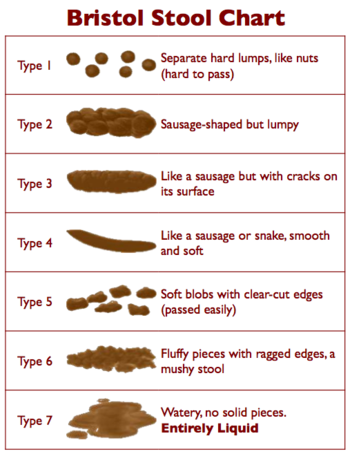
Diarrhoea type 5, 6, 7 Bristol stool chart (Appendix I)
-
Abdominal pain/tenderness
-
Fever
-
Loss of appetite
-
Nausea
-
Severe CDI may present with symptoms of constipation and abdominal distension and can be a sign of toxic megacolon.
-
If an infectious cause of diarrhoea is suspected, an unformed stool (Type 5 to 7 on the Bristol Stool Chart (Appendix I)) specimen must be sent for testing without delay, requesting investigation for Clostridioides difficile toxin (CDT).
-
Order ‘C.difficile detection, faeces’ on Epic to request testing.
-
Include clinical details (such as antibiotic therapy) in the test request, which can guide treatment and management in the event of a positive result.
-
Facilities for testing for CDT are available 7 days a week.
-
Stool samples are not required to be sent for CDT testing from asymptomatic patients (including screening samples and clearance samples (post-successful treatment completion)).
3.3 Documentation & Communication
-
Patients with a suspected or confirmed CDI will have this added by the IPC Team on Epic under Infection Status. The CDI infection status, triggers display of Infection and solation Instructions on Epic, which provides clinical staff with guidance for management of CDI.
-
On confirmation of diagnosis, the CDI care pathway should be commenced on Epic.
-
Stool charts on Epic must be used to document frequency amount and type of diarrhoea from the onset of symptoms. The volume of liquid stool must also be recorded on the fluid chart to enable accurate assessment of fluid balance.
-
Patients must be informed of the diagnosis. Please provide them with a copy of the trust CDI information leaflet (available from the intranet and PALS).
-
In addition to patients being reviewed daily by their clinical team, patients symptomatic with CDI should be referred to Gastroenterology and Dietetics for their input into care.
-
The identification and management of CDI must be included on discharge/transfer letters.
3.4 Treatment of CDI
Refer to the Trust Microguide for the treatment of CDI.
4. Period of Increased Incidence (PII) / Outbreaks of CDI
-
A post-infection review (PIR) is undertaken for each healthcare-associated (Trust-apportioned) case of CDI.
-
A period of increased incidence of CDI, or an outbreak, is defined as ‘the occurrence of two or more related cases over a defined period taking account of the background rate’ (DH 2008). Two cases or more CDI in a clinical area within 28-day period is a reported as a PII to the Frimley ICB, and a formal meeting held to identify actions for management of CDI in the clinical area.
-
Increased surveillance by the IPC Team and the Clinical Matron in the ward/dept., to include daily review of the patients with CDI and increased auditing of guideline compliance (e.g. hand hygiene, isolation, decontamination, antimicrobial prescribing).
-
Stool samples from all patients involved in a PII will be sent to the reference laboratory for typing in order to identify whether this also constitutes an outbreak. Outbreaks of CDI are reported to the Frimley ICB, the UKHSA local Health Protection Team, and the regional NHS England IPC Team.
-
Ward/bay closure for outbreaks of CDI must not occur without advice from the Infection Prevention & Control Team or the On-call Consultant Medical Microbiologist.
5. Reporting of CDI
All C. difficile toxin-positive stool samples, from patients 2-years and over, are reported:
- via CoSurv by the pathology laboratory, and
- via the UKHSA Healthcare-Associated Infection Data Capture System (DCS) by the IPC Team.
-
In addition to C. difficile toxin-positive stool samples, CDI cases diagnosed by the following methods must also be reported to the UKHSA:
-
Pseudomembranous colitis revealed by lower gastro-intestinal endoscopy or Computed Tomography.
-
Colonic histopathology characteristic of C. difficile infection (with or without diarrhoea or toxin detection) on a specimen obtained during endoscopy or colectomy
-
Faecal specimens collected post-mortem where the specimen is C. difficile toxin positive or tissue specimens collected post-mortem where pseudomembranous colitis is revealed or colonic histopathology is characteristic of C. difficile infection.
References
Department of Health (2012) Updated guidance on the diagnosis and reporting of Clostridium difficile. Available at: Diagnosis and reporting of Clostridium difficile.
Department of Health (2008) Clostridioides difficile infection: how to deal with the problem. Available at: Clostridioides difficile infection.
Department of Health (2010) High impact intervention: care bundle to reduce the risk of Clostridium difficile. Available at: Reduce the risk of Clostridium difficile.
Department of Health (2006) Healthcare associated infections, in particular infection caused by Clostridium difficile: letter from the Chief Medical Officer, Chief Nursing Officer, Chief Pharmaceutical Officer and the Chief Executive of the NHS to all Trust, PCT and SHA Chief Executives to all Trust, PCT, and SHA Chief Executives. Available at: Healthcare associated infections.
Department of Health (2003) Winning ways: working together to reduce healthcare associated infection in England: report from the Chief Medical Officer. Available at: Working together to reduce healthcare associated infection in England.
Mid Staffordshire NHS Foundation Trust Inquiry (2010) Independent inquiry into care provided by Mid Staffordshire NHS Foundation Trust January 2005 - March 2009. Available at: Mid Staffordshire.
National Institute for Health and Care Excellence (NICE) (2021) NICE guideline [NG199] Clostridioides difficile infection: antimicrobial prescribing. Available at:
https://www.nice.org.uk/guidance/ng199
Appendix: Bristol Stool Chart
Full version control record
This guideline has been registered with the Trust. However, clinical guidelines are guidelines only. The interpretation and application of clinical guidelines will remain the responsibility of the individual clinician. If in doubt, contact a senior colleague or expert. Caution is advised when using guidelines after the review date.
This guideline is for use in Frimley Health NHS Foundation Trust hospitals only. Any use outside this location will not be supported by the Trust and will be at the risk of the individual using it.
Version Control Sheet
Related Documents