2.1 The Obstetric Anaesthetist on call should check the anaesthetic machine in the obstetric theatre(s) (location is site dependent) and all associated equipment (including range of laryngoscopes, tubes and bougies) daily. Emergency drugs are drawn up by the ODP in conjunction with the Obstetric Anaesthetist (WXP) or the duty Obstetric Anaesthetist (FPH) and kept in the fridge in theatre.
2.2 Patients should be fully pre-assessed wherever possible. At the very least, past medical history and allergies should be elicited, as well as an assessment of the airway. The plan for anaesthesia should be discussed in as much detail as possible with the patient. A valid group and save should be taken prior to all CS at risk of PPH. Elective CS patients should ideally be assessed 2-3 days beforehand by the LW anaesthetist when prompted to do so by the MAC midwife (WXP) OR are seen in the pre-assessment clinic on Thursdays or Fridays the week before ELCS (FPH). There should be timely referral to the anaesthetic high risk clinic.
2.3 Regional anaesthesia should be used if there are no contraindications and time permits. For general anaesthesia, airway protection with RSI and ETT should be considered for all pregnant woman at >13 weeks (depending on the history of reflux, abdominal size and other risk factors), and is required for >18 weeks or <2 days after delivery.
2.4 All patients awaiting a caesarean section (CS) should be given antacid therapy2.
3.0 General Conduct for Caesarean Section
3.1 Monitoring (NIBP, SpO2, ECG) and intravenous access (ideally 16G or larger) should be established once the patient has been checked in theatre or anaesthetic room. Fluid should be started if not already initiated, in order to avoid hypotension.2
3.2 After delivery of the shoulder or entire baby when breech (even when deferred cord clamping) give either:
- Carbetocin 100 microgram iv over 1 minute after discussion with the obstetric team (provided there is no contra-indication) if there is a risk of post-partum haemorrhage. Remember that a peak effect does not occur until 4 minutes after administration.
- OR 5 units of oxytocin and (if required) an infusion of 40 units of oxytocin in 500ml sodium chloride 0.9% over 4 hours via pump (or in 100ml of sodium chloride 0.9% if the patient is pre-eclamptic and large fluid volumes need to be avoided).
3.3 Analgesia should preferably be given by the regional route (diamorphine or morphine and fentanyl combination);2-4 additional iv paracetamol can be given along with PR diclofenac (with the patient’s consent). If no regional route is available iv morphine should be used. In the rare event of a morphine allergy, iv oxycodone or fentanyl can be used. TAP blocks should be considered for those patients without a regional block in situ (see below).
If an epidural has been sited, ensure it has been removed at the end of surgery, unless there is a good reason to keep it in.
3.4 Intravenous antibiotics should be given pre-delivery, as per microbiology guidance.
3.5 The importance of good documentation is vital. It can be crucial for later litigation.
3.6 Remember some drugs commonly in obstetric anaesthesia nationwide may be in use off-licence.
4.0 Regional Anaesthesia
4.1 Full aseptic technique should be used.
The mother should be positioned in the sitting or left lateral position. If de novo, a spinal or CSE can be given below L3 and a mixture of hyperbaric 0.5% bupivacaine with diamorphine, or a mixture of hyperbaric 0.5% bupivacaine with morphine and fentanyl, should be injected into the CSF 2-4. The total volume of drug is at the discretion of the anaesthetist (depending on the height of the mother, gestation, etc). A filter needle should be used to draw these up.
The blood pressure should be maintained using volume pre-loading (Plasmalyte®) and phenylephrine boluses or infusion, or ephedrine (2018 international consensus statement recommends phenylephrine by pump5). It should be monitored every 1-2 mins initially. Left lateral tilt (at least 15˚) should be maintained until delivery.2 The obstetric WHO checklist should be carried out prior to KTS; expediently if it is a category 1 CS.
If the BP drops >20% of baseline or SBP <90mmHg, or the patient is symptomatic (dizzy, faint, nauseous or vomiting, sweaty or tachycardic), a bolus of a vasoconstrictor should be given. There should be an increase in the rate of infusion of phenylephrine. See Hypotension during regional block in obstetric patients.
If there is no urinary catheter in situ this can be inserted whilst waiting for the block to develop.
4.2 Checking the block
The exact time of intrathecal injection should be noted and documented on Epic EPR; a block which is suitable for a CS should develop by 20 minutes.
The patient should be asked during the injection if they feel any sensation of warmth in the back, buttocks or thighs; a lack of this may imply misplacement.
An ideal block for caesarean section should be:
a. Sensory block (cold) S5 –T4
b. Sensory block (light touch) S5-T5
c. Motor block (ideally Bromage 3/4)
Bilateral sympathetic block (warm, dry feet) 6
The time that the block is achieved should be noted and documented.
4.3 If the block height is inadequate, the following should be tried:
Trendelenberg position
If an epidural is in-situ, the block may be brought up with 2-4ml aliquots of 2% lidocaine
If the block is not adequate, surgery should not be started and the block should be repeated with a modified dose as appropriate. A GA should be carried out if there is fetal compromise, and time is of an issue or if repeated regional blocks are also inadequate. This decision should be guided by professional discussion with the obstetricians.
5.0 Emergency Caesarean Section
5.1 If practical, the woman should be seen by the anaesthetist in her room, and the obstetric and medical history, anaesthetic history, allergies, medications, fasting status and potential airway issues should be established. If Category 1 CS, the woman should be transferred to theatre within 5 minutes and the anaesthetist can establish the above information en-route or in theatre. The WHO checklist should be performed. A reassuring approach should be used, as the woman and her partner may be frightened.
If using a de-novo regional technique, the time should be observed by someone else, whilst you administer the block.
5.2 If an epidural is topped up in the labour room the anaesthetist must not leave the patient under any circumstances.
Top up for an existing working epidural should be done using 10-20ml (in 5ml boluses) of any of the following:
Mixture of 10ml 2% lidocaine + 10ml 0.5% bupivacaine
20ml 0.5% bupivacaine
2ml of preservative free sodium bicarbonate 8.4% is added to 20ml 2% lidocaine. After gentle agitation, remove 2ml of solution and then add 0.1ml of 1:1000 adrenaline to the remaining 20ml volume. This mixture has been shown to halve the onset time of anaesthesia when compared with bupivacaine alone (7mins vs 14mins).7 This solution takes more time to make up, and so the ampoules and syringes should all be ready to prepare the mixture. The increased potential for drug error should be appreciated. The syringes and ampoules are now kept ready to use in the labour ward theatre in a box; this should be checked by the bleep carrier at the start of the shift.
If bicarbonate is not available; 20ml 2% lidocaine and 0.1ml of 1:1000 adrenaline (1:200 000).
Epidural diamorphine (2.5-5mg) or morphine (3mg) (FPH) should be given towards the end of the operation.2-4
Epidural fentanyl 100mcg may be given in order to speed the onset of the block and improve comfort.
6.0 Preventing and Treating Pain at Caesarean Section
7.1 Patients should be fully pre-assessed as much as time permits. In particular, the airway should be assessed, and query should be made about past problems with anaesthetic. Laryngeal oedema should be anticipated in patients with pre-eclampsia. An explanation should be made about cricoid pressure and pre-oxygenation. The appropriate antacid regime should be given.
The patient should be prepped and draped during pre-oxygenation with the surgeon scrubbed and ready to operate. The urinary catheter should be sited prior to induction if not already in situ.
Category 1 patients should be transferred in the left lateral position and any oxytocin infusions that have been running for the augmentation of labour should be stopped.
In addition to the ODP, a second anaesthetist can be called for support; it may be useful in the case of a difficult intubation. DAS guidance suggests a videolaryngoscope should be immediately available.
Ensure intravenous access is adequate and fluids are running.
The patient should be positioned in the optimum position to intubate (ramped). The Oxford pillow is available in the LW theatre (WP) or obstetric theatre (FP).
Pre-oxygenate for a full 3 minutes. Consider use of Optiflow or nasal cannula if difficult intubation is anticipated. The monitoring must be attached during this time (NIBP, SpO2, ECG and EtCO2). The presence of a capnography trace should be confirmed. The suction should be on and ready to use.
Cricoid pressure should be applied immediately prior to induction.
Thiopentone or propofol and suxamethonium (ensure adequate dose; may need more than 1 ampoule) should be administered. An opioid (inform paediatricians) or antihypertensive agent may be needed in case of pre-eclampsia. When fully relaxed, intubate the trachea and inflate the cuff. There should be evidence of: equal breath sounds and EtCO2. Surgery should not be started until you are happy with the airway.
Maintain anaesthesia with an inhalational anaesthetic. 100% oxygen may be beneficial if there is fetal distress.
A non-depolarising muscle relaxant may be given. The effect of inhalational agents on uterine contractility and the risk of awareness should be remembered.
After the cord is clamped give a sufficient dose of opioid (e.g. iv morphine 10-20mg) may be required). If a working epidural is in situ, an opioid should be given via the epidural catheter (2.5-5mg of diamorphine (or morphine 3mg (FPH)).2-4
At the end of surgery, the neuromuscular block should be reversed (be mindful when magnesium sulphate has been used). The patient should be extubated fully awake, in the sitting or left lateral position. They should be transferred to PACU with oxygen via a facemask.
Consider a Transversus Abdominis Plane (TAP) block for post-operative analgesia (see below).
8.0 Postoperative Care and Pain Relief
8.1 All obstetric patients undergoing procedures in theatre under RA or GA are recovered as follows:
FPH: PACU
WXP: LW if regional procedure carried out in LW theatres, or PACU if GA given or Elective CS
Good quality analgesia after any surgery leads to earlier mobilisation, fewer pulmonary and cardiac complications, a reduced risk of DVT and earlier return of gastrointestinal function.8 In new mothers, good analgesia can improve the ability to look after the newborn and facilitate breastfeeding. Postoperative analgesia starts at the time of CS.
8.2 Criteria for transfer to PACU/LW room
The woman is physiologically stable on departure from the operating theatre.
The airway is secure. It is the anaesthetist’s responsibility to ensure that any ETT is removed safely.
If the general condition of the patient is poor, then adequate mobile monitoring of ECG, pulse oximetry and blood pressure should be used for transfer.
Supplemental oxygen is administered for transfer after GA or sedation.
The anaesthetist has ensured that PACU is adequately staffed to receive the patient.
The anaesthetist is responsible for ensuring safe transfer and must give a formal hand over to the PACU staff, including plans for postoperative care and analgesia. The woman must be clinically stable before the anaesthetist leaves the woman.
The following should be prescribed on the MAR on Epic, as long as there are no contra-indications:
Regular paracetamol 1g QDS
Regular NSAIDs: 50mg diclofenac TDS (WXP) OR ibuprofen 400mg QDS (can use 600mg ibuprofen QDS for first 48hrs - FPH)
Regular subcutaneous thromboprophylaxis according to weight of patient & TEDs after discussion with the obstetricians (correctly dosed by weight).
The dose and timing of any relevant drugs given intra-operatively should be documented on the anaesthetic chart on Epic EPR.
Codeine should not be prescribed for breast feeding mothers.
8.2 Neurological Monitoring After Regional Anaesthesia
Serious neurological lesions such as vertebral canal haematoma are rare after obstetric anaesthesia, but early detection may be crucial to avoid permanent damage. This may be hindered by the variable and sometimes prolonged recovery after ‘normal’ anaesthesia block, such that an underlying lesion may easily be missed13.
All women recovering from neuraxial anaesthesia (spinal or epidural top-up in theatre) should be tested for straight leg raise at 4 h from the time of the last epidural/spinal dose of local anaesthetic. If a woman is unable to straight-leg raise at 4 h, the anaesthetist should be called, to make a full assessment.
The anaesthetist will assess whether the woman’s care should be escalated to investigate the possibility of reversible causes of neurological injury (see escalation guideline). Neurological impairment caused by epidural haematoma may become permanent if not detected and managed within 8-12 h.
Women should be informed of the likely timescale for return of motor and sensory function and encouraged to report any delay. Recovery of sensorimotor block after caesarean section has been reported as typically taking 2-3 h after intrathecal bupivacaine and 3-5 h after epidural bupivacaine and/or lidocaine, although recovery can be highly variable. Furthermore, unexpectedly and dramatically prolonged blocks (up to 24-48 h) may occur rarely in otherwise routine cases and with no explanation found.
The Bromage scale is a standardised method used for documentation of the resolution or persistence of motor block.
Escalation
An epidural haematoma can cause irreversible neurological damage if not evacuated within 8-12 h. If there is concern over the extent of the neuraxial block, for example, no resolution of block or increasing motor block, the anaesthetist should consider urgent escalation of care including urgent imaging of the spine. MRI is the preferred imaging modality. Our policy is to call the Consultant Radiologist on-call via switchboard (in and out of hours); this should be a Consultant-to-Consultant referral (See Management of Suspected Vertebral Canal Haematoma.
See ‘The care of women within the first 24 hours post caesarean section or other operative intervention’ Guideline at FPH.
9.1 Every patient should be visited the day (as early as possible) after their regional or general anaesthetic, or labour epidural. This visit should be documented on Epic EPR.
In particular, the documentation in the notes should have the following if present:
Issues with post-delivery analgesia
Residual block: sensory or motor
Presence of any headache
Presence of urinary retention
Any other complications thought to be secondary to RA/GA
9.2 If any of these are present and felt to be anaesthesia-related, it should be flagged up to the consultant anaesthetist covering labour ward. Symptoms, signs, differential diagnoses, investigations and a management plan should be documented. Care should be taken to hand these patients over at every shift change. A handover of these patients between consultants should also occur.
10.0 Transversus Abdominis Plane Blocks for Analgesia after CS
10.1 TAP Block
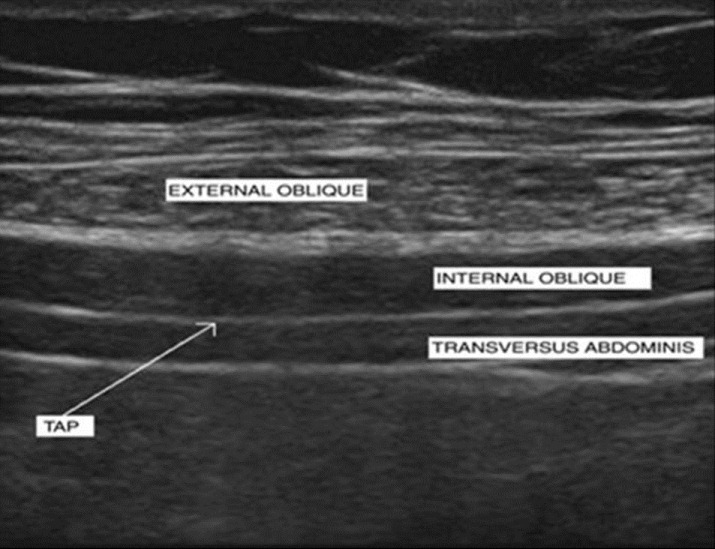
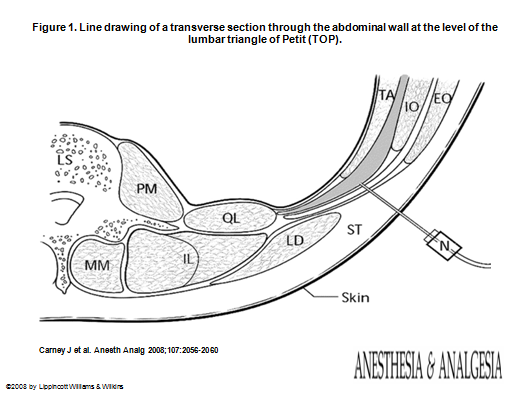
The transversus abdominis plane (TAP) block is performed by introducing local anaesthetic into the plane between the fascia of the transversus abdominis muscle and the internal oblique muscle; it should be considered when it has not been possible to administer regional opioids. A recent systematic review and meta-analysis looked at a number of studies and found TAP blocks to be effective as part of a multimodal analgesia regime that excludes intrathecal morphine.9 The technique should be performed under ultrasound guidance as “blind” TAP blocks have been shown to have a high incidence of intraperitoneal placement.10
10.2 Contraindications
Patient refusal
Sensitivity to local anaesthetics
Local infection
Large doses of local anaesthesia in the last four hours (e.g., epidural dosing, small patients). You should calculate the dose received by each patient and determine whether TAP blocks are feasible.
10.3 Method
Ideally obtain informed consent for regional blockade prior to caesarean delivery (this may not be possible in a Category 1 CS)
The block is carried out at the end of the CS once the wound dressing has been applied and prior to waking up the mother.
Aseptic technique.
Draw up and label 2 sets of local anaesthetic (suggest 20mls of 0.375% bupivacaine for each side).
Assemble equipment (suggested 5 or 10cm Stimuplex needle depending on the size of the patient).
With an in-plane technique pass your needle until it reaches the correct plane, aspirate and inject a few mls of local anaesthetic – you should see the planes separating. Continue to inject the rest of the solution.
Remember intraoperative analgesic requirements are the same and immediate postoperative analgesia requirements are often significant.
10.4 Ultrasonic view of Location of Transverse Abdominis Plane Block11
10.5 Drawing of Transverse Section through Abdominal Wall at the Level of the Lumbar Triangle of Petit12
Lucas DN, Yentis SM, Kinsella SM et al. Urgency of Caesarean section: a new classification. Journal of the Royal Society of Medicine 2000; 93: 346 – 350.
Skilton, R.W., et al., Dose response study of subarachnoid diamorphine for analgesia after elective caesarean section. Int J Obstet Anesth, 1999. 8(4): p. 231-5
Kelly, M.C., U.A. Carabine, and R.K. Mirakhur, Intrathecal diamorphine for analgesia after caesarean section. A dose finding study and assessment of side-effects. Anaesthesia, 1998. 53(3): p. 231-7
Kinsella M et al. International consensus statement on the management of hypotension with vasopressors during caesarean section under spinal anaesthesia. Anaesthesia 2018; 73: 71-92
Russell IF. Levels of anaesthesia and intraoperative pain at caesarean section under regional block. Int J Obstet Anesth 1995. 4(2): 71-77.
Allam J. Malhotra C, Hemingway C and Yentis S. Epidural lidocaine-bicarbonate-adrenaline vs levobupivacaine for emergency Caesarean section: a randomised controlled trial. Anaesthesia 2008; 63: 243-249.
Kehlet, M., Multimodal approach to control postoperative pathophysiology and rehabilitation. Br J Anaesth 2008. 101(1): p.77-86
Abdallah, F., et al., Transversus abdominis plane block for postoperative analgesia after Caesarean delivery performed under spinal anaesthesia? A systematic review and meta-analysis. Br J Anaesth. 2012 Nov;109(5): p. 679-87
McDermott, G., et al, Should we stop doing blind transversus abdominis plane blocks? Br J Anaest 2012 Mar;108(3): p. 499-502
Reproduced from: Parikh BK, Waghmare VT, Shah VR, Mehta T, Butala BP, Parikh GP, Vora KS. The analgesic efficacy of ultrasound-guided transversus abdominis plane block for retroperitoneoscopic donor nephrectomy: A randomized controlled study. Saudi J Anaesth 2013;7:43-7
Yentis SM, Lucas DN, Brigante L, Collis R, Cowley P, Denning S, Fawcett WJ, Gibson A. Safety guideline: neurological monitoring associated with obstetric neuraxial block 2020. A joint guideline by the Association of Anaesthetists and the Obstetric Anaesthetists’ Association. Anaesthesia 2020; 75: 913-919.
Version:
3.0
Guidelines Lead(s):
Dr Nimisha Patel, Consultant Anaesthetist
Contributor(s):
Dr Sarah Armstrong, Consultant Anaesthetist
Lead Director / Chief of Service:
Dr Subodh Tote
Library check completed:
None
Ratified at:
Labour ward forum May 2019, Anaesthesia Clinical Governance March 2021, January 2024 (for noting)
Date Issued:
April 2021
Review Date:
December 2027
Pharmaceutical dosing advice and formulary compliance checked by:
Laura Johnson, Ruhena Ahmad, March 2021
Key words:
Caesarean section, anaesthesia, regional anaesthesia, general anaesthesia, TAP block, uterotonics
This guideline has been registered with the trust. However, clinical guidelines are guidelines only. The interpretation and application of clinical guidelines will remain the responsibility of the individual clinician. If in doubt contact a senior colleague or expert. Caution is advised when using guidelines after the review date. This guideline is for use in Frimley Health Trust hospitals only. Any use outside this location will not be supported by the Trust and will be at the risk of the individual using it.
Version History
Version
Date
Guideline Lead(s)
Status
Comment
1
1/12/18
Nimisha Patel
Final
First cross-site guideline
2
21/3/21
Nimisha Patel
Final
Addition of Neurological Monitoring After Regional Anaesthesia (section 8.2)
2.1
2/10/23
Nimisha Patel
Interim
Updates post Epic EPR at sections 3.3, 4.1, 8.1, 8.2