Key Points
This guideline refers to all patients over the age of 16years, who are to be catheterised with a ‘Foley’ type urethral catheter, which is intended to stay in situ for longer than one hour. It should be noted that indwelling urethral catheters are a major cause of hospital acquired infections and should only be considered after careful assessment of all risks/benefits to the patient.
The guideline will focus on the following interventions:
- Assessing the need for catheterisation
- Select appropriate catheter (3 way, supra pubic, urethral, and intermittent)
- Aseptic catheter insertion
- Catheter maintenance
This is a controlled document. If you are using a printed copy, check it against the guidelines site to ensure you are using the latest edition.
Print copies must be destroyed after use.
Abbreviations
1.0 Definitions
1.1 Urinary Tract Infection
Urinary Tract Infections (UTI) are the most common hospital acquired infection, accounting for 23 % of all infection. (NICE, 2018)
The presence of a urinary catheter and the duration of its insertion are contributing factors to the development of a urinary tract infection. Some 60% of healthcare-associated urinary tract infections are related to catheter insertion (Loveday et al 2013).
1.2 Catheter-Associated Urinary Tract Infection (CAUTI)
Catheter-associated urinary tract infection, or CAUTI, is a urinary tract infection associated with the use of a urinary catheter (Urethral or suprapubic).
The majority of hospital-acquired UTIs are associated with catheter use, and catheter-associated UTIs are the source of 8% of hospital-acquired bacteraemia. (NICE, 2018)
1.3 Suprapubic catheter (SPC)
A suprapubic catheter is a means of draining the urinary bladder via an artificial tract made through the abdominal wall into the bladder
1.4 Bacteraemia
The presence of bacteria in the urine, with or without associated symptoms of infection. In the absence of symptoms this is referred to as asymptomatic bacteriuria (or, in the case of a patient with an indwelling catheter, as catheter colonisation).
Asymptomatic bacteraemia in a catheterised patient does not require antibiotic treatment.
1.5 Midstream Urine Sample (MSU)/Catheter Specimen Urine Sample (CSU)
A specimen of urine that is subjected to examination for the presence of micro-organisms. Obtaining a specimen that is free of contamination, the periurethral area is cleansed with soap and water and the patient requested to discard the initial flow of urine before collecting the specimen into a sterile container.
CSU samples can be obtained from the needle-free port on the catheter after cleaning the site with appropriate cleansing wipe.
Urine sample can be also obtained from newly catheterised patient via the catheter bag or the needle-free port. Samples should be sent using the red-topped boric acid container.
2.0 Insertion
2.1 Urethral Catheters (DH 2011) Section 7 details which staff are permitted to catheterise patients.
-
Prior to catheterisation, informed consent must be obtained and documented.
-
Awareness of any patient’s allergies e.g., silicone, latex
-
Catheterisation is only performed following an assessment of clinical need. The Trust is following the national guidance for urinary catheterisation: HOUDINI (Adams et al., 2012; NHS England; Urinary Catheter Tools 2020) and encourages staff to consider alternative actions, e.g., intermittent self-catheterisation (ISC)
-
Catheters may only be inserted by staff trained and competent in the procedure, or by medical or nursing staff in training, under direct clinical supervision.
-
Procedure is carried out using Aseptic Non-Touch Technique (ANTT).
-
Use of personal protective clothing must be based on an assessment of the risk of exposure to body fluids during the task. Any PPE must be removed and disposed of immediately after the procedure.
-
Hand hygiene must be performed in line with the ‘5 Moments for Hand Hygiene’ (WHO 2009) and the Trust Hand Hygiene policy (IPC05).
-
Urethral meatus is cleaned prior to catheter insertion using normal saline, wiping from front to back (females). After cleaning, a sterile single-use lubricant is used (NICE 2011) such as Instillagel®, to minimise trauma to mucosa and maximise patient comfort during insertion.
-
A sterile closed drainage system must be used.
-
The choice of urinary catheter is based on patient assessment. When determining appropriate catheter size, staff must consider the rationale for the particular individual being catheterised. Retract the foreskin for male patients unless circumcised, ensure that foreskin is repositioned after catheterisation.
-
Document the date, reason for insertion, catheter type and size, that ANTT was used, the name of the person who inserted the catheter, ease of insertion and residual volume.
-
Review the need of the urinary catheter on a daily basis, documenting this on the notes and communicating to the team
-
Provide patient with the ‘Inpatient Catheter Care’ leaflet that can be found on the intranet
Catheter Size
When determining catheter size, staff must consider the rationale for the particular individual being catheterised. As a guide it is recommended that a size 12ch catheter is used for female patients and a 16ch for males.
Please note that due to recommendations from National Patient Safety Agency (NPSA) only 40cm length (standard or male length) catheters are available in general areas. Contact Urology Nurse Specialist if open tip catheters are required for suprapubic catheterised patients.
Urine Output
-
Ensure residual volume is documented after 30 mins of catheter insertion
-
Subsequent urine output should be measured and accurately recorded in the patient’s
-
Urine output must be monitored closely for 3-4 hours and contact the medical team if there is continuous high urine output e.g., 200-250 mls. per hour
2.2 Suprapubic Catheters
A suprapubic catheter is a means of draining the urinary bladder via an artificial tract made through the abdominal wall into the bladder.
The initial insertion is performed by a doctor, usually under general anaesthetic.
Suprapubic catheters are contra-indicated for people with unexplained haematuria, known bladder cancer, or other abdominal masses.
2.2.1 Changing a Suprapubic Catheter (N.B. the catheter must have been in place for 8-10 weeks before a change should be considered. Only suitably trained and competent staff can change catheter) First change with the CNS/Urology team
-
Consider clamping suprapubic catheter 30 minutes prior to catheter change or a 100ml of saline into the bladder whilst
-
Procedure to be performed using ANTT.
-
Clean hands in line with the ‘5 moments of hand hygiene’ (WH0 2009) and the Trust Hand Hygiene policy (IPC05).
-
Catheter balloon can be deflated using a 10ml syringe and non-sterile gloves
-
Grasp the catheter close to the skin and remove the catheter while the patient is exhaling. Observe the length /tip of catheter that was removed, and catheter is still intact. Observe for any signs of encrustation/catheter damage before disposing of it.
-
Remove gloves and clean hands.
-
Put on a sterile pair of gloves.
-
Clean around the ‘stoma’ site using normal saline.
-
Insert a new catheter into the stoma channel 1-2cms further than the length you removed, inflate the balloon with 2mls of the fluid accompanying the catheter, as you continue to inflate the balloon, gently pull back on the catheter until resistance is felt (this is to ensure that the catheter does not enter the urethra and cause trauma.
-
Document the date that the catheter was replaced and the name of the person who changed it.
-
Observe signs of over-granulation at stoma site and apply appropriate dressing e.g., Inadine (if over granulation or infection present)
3.0 Documentation
The following details of the catheterisation must be documented in the Epic and Trust urinary catheter care pathway:
-
Date and time of catheterisation
-
Reason for the catheterisation
-
Size and type of catheter
-
Problems encountered during procedure (document in nursing notes, and escalate to urology team)
-
Document amount of urine drained
-
Planned date of review or removal of catheter daily unless a long-term indication
-
Signature of the practitioner who carried out the catheterisation along with name in capitals and designation
Where antibiotics are prescribed for a diagnosed urinary tract infection, these must have a stop or review date documented. Any urine culture results must be checked, and antibiotic treatment reviewed accordingly (refer to Trust Microguide), to ensure appropriate treatment is received for the sensitivity of the causative microorganisms. It is also important to ascertain if the patient has a past history of colonisation with multi-drug resistant organisms prior to antibiotic prescribing, as this may impact on the treatment regime.
4.0 Ongoing Catheter Care
The information must follow the NMC (2015) guidelines for records and record keeping.
Whilst the catheter remains in situ, the reasons for continued catheterisation, and other aspects of catheter care must be documented in Epic daily.
-
Hand hygiene must be performed in line with the ‘5 Moments for Hand Hygiene’ (WHO 2009) and the Trust Hand Hygiene policy (IPC05).
-
Use of personal protective clothing must be based on an assessment of the risk of exposure to body fluids during the task. Any PPE must be removed and disposed of immediately after the procedure.
-
Catheter Hygiene – the catheter site is cleaned at least twice daily, and the catheter is emptied a minimum of twice daily while in a hospital setting. When emptying the urine bag use a separate clean or single-use container each time (and for each patient).
-
Urine samples must be taken using ANTT (to prevent contamination) via a needle-less sample port. Do not send urine for culture if no clinical evidence of infection – a positive result will otherwise simply reflect bacterial colonisation of the catheter.
-
Position the urine drainage bag below the level of the bladder on a stand that prevents contact with the floor.
-
Ensure the connection between the catheter and the drainage system is not broken. The closed system should only be broken for limited, clearly defined clinical reasons.
-
Bladder washouts may only be performed for specific clinical reasons and appropriately trained staff (for example, blocked catheters, clot retention Do not carry out bladder washout if there is a history of bladder perforation/fistula.
-
Review the need for the catheter daily. When it is removed, document the date and time of removal and the name of the person removing it.
If a Catheter-Associated Urinary Tract Infection (CAUTI) is suspected:
If urine culture is positive treat as catheter associated UTI ONLY if one or more of the following signs or symptoms:
Refer to Trust Microguide if antibiotic treatment is indicated.
Remove and replace urinary catheter. Send catheter specimen urine (CSU) immediately from the new catheter.
Dipstick tests must NOT be used as a diagnosis for possible urine infection as almost all catheterised patients will be colonised with bacteria.
5.0 DISCHARGE with Catheter
All patients discharged from hospital with an indwelling catheter should be:
-
Referred to the Community Nursing Team (CNT) via Epic, informing of catheter insertion date, size, type and predicted date of change and if it is safe for district nurses to change
-
Provide with at least a week’s supply of equipment (i.e., catheter leg bags, catheter night bags, valves straps) and registered with home delivery service to ensure patients get sufficient supplies in a timely manner
-
Provide patient with the catheter passport with complete information to support the care of the catheter in the community.
-
Provided a point of contact in the event of any problems arising (e.g., discharging ward)
-
Ensure supplies are ordered (Greatbear, Fittlelworth, Nightingale)
-
Ensure Plan for Catheter is in place (is long term, short -term, twoc clinic
6.0 Permission to Catheterise
6.1 Medical staff:
-
Catheter introducers, dilators, guidewires must only be used by Urology team
-
In an emergency and unable to catheterise, contact urology team
-
Guidewire assisted catheterisations via a flexible cystoscope may only be performed by staff proficient in this procedure.
6.2 Nursing/Midwifery /AHP staff:
-
Nurses and midwives will practice only within their sphere of competence
-
When Healthcare Assistants (NVQ level 3) or Medical Technical Assistants are catheterising patients, the registered practitioner remains responsible for their practice
-
AHP’s where catheterisation is part of their role and is specified in their job description can catheterise provided that they have undergone the training and achieve the competency and only work within their sphere of competence.
-
Only staff designated by the Urology department may insert a 3-way catheter
-
If unsuccessful on the first attempt, help must be sought from a more experienced member of the team.
Only experienced Nursing, Midwifery, AHPs or Medical staff who are proficient in the procedure may perform urethral catheterisations/bladder washouts.
Registered Nurses / Midwives / Nursing Associates / AHPs must have obtained an underpinning theoretical knowledge or have attended the study day relating to urinary catheter insertion and removal and had opportunities to practice under supervision before completing the competency assessment. Sign off needs to be completed by a proficient assessor.
Newly qualified practitioners who have been assessed as competent within their pre-registration training and Staff commencing employment at Frimley Health but have been previously trained and assessed as competent elsewhere must:
-
Provide evidence of the training and assessment programme that they completed.
-
Have a professional discussion with the approved practice assessor / clinical educator to determine whether their existing evidence meets the trust standards.
-
Comply with the relevant trust policy and undertake an additional training / refresher and a practical assessment by an appropriate assessor if the evidence is insufficient or does not meet the trust standards.
Health Care assistants (NVQ level 3) must acquire knowledge, understanding and skills relating to the supervised delivery of urinary catheter care, insertion and removal. They need to attend the trust study day with practical sessions and undertake am observational assessment with a practice assessor. HCAs must inform their immediate line manager if they feel they are not competent to undertake urinary catheter care, so that additional training needs can be identified.
6.3 Student Nurses
Student nurses must be able to select and use appropriate continence products, insert, manage and remove catheters for all genders, and assist with self-catheterisation when required. Evidence of theoretical knowledge including practical assessment carried out in the university should be confirmed by the practice assessor / practice Supervisor. The registered practitioner remains responsible for their practice.
References
-
UK Health Security Agency (2023) Point prevalence survey on HCAI, AMU and AMS in England. Available at: https://www.gov.uk/guidance/point-prevalence-survey-on-hcai-amu-and-ams-in-england (Accessed: 08 November 2023).
-
National Institute for Health and Care Excellence [NICE] (2011). Healthcare-associated infections: prevention and control. PH36. Available at: https://www.nice.org.uk/guidance/ph36 (Accessed: 08 November 2023).
-
Loveday, H. P. et al. (2014) 'epic3: National Evidence-based Guidelines for Preventing Healthcare-Associated Infections in NHS Hospitals in England', The Journal of Hospital Infection, 86(supplement 1), S1-S70. Available at: https://doi.org/10.1016/S0195-6701(13)60012-2 (Accessed: 08 November 2023).
-
Nursing and Midwifery Council (2018) Professional standards of practice and behaviour for nurses, midwives and nursing associates. Available at: https://www.nmc.org.uk/standards/code/ (Accessed: 08 November 2023).
-
Royal College of Nursing (2017) Essential Practice for Infection Prevention and Control. Available at: https://www.rcn.org.uk/Professional-Development/publications/pub-005940 (Accessed: 08 November 2023).
-
Rowley, S. et al. (2010) 'ANTT v2: An updated practice framework for aseptic technique', British Journal of Nursing, 19(supplement 1), S5-S11. Available at: https://doi.org/10.12968/bjon.2010.19.Sup1.47079 (Accessed: 08 November 2023).
-
British association of urology surgeons (Baus)2018 Trial without catheter, patient information www.baus.org/UK/professionals/education
-
Catheter Care: Guidance for Health Care Professionals https://www.rcn.org.uk/professional-development/publications/catheter-care-guidance-for-health-care-professionals-uk-pub-009-915
-
Future nurse: Standards of proficiency for registered nurses, Nursing and Midwifery Council, Published 17 May 2018

Appendix 1 – Trial Without Catheter (TWOC) flowchart
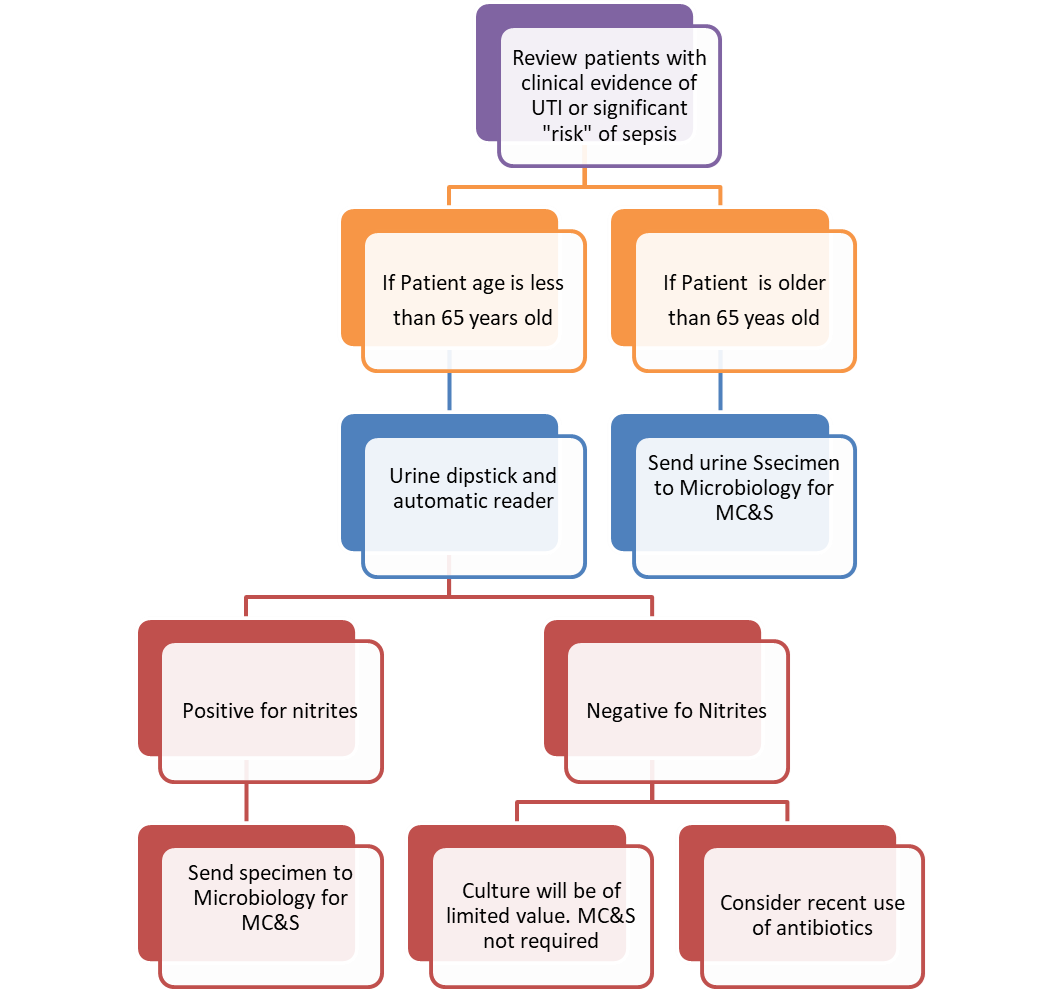
Appendix 2: Urine Testing Algorithm - newly inserted catheters
Full version control record
This guideline has been registered with the Trust. However, clinical guidelines are guidelines only. The interpretation and application of clinical guidelines will remain the responsibility of the individual clinician. If in doubt, contact a senior colleague or expert. Caution is advised when using guidelines after the review date.
This guideline is for use in Frimley Health NHS Foundation Trust hospitals only. Any use outside this location will not be supported by the Trust and will be at the risk of the individual using it.
Version History
Related Documents