Key Points
• This guideline outlines the procedures to prevent and control healthcare-associated infection in situations where there is a breach of the body’s defence system by a break in the skin or invasive devices.
• Asepsis means ‘in the absence of pathogenic organisms’. Clinical procedures that aim to prevent contamination of a susceptible body site are said to use ‘aseptic technique’.
• An aseptic technique should be implemented during any invasive procedure that bypasses the body's natural defences (Loveday at al 2013), e.g. the skin and mucous membranes, or when handling equipment such as intravenous cannulae and urinary catheters, that have been used during these procedures.
This is a controlled document. If you are using a printed copy, check it against the guidelines site to ensure you are using the latest edition. Print copies must be destroyed after use.
Abbreviations
1.0 Introduction and Background
This guideline outlines the procedures to prevent and control healthcare-associated infection in situations where there is a breach of the body’s defence system by a break in the skin or invasive devices.
The Health & Social Care Act 2008: code of practice on the prevention and control of infections and related guidance (DHSC 2022) states the following:
• Clinical procedures should be carried out in a manner that maintains and promotes the principles of asepsis.
• Education, training and assessment in the Aseptic Technique should be provided to all persons undertaking such procedures.
• The Technique should be standardised across the organisation.
• Audit should be undertaken to monitor compliance with Aseptic Technique.
2.0 Definitions
Asepsis is the state of being free from disease-causing micro-organisms (such as pathogenic bacteria, viruses, pathogenic fungi, and parasites). Clinical procedures that aim to prevent contamination of a susceptible body site are said to use ‘aseptic technique’.
Aseptic technique is a practice/procedure designed to minimise the risk of contamination from microorganisms into a wound, on insertion or ongoing care of a medical device such as a vascular access device or urethral catheter or during surgical procedures. (NHSE 2024). This can be achieved by ensuring that only sterile equipment and fluids are used during invasive medical and nursing procedures.
The aseptic technique should be implemented during any invasive procedure that bypasses the body's natural defences, including:
• insertion and maintenance of invasive devices.
• infusion of sterile fluids and medication
• care of wounds and surgical incisions (Loveday at al 2013)
It is the responsibility of every healthcare worker to understand the meaning of the principles of aseptic technique and to use them in practice. All healthcare workers are responsible for ensuring their practice and that of staff they supervise complies with this policy and that they are competent to undertake such tasks.
Aseptic Non-Touch Technique (ANTT) is a defined practice framework for aseptic technique providing a common practice language and principles which can be applied to any clinical procedure in any setting and be adapted when circumstances arise (ANTT®).
3.0 Aseptic Non-Touch Technique (ANTT)
Aseptic Non-Touch Technique (ANTT) achieves asepsis by:
- the unique approach of Key-Part and Key-Site Protection.
- a combination of Standard Precautions and non-touch technique
- the use of ‘Critical’ and ‘General’ Aseptic Fields’ (ANTT®)
ANTT is designed and used for all invasive procedures - from major surgery to simple maintenance of indwelling medical devices.
3.1 Identifying Key-Parts and Key-Sites
The fundamental principle of ANTT is the “key-part and key-site protection”.
Key-parts are those parts of the equipment that if contaminated are likely to contaminate the patient.
The 3 main ways that equipment can be contaminated during clinical procedures are:
-
touch by healthcare workers’ hands
-
touch by contaminated objects
-
air environment, including patients’ flora.
Some examples of key parts are indicated below:
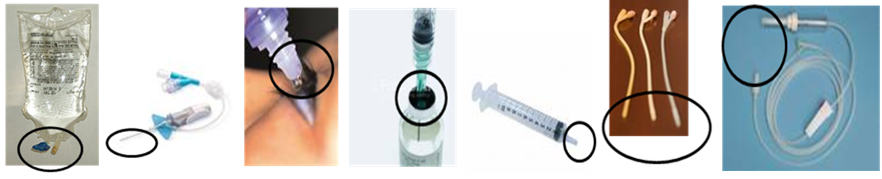
- Key-sites are any portal of entry for micro-organisms into the body such as open wounds and medical device access sites.

Key-parts must only come in contact with other aseptic key-parts, or key-sites’.(ANTT®)
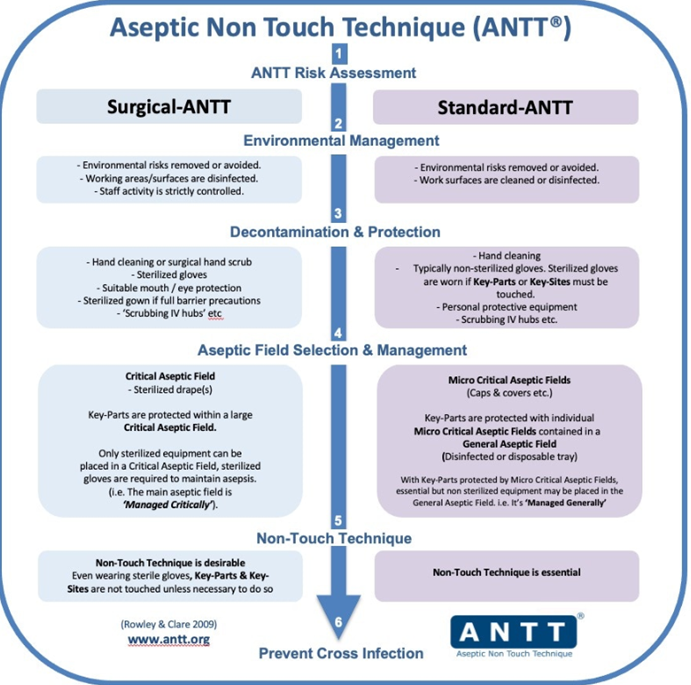
3.2 Six Actions for Safe ANTT
- ANTT Risk Assessment
The healthcare professional must assess whether the procedure can be performed without touching key-parts (e.g. urinary catheter tip, syringe tip, sterile instruments, ) taking into account the number of the key-parts, technical difficulty of the procedure and the competency of the practitioner, to decide whether Standard or Surgical ANTT is required
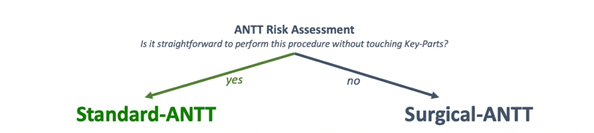
Standard ANTT is used for technically simple procedures, short in duration (in general less than 20 minutes), and involve smaller key-sites and key-parts (e.g. IV therapy, peripheral cannulation, simple wound dressings).
Key-parts are protected individually with micro critical aseptic fields, non-touch technique is mandatory and non- sterile gloves are only needed when exposure to body fluids is expected.
Surgical ANTT is used for technically complex procedures, involving extended periods of time, large open key-sites or large or numerous key-parts (e.g., surgery in the operating theatre, CVC insertion, complex wound dressings).
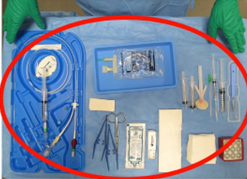
Key-parts are protected collectively on a critical aseptic field (sterile drape), non-touch technique is desirable where possible and sterile gloves are essential.
2) Manage the Environment
For both Standard ANTT and Surgical ANTT the environmental risks are removed and avoided (e.g., not during ward cleaning or bed-making, minimal distractions, uncluttered, without items of equipment that may increase environmental contamination such as commodes, designated areas for CVC insertion, reduce movement in immediate vicinity of the area in which the procedure is to be performed, ensure ventilation is maintained in laminar flow theatres, do not place sterile items near operating fans, open windows or doors, if patient is in a single room, ensure the door is closed).
Working surfaces or areas are disinfected.
Staff activity is strictly controlled when Surgical ANTT is in progress.
3) Decontamination and Protection
Hand Hygiene is the single most effective way to prevent the spread of infection and is a fundamental aspect of ANTT. Hand hygiene is performed using alcohol hand sanitiser (moment 2 of the 5 Moments for hand hygiene, WHO 2009) and following the correct technique for decontamination - Standard ANTT or for surgical hand antisepsis - Surgical ANTT (NHSE 2024).
Personal Protective Equipment
The choice of appropriate personal protective equipment is based on risk assessment by the healthcare practitioner.
Sterile gloves must be worn when the procedure requires direct contact with ‘Key-parts’ or ‘Key-sites’ for both Standard ANTT and Surgical ANTT and non-sterile gloves only when there is an exposure risk to blood or body fluids, knowing that they will not protect from contamination if ‘Key-parts’ and ‘Key-sites’ are touched.
Preparing of Key-sites
When a Key-site is not aseptic, in order to use it, the site or component must be disinfected.
2% Chlorhexidine gluconate in 70% alcohol (or aqueous povidone iodine) should be used and allowed to dry to decontaminate patients’ skin prior to IV cannulation, venepuncture, surgical procedures, or the insertion site during dressing change and to decontaminate the access port or catheter hub (ANTT®).
4) Aseptic Fields Selection and Management
Protecting the aseptic state of key-parts is critically important. Aseptic fields are considered important because they help promote or ensure the integrity of asepsis during clinical procedures, by providing a controlled aseptic working space.
The equipment ranges from small cardboard trays to larger plastic trays or procedure trolleys and is increased in size and has sterilized drapes or towels added on the basis of procedure complexity.
There are two grades of aseptic fields:
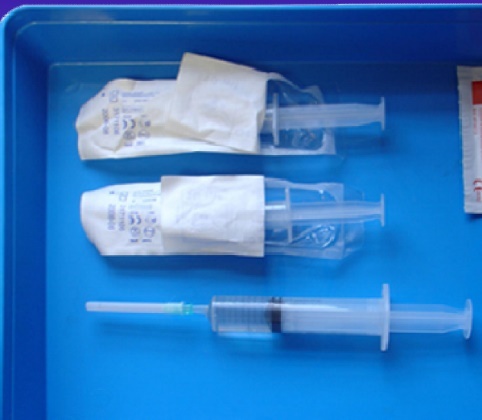
- general aseptic field, when key-parts can easily and optimally be protected by critical micro aseptic fields, like the syringe caps, sheathed needles, covers or packaging which have been sterilized and thus provide optimum complete critical micro aseptic fields for key-parts.
- critical aseptic field, when key-parts, usually due to their size or number, cannot easily be protected at all times with covers and caps, or handled at all times by a non-touch technique. In such cases, the main critical aseptic field demands to be managed as a ‘Key-part’ (i.e. only equipment that has been sterilized and is aseptic can be introduced into the critical aseptic field, which consequently demands the use of sterile gloves). As a result, management of the critical aseptic field is relatively more complicated.
5) Use a Non-Touch Technique
The optimal way of protecting key-parts is never to touch them therefore, to ensure asepsis, a non-touch technique is critically important. A non-touch technique is advocated whether healthcare professionals are wearing gloves or not, and regardless of glove type, as sterile gloves can still become contaminated.
6) Prevent Cross-Infection
• Remove personal protective equipment at end of procedure.
• Clean hands (Moment 3 for hand hygiene (WHO 2009).
• Ensure all waste and sharps are disposed of safely and according to Trust policy.
• Ensure “single use” items are not re-used  .
.
4.0 Monitoring
Monitoring of this guideline is via observation and audit using tools such as the IPC Best Practice Assurance Audit, Saving Lives audits, and ANTT auditing resource tools.
References
Department of Health &Social Care (2022) Health and Social Care Act 2008: code of practice on the prevention and control of infections and related guidance.
Available at:
https://www.gov.uk/government/publications/the-health-and-social-care-act-2008-code-of-practice-on-the-prevention-and-control-of-infections-and-related-guidance/health-and-social-care-act-2008-code-of-practice-on-the-prevention-and-control-of-infections-and-related-guidance
Loveday HP, Wilson JE, Pratt RJ, Golsorkhi M, Tingle A, Bak A, Browne J, Prieto J, Wilcox M 2013 epic3: National Evidence-Based Guidelines for Preventing Healthcare-Associated Infections in NHS Hospitals in England. Available at: https://www.journalofhospitalinfection.com/article/S0195-6701(13)60012-2/pdf
National Institute for Health and Care Excellence 2014 Infection prevention and control.
Available at:
https://www.nice.org.uk/guidance/qs61/chapter/Quality-statement-5-Vascular-access-devices
NHS England (2024) National infection prevention and control manual (NIPCM) for England.
Available at:
https://www.england.nhs.uk/publication/national-infection-prevention-and-control/
Rowley, S. et al. (2010) ANTT v2: An updated practice framework for aseptic technique. Available at:
ANTT v2: An updated practice framework for aseptic technique (magonlinelibrary.com)(accessed 26 June 2024)
The Association for Safe Aseptic Practice (2013) ANTT Aseptic Non Touch Technique. The international standard for safe aseptic technique.
Available at:
www.antt.org (accessed 26 June 2024)
World Health Organisation (2009) WHO guidelines on hand hygiene in health care. First global patient safety challenge. Clean care is safer care.
Available at:
https://www.who.int/publications/i/item/9789241597906
APPENDIX : The ANTT-Approach
Full version control record
This guideline has been registered with the Trust. However, clinical guidelines are guidelines only. The interpretation and application of clinical guidelines will remain the responsibility of the individual clinician. If in doubt, contact a senior colleague or expert. Caution is advised when using guidelines after the review date.
This guideline is for use in Frimley Health NHS Foundation Trust hospitals only. Any use outside this location will not be supported by the Trust and will be at the risk of the individual using it.
Version Control Sheet
Related Documents