Key Points
-
This guideline applies to all Frimley Health Foundation Trust (FHFT) staff who are directly involved in the care of older patients and or those with frailty with acute pain and should be read in conjunction with the Trust’s Frailty Guidelines/Policies.
-
Pain is universal so it is essential that it is recognised by all people working with older people. The symptom can manifest itself not only as a sensory experience but also by causing psychological distress.
-
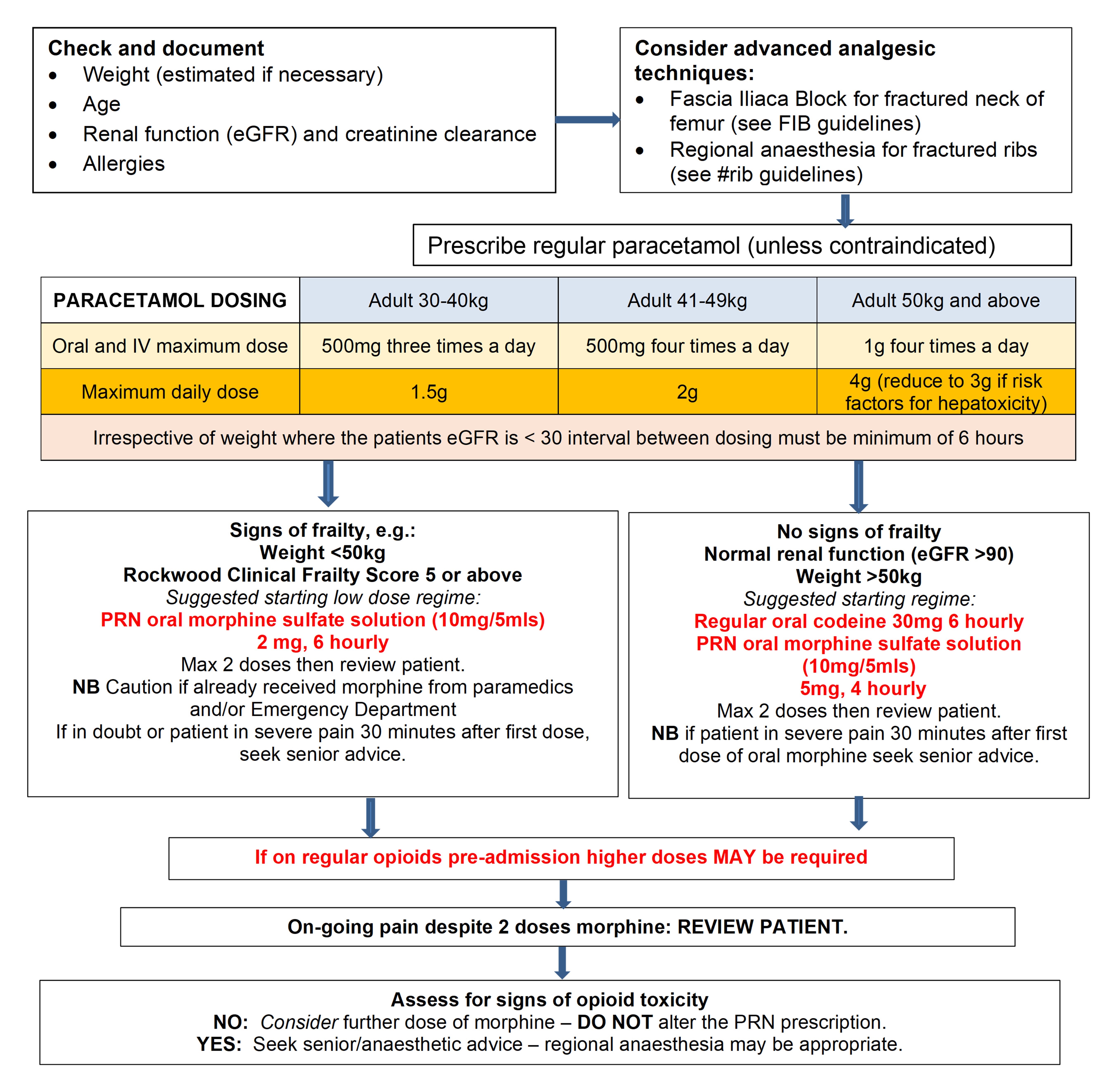
Frail and or older patients require significantly less opioid to achieve adequate analgesia
-
Think Kidneys: adjust analgesia dose and interval when required for renally impaired patients1.
-
Consider advanced analgesic techniques such as regional analgesia, especially for fractured ribs or fractured neck of femur2.
-
It is vital to continually assess patients for signs of opioid toxicity.
-
Non-steroidal anti-inflammatory (NSAIDs) are one of the most common causes of adverse drug reactions. As patients age, and the number of medications increase, so do the contraindications to prescribing NSAIDS3.
Ideally NSAIDs in older patients or those with frailty should be avoided.
This is a controlled document. If you are using a printed copy, check it against the guidelines site to ensure you are using the latest edition. Print copies must be destroyed after use.
Abbreviations
ANALGESIA FOR MANAGING ACUTE PAIN IN OLDER PEOPLE AND OR THOSE WITH FRAILTY
-
Frail and/or older patients require significantly less opioid to achieve the same level of analgesia: Initial doses should be reduced to 25-50% of the doses used in young healthy patients1.
-
Δ Think Kidney: These medications and their metabolites may also accumulate, especially in
patients with renal impairment (eGFR <90) necessitating an increase in the dosing interval. In those with frailty (because of low muscle mass4) eGFR may over-estimate renal function1,2, creatinine clearance is more accurate. Consider use of an alternative opioid, or alternatives to opioids, for those with renal impairment.
-
Remember: Codeine is broken down to morphine1 (oral codeine 30mg equates to 3mg oral morphine sulfate solution).
-
Always refer to current BNF for specific drug and dose information6.
-
NSAIDs should be prescribed for the shortest duration possible in the lowest effective dose, and with careful surveillance to monitor GI, renal, and cardiovascular toxicity8. Always check for contraindications.
GUIDANCE ON THE USE OF NSAIDs
NSAIDs should be avoided in older and frail patients.
If prescribing an NSAID is necessary, then clear rationale should be documented, and all contraindications to their use should be carefully considered. Avoid in patients with renal impairment.
-
NSAIDs are one of the most common causes of adverse drug reactions.
-
NSAIDs should be prescribed for the shortest duration possible in the lowest effective dose, and with careful surveillance to monitor GI, renal, and cardiovascular toxicity.
-
All NSAIDs should be avoided in patients with stage 4 and 5 CKD.
-
GI bleeding and ulceration from NSAIDs use increase in severity and frequency with increasing age.
-
All NSAIDs could be associated with increased cardiovascular adverse effects and each medications’ risk/benefit profile should be considered before prescribing to individual patients7,8.
-
Always refer to current BNF for specific drug and dose information, and a full list of cautions 6
BEFORE you GRAB an NSAID for a patient…
Remember the side effects…..
-
G ut- avoid use in patients with active gastric ulceration or irritation
-
R enal- do not give to patients with poor diuresis and hypovolemia or those with heart failure
-
A llergy- avoid use of NSAIDs if allergy to aspirin or have uncontrolled asthma
-
B leeding- do not give to patients who are actively bleeding or on systemic anticoagulation
Remember - with or without food, PO/IM/IV/PR, NSAIDs have the same side effects!
(only topical NSAIDs are free from systemic side effects- except in renal patients)
Consider gastric protection for those at high risk. Remember- NSAIDs can increase the risk of cardiovascular disease, including risk of heart attacks, stoke and high blood pressure.
Who to call for help?
Inpatient/Acute Pain Service: available in normal working hours Aim to:
• Review inpatients with advanced analgesic techniques: Regional Analgesia (RA), especially Continuous Epidural Analgesia (CEA), and non-standard Patient Controlled Analgesia (PCA)
• Respond to inpatients with complex pain issues such as chronic pain
During office hours Monday to Friday staff should first contact Inpatient Pain Nurse on:
-
FPH Bleep 5252 or ext 134571
-
WPH Bleep 4820 or ext 154435
-
HWD 07776633562 (or bleep 4820)
Outside these times: for urgent advice, the owning medical team can contact the on-call anaesthetist on
FPH Bleep 5002
HWD/WPH 07768463877
When contacting the pain team or anaesthetist, please ensure the patient’s own medical team have reviewed and optimised the analgesia; and that you have the patient’s MRN number to hand.