Key Points
-
This guideline applies to all Trust staff who are directly involved in the care of patients with dementia or cognitive impairment with communication difficulties, their carers, and families.
-
Frimley Health NHS Foundation Trust acknowledges the impact that dementia and cognitive impairment can have on patients, their carers and families and aims to ensure that appropriate pain management is provided to all patients.
-
Frimley Health NHS Foundation Trust has a strategy with the aim that it will be a dementia friendly organisation and externally recognised as such; delivering compassionate person-centred care.
This is a controlled document. If you are using a printed copy, check it against the guidelines site to ensure you are using the latest edition. Print copies must be destroyed after use.
Abbreviations
Introduction
This guideline offers practical guidance on assessing, identifying and managing pain in individuals who have difficulty communicating their pain, such as those with dementia or cognitive impairment. It supports equitable, accessible, and patient-centred care consistent with Frimley Health NHS Foundation Trust’s values and should be applied in all care settings within the Trust. This document complements the Trust’s Dementia Care Policy.
The older adult population is increasing, creating greater demand for specialised pain management in patients with cognitive impairment (1). Patients with dementia often cannot articulate pain verbally; therefore, non-verbal cues must be identified and interpreted accurately to reduce patient distress.
Risks of Poor Pain Management
Inadequate pain control can lead to neuropsychiatric symptoms, reduced quality of life,
increased caregiver burden, and avoidable institutionalisation. It also increases the risk
of medication-related complications such as confusion, falls, and opioid toxicity(2,3).
Definitions
- Dementia: A progressive neurological syndrome marked by memory loss, impaired reasoning, personality changes, and functional decline. Causes include Alzheimer’s disease, vascular dementia, Lewy body dementia, and post-stroke syndromes.
It is a largely irreversible condition characterised by a widespread impairment of mental function which can include some or all the following: memory loss, language impairment, disorientation, changes in personality, difficulties with activities of daily living, self-neglect, and psychiatric symptoms such as aggression and sleep disturbances.
-
Cognitive Impairment: A state between normal ageing and dementia characterised by mild deficits in memory, language, and judgment.
-
Pain: A subjective emotional experience classified as acute (less than 12 weeks) or chronic (more than 12 weeks), signalling potential or actual tissue damage but sometimes occurring without identifiable injury.
Dementia and Pain
Care Complexity
Advanced dementia increases dependency and morbidity, requiring skilled pain assessment and management. Patients may be unable to communicate pain effectively, necessitating knowledge of their baseline behaviour for accurate assessment and monitoring.
Pain Dimensions
Pain is a subjective, personal experience that can only be known to the individual. The experience of pain is multidimensional, including:
-
Sensory (intensity, location, quality)
-
Affective (emotional response)
-
Impact (interference with function and social participation)
Chronic pain is prevalent in older adults but often under-recognised in dementia due to:
-
Declining verbal communication- as dementia progresses, the ability to speak and articulate often diminishes
-
Lack of pain recognition by carers/staff
-
Misinterpretation of behavioural changes- may be attributed to dementia rather than pain
-
Attribution of emotional distress solely to dementia (4).
Pain Assessment
General Principles
Assessing pain may be challenging for patients with cognitive impairment, communication difficulties or language and cultural barriers.
Self-report is the gold standard for pain assessment.
Verbal descriptor scales may be suitable for mild cognitive impairment, potentially with support from speech and language therapy.
Patients who have severe cognitive/communication impairment may not be able to self-report pain; assessment must rely on behavioural responses (5).
Observational Indicators of Pain
Refer to Table 1 for behavioural and physiological signs indicating pain (e.g., autonomic changes, facial expressions, body movements, vocalisations, activity pattern changes, mental status changes).
Table 1: Observational changes associated with pain (6)
* Guarding = abnormal stiff, rigid, or interrupted movement while changing position
** Bracing = a stationary position in which a fully extended limb maintains and supports an abnormal weight distribution for at least three seconds
Assessment Process
-
Establish baseline behaviour on admission, with input from family/carers
-
Discuss causes of pain, known expressions of pain (including behavioural changes), preferred and failed treatments with patient’s carers
-
Utilise and refer to the ‘This is Me’ booklet containing personal information
-
Consider factors including pain location, onset, triggers, characteristics, severity, relieving/exacerbating factors, and associated symptoms.
Pain Assessment Tool
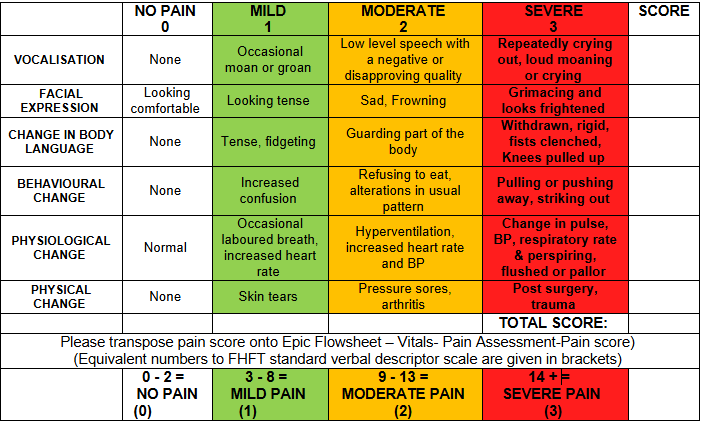
There are many different types of assessment tools that can be used in patients with dementia or cognitive impairment. The Bolton Pain Assessment Tool (BPAT) was devised by the Royal Bolton Hospital NHS Foundation Trust (2011) and it is used in Frimley Health NHS Trust for individuals with communication difficulties. BPAT holistically assesses patient’s behaviour, expressions, vocalisations, and physical/physiological changes (6).
It is important that patients with dementia or a cognitive impairment who cannot vocalise their pain are assessed using observational pain assessment tools like the Bolton Pain Assessment Tool.
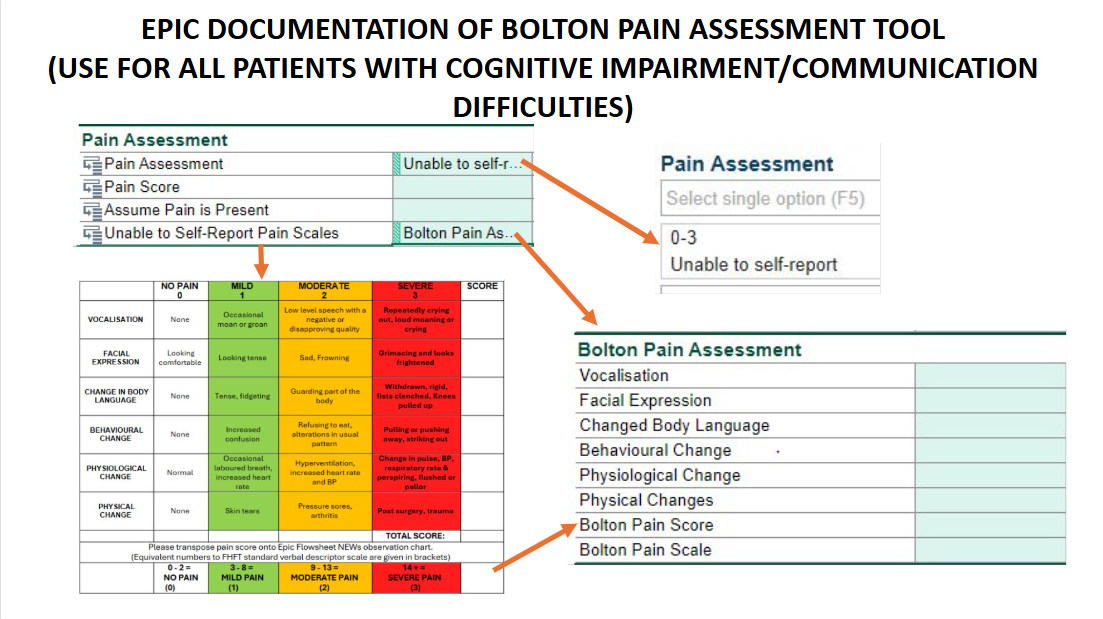
See Appendix for BPAT details and documentation within the EPR system:
1. From the Vitals Flowsheet, Pain Assessment Row select ‘Unable to ‘Self-Report’
2. Select ‘Bolton Pain Assessment’ in the Unable to Self-Report Pain Scales.
3. Complete Bolton Pain Assessment.
NO PAIN
Bolton score actions
0-2 points: No action required. Regular pain assessment.
MILD PAIN
Bolton score actions
3-8 points: Give Paracetamol if appropriate. Regular pain assessment.
MODERATE PAIN
Bolton score actions
9-13 points: Give regular analgesia and offer PRN analgesia. Repeat assessment in one hour.
SEVERE PAIN
Bolton score actions
14+ points: Give regular and PRN analgesia. Ongoing pain assessment and escalate to medical team immediately.
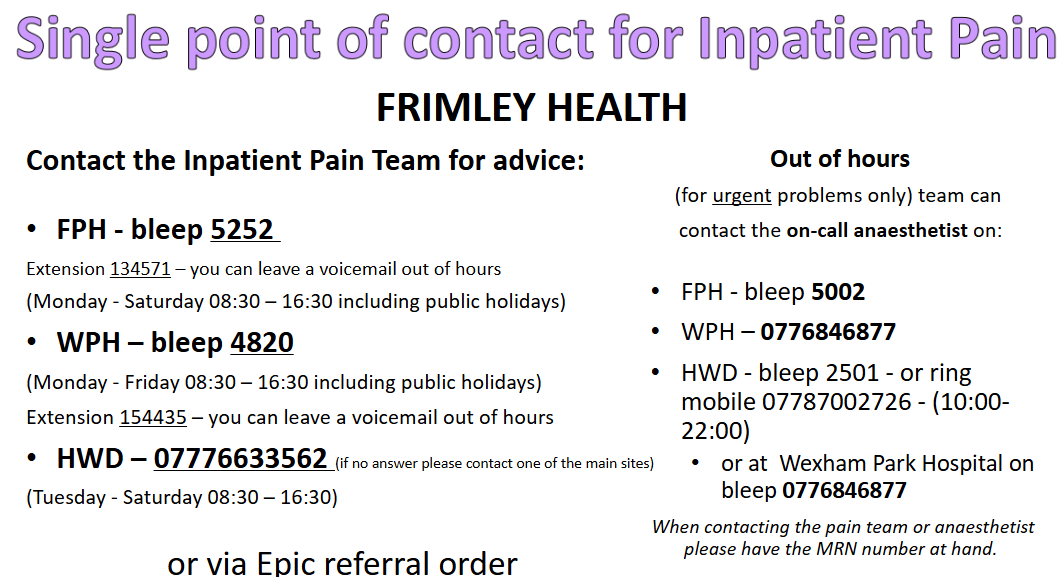
If pain is not controlled with regular and PRN analgesia, medical team please consider referring patient to the Inpatient Pain Team.
Pain Management
Limited studies exist on analgesic effects specifically in those over 65. As adults grow older changes occur to their body composition and their ability to absorb and metabolise drugs.
General Principles
-
Physiological changes – this may increase the sensitivity to some analgesic drugs. Lower doses should be considered in the initial prescribing. Doses can then be titrated according to response.
-
The incidence of side effects with drug therapy can be higher in the older population but analgesics can still be given safely and effectively if co-morbidities and other concomitantly prescribed medications are carefully considered.
-
The least invasive route of administration should be used.
-
The timing of medication administration is important. Severe and/or episodic pain requires treatment with analgesics that have a rapid onset of action and a short duration.
-
If continuous pain is experienced, then modified preparations should be considered and advice sought from the pain team
-
Only one drug should be administered at a time using a low dose followed by slow titration. This allows for any side effects to be noted and monitored with each individual drug
-
Consider leaving longer intervals between the introductions of multiple drugs to allow the assessment of the effect of each medication
-
Consider non-pharmacological strategies to pain management where appropriate
-
Monitor treatment regularly and adjust it as required to improve the efficacy of treatment and to limit adverse reactions
-
When choosing analgesics consider co-morbidities and other medication to minimise the risk of drug-disease and drug-drug interactions (7).
Non-Pharmacological Pain Management
Non-pharmacological pain treatment may include complementary and alternative medicine therapies such as massage, use of essential oils, application of heat or cold (8)
Simple interventions such as relaxation, distraction, repositioning, music, reminiscence therapy, pet visitations, environmental modifications, and the presence of a loved one are effective ways of reducing pain. (9)
Pharmacological Management
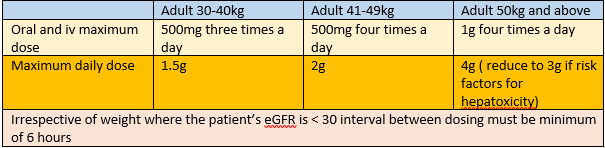
Paracetamol: Recommended as first-line for acute and persistent pain, especially musculoskeletal origin, due to efficacy and safety. Maximum daily dose is 4g; reduce dose in patients weighing less than 50kg(10). Document and update weight on Epic.
For patients who weigh less than 50kg paracetamol dose should be reduced(10).
-
Non-steroidal anti-inflammatory drugs (NSAIDS): should be used in extreme caution in the elderly population. If required, use the lowest effective dose for shortest duration with gastroprotection (PPI) as appropriate. All patients should be monitored for gastrointestinal, cardiovascular, and renal side effects.
-
Opioids : Consider for moderate to severe pain that impairs function or quality of life. Monitor for side effects and prescribe adjuvants (e.g., laxatives) as needed.
Elderly and/or frail patients require significantly less opioid to achieve the same level of analgesia: Initial doses should be reduced to 25-50% of the doses used in young healthy patients.
Δ Think Kidney: These medications and their metabolites may also accumulate, especially in patients with renal impairment (eGFR <60), necessitating an increase in the dosing interval.
Remember: Codeine is broken down to morphine.
Always refer to current BNF for specific drug and dose information
-
Transdermal opioid patches may be a useful delivery mechanism if concordance is an issue. Careful discussion surrounding capacity to consent and treatment in the best interests of the patient should take place before transdermal analgesia is prescribed and administered.
-
Tricyclic antidepressants and anti-epileptic drugs have demonstrated efficacy in neuropathic pain, but tolerability and adverse effects limit their use in the older population, who may also have comorbidities which make these drugs unsuitable.
Training and Implementation
-
Staff involved in dementia care should receive training on pain assessment and management tools, including BPAT.
-
Carers and families should be engaged to provide baseline behavioural information.
Monitoring Compliance of Guideline
This guideline should be monitored by all healthcare professionals with a duty of care to
patients with dementia and / or cognitive impairment. The pain management of patients with
cognitive impairment and dementia and use of this guideline will be reviewed by the
Inpatient Pain Team on ward rounds.
Appendix – Bolton Pain Assessment Tool