Key Points
• This guideline describes the procedure for blood culture collection, for the detection of micro-organisms in the blood.
• Blood cultures taken at the right time with the right technique can reduce the risk of blood culture contamination, whilst ensuring timely and appropriate treatment of infection.
• The guideline incorporates guideline IPC41: Guidelines for Taking Blood Cultures (Paediatrics)
This is a controlled document. If you are using a printed copy, check it against the guidelines site to ensure you are using the latest edition.
Print copies must be destroyed after use.
Abbreviations
1.0 Introduction
Blood culture is the investigation used for detection of micro-organisms in blood. The culture of micro-organisms from blood is essential for microbiological diagnosis of bacteraemia, fungaemia, infective endocarditis and conditions associated with a clinical presentation of pyrexia of unknown origin.
Blood culture is also important for the diagnosis of prosthetic device infections (e.g. joints and vascular grafts) and intravascular line-associated sepsis. Blood cultures may also detect bloodstream infections associated with other conditions such as pneumonia, septic arthritis and osteomyelitis.
This guideline provides information on the blood culture collection procedure with the aim of preventing blood culture contamination and reducing the risk of sharps injuries.
Ensuring blood cultures are taken at the right time, with the right technique, can have the following benefits (NHSE 2023):
-
Improved rates of detection of patients with bloodstream infections
-
Improved patient outcomes
-
Reduced length of stay
-
Rapid identification of specific organisms, supporting a more accurate diagnosis and management of infections
-
Improved antimicrobial stewardship (including reduction in the unrequired used of antibiotics)
2.0 When to take blood cultures
Blood cultures should be taken only when clinically indicated and must be taken immediately if sepsis is suspected. A blood culture should not be taken if there is no intention to treat (e.g. terminally ill).
Febrile patients may not require a blood culture if source of the infection is known, and the patient is systemically well. In these cases, discuss with a senior doctor.
Blood cultures should be ideally taken before the administration of antimicrobials, however, do not delay taking the blood culture if the patient illness too severe to do so safely.
Staff collecting blood cultures are responsible for preventing microbial contamination by maintaining the principles of asepsis throughout the blood sampling procedure. Blood cultures should only be collected by members of staff who have been trained in the collection procedure and whose competence in blood culture collection has been assessed.
3.0 Clinical signs of bacteraemia or sepsis
There are many signs and symptoms which may suggest bacteraemia and clinical judgement is required but the following indicators should be taken into account when assessing a patient for signs of bacteraemia or sepsis:
-
Unexplained deterioration in the patient’s condition and clinical suspicion of bacteraemia
-
Red Flag Sepsis (NICE 2024)
-
Core temperature out of normal range
-
Focal signs of infection
-
Abnormal heart rate (raised), BP (low or raised) or respiratory rate (raised)
-
Chills or rigors
-
Raised or very low WBC
-
New or worsening confusion
NB. Signs of sepsis may be minimal or absent in young infants and children, older frail adults, patients having treatment for cancer, people with spinal cord injury, and also patients that are already ill with severe sepsis (NICE 2024).
4.0 How to take a blood culture
4.1 Preparation
-
Discuss the procedure with the patient and gain their consent.
-
The sampling should preferably take place in an environment that is clean, free from extraneous items such as patient belongings and readily cleanable if a blood spillage occurs.
-
All equipment for procedure should be assembled on a clean tray or trolley and expiry dates checked.
-
Using blood culture collection packs (which can be ordered through the Trust Procurement system) can assist with following the guidance, as it contains the kit needed to enable collection with an aseptic non-touch technique.
-
Clean hands in line with the WHO (2009) ‘5 Moments for Hand Hygiene’ with alcohol-based hand sanitiser, or soap and water.
-
A personal protective equipment risk assessment should be undertaken prior to commencing the procedure, and the correct equipment selected and worn.
-
Place disposable tourniquet on limb to be used for sampling.
-
Select the site of venepuncture, palpate as required to confirm site for venepuncture. (Femoral veins should be avoided because of the difficulty in adequate skin decontamination (DH 2011).)
4.2 Skin Preparation
-
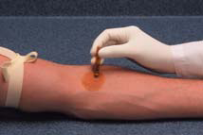
Thoroughly cleanse the patient’s skin before venepuncture using soap and water if visibly soiled.
-
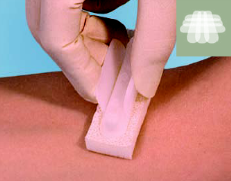
Patients aged over two months: Wipe the venepuncture site gently but firmly with 2% chlorhexidine in 70% isopropyl alcohol single use applicator (such as Chloraprep FREPP), following the manufacturers’ instructions.
-
Patients aged under two months: Use 70% isopropyl alcohol to decontaminate the planned venepuncture site.
-
Allow the site to air dry prior to venepuncture.
-
Do not re-palpate the vein following use of skin antisepsis.
-
Do not use peripheral lines or sites immediately above peripheral lines; use a fresh stab wherever possible.
-
If a central line is present blood may be taken via the line after blood has been taken from a peripheral site (please ensure that the access port has been disinfected with a 2% chlorhexidine in 70% isopropyl alcohol swab and allowed to dry before access).
4.3 Bottle Preparation
-
Prepare the culture bottles (anaerobic and aerobic) for inoculation.
-
Flip the cap off each blood bottle and then disinfect the top of each culture bottle with a 2% chlorhexidine in 70% isopropyl alcohol impregnated wipe for medical equipment.
-
Allow to air dry. Do not touch the top of the blood culture bottle once decontaminated.
4.4 Venepuncture and Bottle Inoculation
-
Follow the procedure in Section 6.0.
-
Perform venepuncture using Aseptic Non-Touch Technique (ANTT) (Trust guideline IPC30).
-
Using the fill indicator lines on the label, obtain the specified amount of blood.
-
In patients with a suspected bacteraemia, it is recommended that two sets of cultures be taken at separate times and from separate sites. The two sets should provide a volume of 9-10ml blood per bottle.
-
Routine bloods may be taken after blood culture collection.
-
Place needle and collection system in appropriate sharps bin.
-
If necessary, use sterile gauze to stem bleeding and cover site with sterile gauze dressing or sterile adhesive plaster.
4.5 Labelling
-
Remove gloves (if worn), dispose of in clinical waste bag, and clean hands.
-
Label the blood bottles with patient details, time and date before leaving the patient, to prevent labelling errors. DO NOT REMOVE OR COVER THE BARCODES.
-
The bottles and request form must be delivered to the laboratory immediately.
-
The sender of a specimen for culture is responsible for checking the culture result, and the patient’s clinician should amend antimicrobial treatment accordingly.
4.6 Documentation
-
After the blood culture has been taken, the person who has taken it must document in the electronic patient record.
-
If blood culture has been taken from a site other than a peripheral stab, document this in the specimen request (this will aid interpretation of results), including lumens of IV devices if used for access.
5.0 Monitoring
Monitoring of this guideline is through the annual Infection Prevention and Control Audit and Surveillance programme.
6.0 Best practice techniques for blood culture taking (DH 2011)
Blood culture collection must be carried out using aseptic non-touch technique, to prevent contamination of the sample.
NB – Blood culture packs are available for use.
1. Skin Preparation
-
Wash patient’s skin with soap and water if heavily soiled
-
Clean own hands using soap and water or alcohol hand gel, apply tourniquet before donning gloves
-
After location of the vein, clean the venepuncture site with ChloraPrep® if patient >2 months (if < 2 months use 70% alcohol)
-
If patient allergic to Chlorhexidine use 70% alcohol
-
Allow the site to air dry before venepuncture
-
Do not re-palpate the vein. Ensure time of applying tourniquet is noted (tourniquet time should not exceed 1 minute).
2. Bottle Preparation

Inspect the bottle surface, the media, and the sensor.
Ensure that the broth is clear and the sensor (under the bottle) is intact and is not yellow.
Do not use the bottle if the broth is cloudy, the sensor is damaged or the sensor is yellow
-
Mark bottle labels corresponding to the recommended fill level indicated on the bottle label (10mls blood per bottle is optimum).
-
Remove protective flip top overcap. If the flipcap is missing, discard the bottle.

-
Cleanse the septum with 2% chlorhexidine in 70% alcohol (Clinell wipe).
-
Allow to dry before inoculation.
-
Use one Clinell wipe for each bottle.
Winged blood collection set method
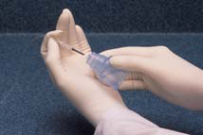
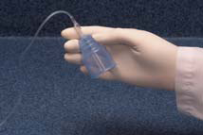
7. After blood collection is complete, remove the holder from the culture bottle, remove tourniquet and then remove the needle from the patient’s vein. Dispose of equipment safely. Remove gloves and clean hands.
Document the procedure and complete the blood culture request form and fill in the culture bottle labels correctly.
NB. Use of needle and syringe is not a recommended method for collection of blood cultures, as it is preferable to use a needle-less system, which also decreases the risk of sample contamination.
References
Department of Health 2011 Taking blood cultures: a summary of best practice. Available at: https://webarchive.nationalarchives.gov.uk/20120118171812/http://hcai.dh.gov.uk/files/2011/03/Document_Blood_culture_FINAL_100826.pdf
National Institute for Clinical Excellence (NICE) 2024 Suspected sepsis: recognition, diagnosis and early management. Available at:
https://www.nice.org.uk/guidance/ng51/resources/suspected-sepsis-recognition-diagnosis-and-early-management-pdf-1837508256709
NHS England 2023 Improving the blood culture pathway. A national review of blood culture pathway processes to support better antimicrobial stewardship and improved patient safety. Available at:
https://www.england.nhs.uk/wp-content/uploads/2022/06/B0686-improving-the-blood-culture-pathway-executive-summary-v1-1.pdf.pdf
Rowley S and Clare S 2011 ANTT: An essential tool for blood culture collection British Journal of Nursing 20 (14): Suppl 9-10. Available at: https://doi.org/10.12968/bjon.2011.20.Sup7.S9
Full version control record
This guideline has been registered with the Trust. However, clinical guidelines are guidelines only. The interpretation and application of clinical guidelines will remain the responsibility of the individual clinician. If in doubt, contact a senior colleague or expert. Caution is advised when using guidelines after the review date.
This guideline is for use in Frimley Health NHS Foundation Trust hospitals only. Any use outside this location will not be supported by the Trust and will be at the risk of the individual using it.
Version History
Related Documents