Early evaluation and on-going treatment of patients presenting with acute upper gastro-intestinal bleeding
Advice on who should be selected for emergency endoscopy and how to refer during the day or night.
The consultant on call for GI bleeding is able to provide case specific advice at any time
Version:
1
Date Issued:
08/06/2023
Review Date:
09/05/2026
Key words:
UGI Bleed, Bleeding, Melaena, Coffee ground vomit
This is a controlled document. If you are using a printed copy, check it against the guidelines site to ensure you are using the latest edition.
Abbreviations
AUGIB
Acute Upper GI Bleed bundle
CGV
Coffee ground vomiting
ESGE
European Society Gastroenterology
EST
Emergency surgical team
GI
Gastrointestinal
PPI
Proton pump inhibitor
SBP
Systolic blood pressure
UGIB
Upper GI bleed
Presenting features
Patients presenting with haematemesis, melaena or coffee ground vomiting (CGV) in the absence of an alternative diagnosis (e.g., bowel obstruction) should trigger the Acute Upper GI Bleed bundle (see Admitting Team section).
Assessment of risks
Any patient with a suspected GI bleed should have a formal assessment of the risk that the GI bleed poses.
At first assessment the Blatchford score should be used and the full Rockall score after endoscopy. Consider early discharge for patients with a pre-endoscopy Blatchford score of 0-1 (1,5).
Glasgow-Blatchford score
Parameter
Score
Urea (mmol/L)
6.5-7.9
2
8.0-9.9
3
10.0-25.0
4
>25.0
6
Haemoglobin (g/dL)
12.0-12.9 (M)/10-11.9 (F)
1
10.0-11.9 (M)
3
<10.0 (M & F)
6
Systolic BP (mmHg)
100-109
1
90-99
2
<90
3
Pulse (bpm)
>100
1
Other factors
Melaena
1
Syncopal episode
2
Evidence of liver disease
2
History of heart failure
2
Admitting team
All patients with a severe acute upper GI bleed are admitted under the medical team. Unwell patients should be discussed with the Gastroenterology ward consultant [Mon – Fri 0900 – 1700] and with the Gastroenterology Cons On call for GI bleeds [Out of hours].
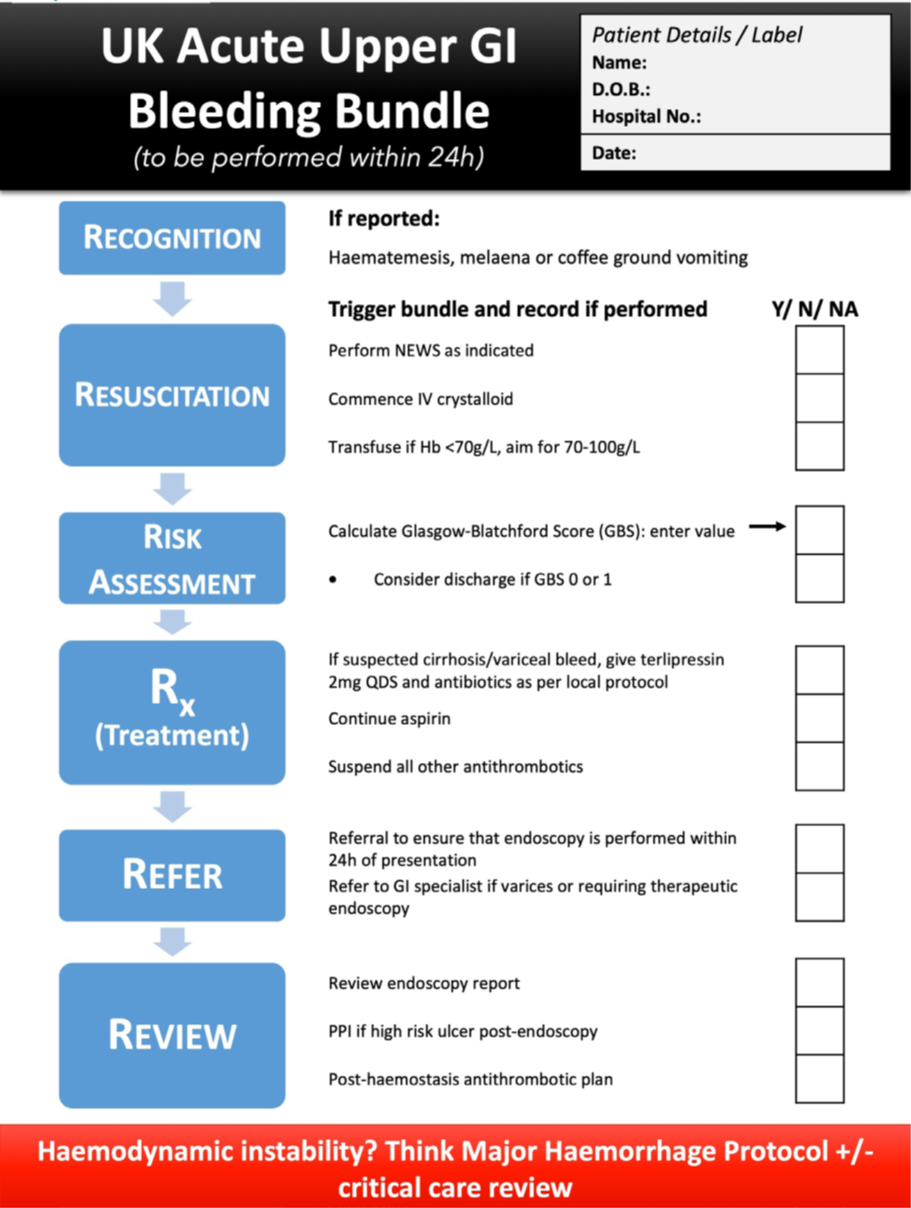
All patients with a suspected UGI bleed should be admitted using the UK Acute UGI bleed bundle, below.
Acute Upper GI bleed Bundle
Summary of the BSG-led acute upper gastrointestinal bleeding care bundle. NEWS, National Early Warning Score; PPI, proton pump inhibitor (6).
Resuscitation and initial management
Assessment and Resuscitation
Haemodynamic instability is defined by NICE as active bleeding where blood pressure or pulse cannot be normalised or where rapid intravenous fluids are required to maintain haemodynamic stability (1).
Any patient, with a suspected Acute UGI bleed should have urgent observations using the National Early Warning Score (NEWS)
‘ABC’s [Airway & breathing, record respiratory rate and O2 saturation, Pulse, BP, perfusion state (capillary refill, sweating, confusion)].
Rectal examination – record fresh blood vs altered blood vs true melaena or normal stool.
Signs of chronic liver disease?
FBC, PT/clotting, U&E, LFTs.
X-match 4 units of blood if transfusion appears likely to be required immediately. If not, group & save. Those identified as low risk by the ‘early discharge’ criteria above do not require G&S.
2x iv access with at least one 16 or 18G (GREY or GREEN) iv cannula.
Monitor pulse and BP half-hourly.
All patients, regardless of haemodynamic status at presentation should be commenced on intravenous fluid replacement. The patient should be monitored using NEWS and clinical review should determine the rate (5,6).
Central venous catheterisation does not aid the speed of resuscitation and may delay administration of volume; it may be indicated in patients with heart failure/renal failure, or patients with precarious peripheral access.
High risk patients identified by haemodynamic instability, higher Blatchford scores or overall clinical impression require the following:
16G or 18G IV cannula x 2.
Volume replacement with crystalloid with a bolus of 500ml over less than 15 minutes
Insert urinary catheter, aim for output >30ml/hr.
Patients with on-going haemodynamic instability should be referred to the critical care outreach team for review
Transfusion, antiplatelets and coagulation
Red cell Transfusion
Single unit transfusions are now recommended in patients who do not have active bleeding.
NICE recommends using restrictive red blood cell transfusion thresholds for patients who need red blood cell transfusions and who do not
have major haemorrhage or
have acute coronary syndrome or
need regular blood transfusions for chronic anaemia (2).
Trigger Haemoglobin (Hb) values for transfusion will vary depending on clinical assessment of ongoing bleeding, cardiovascular status, and co-morbidities (2).
Haemodynamically stable patients with no evidence of ongoing bleeding and no cardiovascular disease have no need for transfusion unless Hb <70 g/l. Target post transfusion Hb 70-90 g/l (5).
Check iron status, replace if deficient, replace using IV iron rather than RBC if not actively bleeding and no cardiovascular compromise
Haemodynamically stable patients with no evidence of ongoing bleeding but significant cardiovascular co-morbidity, transfusion trigger Hb <80 g/l. Target post transfusion Hb 10 g/l (5).
In major haemorrhage please follow trust Massive Haemorrhage Management protocol/Blood transfusion policy for adults with related guidelines on intranet.
Platelet transfusion should be considered in haemodynamically unstable patients who are actively bleeding (WHO grade 2, see Appendix 1 - WHO bleeding scale) with a platelet count less than 50 x109/l (3).
Use higher platelet thresholds (up to a maximum of 100×109 per litre) for patients with thrombocytopenia and either of the following: severe bleeding (WHO grades 3 and 4, see Appendix 1 - WHO bleeding scale) (3).
Consider prophylactic platelet transfusions to raise the platelet count above 50×109 per litre in patients who are having invasive procedures or surgery.
Do not offer prophylactic platelet transfusions unless discussed with the on-call Haematologist if known chronic bone marrow failure, autoimmune thrombocytopaenia, heparin-induced thrombocytopaenia, thrombotic thrombocytopaenic purpura.
Do not routinely transfuse more than one pool of platelets. Reassess after each pool transfused.
Anti-platelets
Aspirin should be continued at presentation (6).
Patients on P2Y12 inhibitors such as clopidogrel, ticlopidine, ticagrelor, prasugrel, and cangrelor should be held until haemostasis has been achieved. If a patient has coronary artery stents a decision should be undertaken after discussion with a cardiologist (6).
Ideally P2Y12 inhibitors should be continued for 12 months after deployment of drug-eluting coronary artery stents or 1 month for bare metal stents. However in the event severe haemorrhage, it may be necessary to temporarily discontinue the P2Y12 inhibitor, but aspirin should be continued,with the aim to restart the P2Y12 inhibitor within 5 days (6).
Any patient whose anti-platelet has been withheld should have a clear plan for resumption (6).
Anti-Coagulation
Patients on Warfarin or a Direct Oral Anti Coagulant (DOAC) should have these temporarily withheld at presentation (6).
Prothrombin Complex Concentrate (PCC): If the patient is on a vitamin K antagonist eg warfarin (VKA) or on a on a direct factor Xa inhibitor eg rivaroxaban, apixaban, edoxaban will need discussion with the on-call haematologist.
For patients who are on Dabigatran (Pradaxa) and are actively bleeding, give Praxbind (Idarucizumab) – will need discussion with the on-call haematologist.
Fresh Frozen Plasma (FFP): Only consider Fresh Frozen Plasma transfusion (Adult dose 15mls/kg) for patients with clinically significant bleeding, without major haemorrhage, if they have abnormal coagulation test results and are not on any anticoagulants (ie VKA NOAC): Prothrombin time ratio or Activated partial thromboplastin time ratio above 1.5). Consider prophylactic Fresh Frozen Plasma transfusions for patients with abnormal coagulation and are not on a VKA or a NOAC who are having invasive procedures or surgery with a risk of clinically significant bleeding.
Consider Cryoprecipitate (Adult dose: 2 pools) if fibrinogen <1.5g/L in an unstable actively bleeding patient.
Consider prophylactic Cryoprecipitate transfusions for patients with a fibrinogen level below 1.0 g/litre who are having invasive procedures or surgery with a risk of clinically significant bleeding.
Any patient whose anti-coagulant has been withheld should have a clear plan for resumption(6).
Medical therapy
Terlipressin
Patients with known or suspected cirrhosis and significant bleeding, please see Management of variceal bleeding section.
Antacids
For patients with presumed non-variceal bleeding, please see Medical Management of non variceal bleeding.
Tranexamic acid
Tranexamic acid is an antifibrinolytic agent that has been studied in patients with upper GI bleeding and is no longer recommended in the treatment of patients with suspected UGI bleeding. In the recent HALT-IT trial, tranexamic acid did not improve death due to bleeding within 5 days. Tranexamic acid use was associated with an increase in venous events (deep vein thrombosis, pulmonary embolism) and seizures compared with placebo. The randomized trial and other meta-analyses suggest that there is no role for tranexamic acid in the treatment of upper GI bleeding (3).
Erythromycin
Erythromycin 125 mg – 250 mg given intravenously 30 minutes before endoscopy ay improve the quality of visualisation of the stomach and may also slightly reduce the need for blood transfusion (8).
Timing of endoscopy
NICE recommends that a full Glasgow-Blatchford score is calculated, and this will be useful in discussions with the on call endoscopist. Scores > 6 suggest at least a 50% chance that endoscopic therapy will be required. Patients admitted with acute UGIB should undergo endoscopy in <24 hours. Emergency or more urgent endoscopy may be required in cases of major or ongoing blood loss, in those with suspected variceal bleeding or those with major comorbidities. Patients with ongoing haemodynamic instability after resuscitation, ongoing active haematemesis, known varices and on-going red cell transfusion requirement (e.g., >4 units over 12-24 hours) are candidates for emergency endoscopy (1,5,6)
Please discuss with the on-call endoscopist if there is any doubt.
Referral pathways
The emergency UGIB service is run by Gastroenterologists. If a patient requires admission the patient should be referred to the medical team. Initial management and resuscitation, is the responsibility of ED team members and subsequent medical team to whom the patient is referred.
If, after initial resuscitation, it appears that the patient will require an emergency OGD, the following steps should be taken according to time of day:
a. Day (0900-1700)
Ensure the admitting medical team are informed.
Inform the Gastroenterology ward consultant and place on OGD order in Epic stating the location where the endoscopy will take place i.e., endoscopy or theatres. For any patient with clinical concerns the requesting team need to talk to the Consultant Gastroenterologist. The requesting team carry the responsibility to ensure that the patient is medically optimised prior to their endoscopy.
b. Out of hours and weekends
The medical registrar should assess the patient, and if an emergency endoscopy appears necessary the on-call consultant should be contacted. They will advise and come into the hospital if required. Endoscopy will be performed in theatres. The requesting team will need to place on OGD order in Epic to take place in theatres. The requesting team carry the responsibility to ensure that the patient is medically optimised prior to their endoscopy. The requesting team will also need to speak to the theatre co-ordinator and anaesthetics.
If an emergency endoscopy is not required, the referring team should request an urgent inpatient endoscopy on the next available endoscopy list.
There is an order set on Epic ‘Upper GI bleeding Admission’ which contains all the pertinent orders for the medical team.
Identifying early discharge candidates
A proportion of patients presenting UGIB can be safely discharged after initial assessment. NICE recommends that patients with a Glasgow-Blatchford Score (GBS) of 0 – 1 can be safely managed in the out-patient setting. Those fulfilling the following criteria will have GBS of 0 -1 and should be considered for out-patient investigation.
urea <6·5 mmol/L
haemoglobin >=130 g/L (men) or >=120 g/L (women)
systolic blood pressure >=110 mm Hg
pulse <100 beats per min
absence of melaena
absence of syncope in the history
absence of cardiac failure, or liver disease
The acute medical team should arrange for an urgent outpatient endoscopy. Ultimately the decision and responsibility for an early discharge lies with the referring medical team. Extenuating circumstances may require an IP endoscopy such as reliability to attend for an outpatient endoscopy.
After endoscopy
NICE recommends that a post-endoscopy Rockall Score is calculated.
Higher Scores indicate a greater risk of re-bleeding, complication and death. Patients with scores 5 or greater require close monitoring (1).
Rockall score
Variable
Score 0
Score 1
Score 2
Score 3
Pre-endoscopy
Age
<60
60-79
>80
-
Shock
No shock
Pulse > 100 BP > 100 systolic
Systolic BP < 100
-
Co-morbidity
Nil major
-
Heart failure, IHD, other major morbidity
Renal failure, liver failure, metastatic cancer
Post-endoscopy
Diagnosis
Mallory-Weiss tear
Other
Cancer
-
Bleeding seen?
none
-
Blood seen, adherent clot seen, spurting vessel seen
Risk of death and re-bleeding according to post-endoscopy Rockall score
Post-endoscopy score
Death (%)
Re-bleeding (%)
>8
40
37
7
23
37
6
12
27
5
11
25
4
8
15
3
1.9
12
0-2
0
5.9
If varices have been identified and treated, terlipressin should continue until melaena clears or a consultant decision is made. Terlipressin is licensed to be given for 72 hours but may be continued at Consultant’s discretion.
Re-bleeding
Further bleeding after an index endoscopy requires discussion with either the consultant looking after the patient or the on-call consultant. Re-bleeding will usually lead to second endoscopy and if haemostasis cannot be achieved, consideration of angiography/embolization or surgery.
Ward Zoning
Patients should be admitted to the gastroenterology ward. If higher level of support is required patients should be referred on to either MADU or ITU. The endoscopy report should be reviewed by the ward team (6)
Management of suspected non-variceal upper gastrointestinal bleeding
Medical management
Proton Pump inhibitors
Routine use of proton pump inhibitors (PPI) prior to endoscopy is not recommended. PPIs provide no significant impact on patient outcomes, including recurrent hemorrhage, need for surgery, or mortality (4, 5, 6). PPIs may be prescribed prior to endoscopy at the discretion of GI bleed consultant on call, but this should not delay early endoscopy (5).
Patients with bleeding from ulcers with high-risk stigmata at endoscopy receive high dose intravenous PPI therapy. Patients should receive a 72-hour PPI infusion (Pantoprazole, 80mg STAT, then 8mg/hr prepared as: 40mg in 100ml 0.9% saline given via infusion pump over 5 hours, repeated for up to 72 hours *) (1,6).
Pantoprazole is officially unlicensed for infusion after endoscopic therapy but is on the hospital formulary and is accepted practise.
Intermittent intravenous or High dose oral PPI may be considered as an alternative. This has been shown to be non-inferior to a continuous infusion outcomes of rebleeding, mortality and urgent interventions (5,7, 10).
H2 Antagonists
In the setting of active UGI bleeding from an ulcer, acid suppressive therapy with H2 receptor antagonists have not been shown to significantly lower the rate of ulcer rebleeding (4). Routine use of a H2 antagonists is not recommended prior to endoscopy. H2 antagonists may be prescribed in peptic ulceration if the response to proton pump inhibitors is inadequate.
NSAIDS
Stop other NSAIDs (including COX-2) inhibitors during the acute phase in patients presenting with upper gastrointestinal bleeding.
Endoscopic treatment
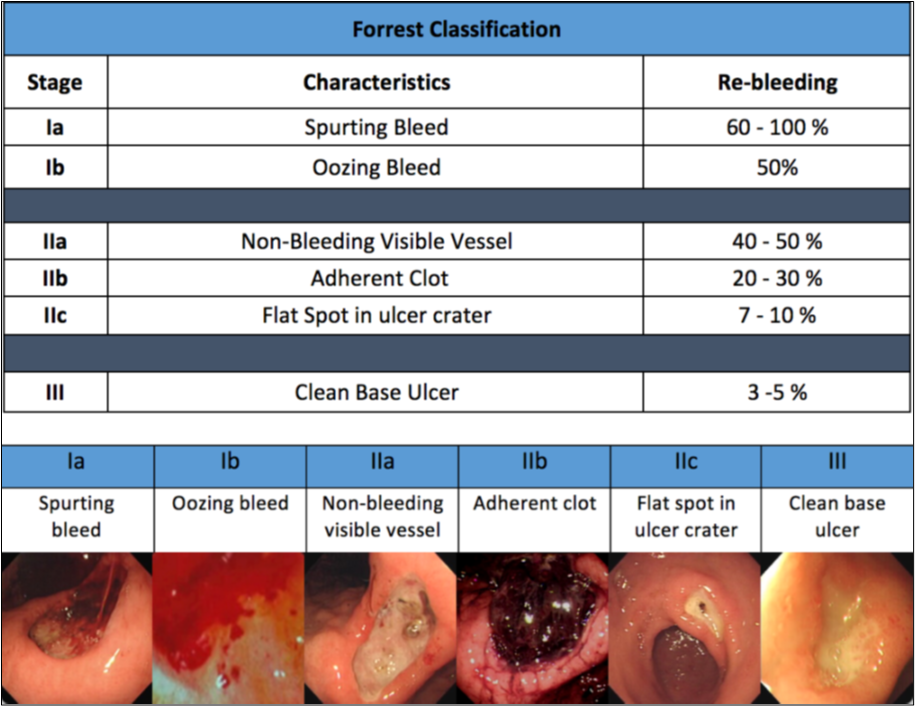
ESGE recommends the Forrest (F) classification be used in all patients with peptic ulcer haemorrhage to differentiate low risk and high-risk endoscopic stigmata (5).
Forrest Classification(7)
The ESGE recommends that peptic ulcers with spurting or oozing bleeding (FIa and FIb respectively) or with a nonbleeding visible vessel (FIIa) receive endoscopic hemostasis because these lesions are at high risk for persistent bleeding or recurrent bleeding. Peptic ulcers with an adherent clot (FIIb) be considered for endoscopic clot removal. Once the clot is removed, any identified underlying active bleeding (FIa or FIb) or nonbleeding visible vessel (FIIa) should receive endoscopic hemostasis. The ESGE does not recommend endoscopic hemostasis in patients with peptic ulcers having a flat pigmented spot (FIIc) or clean base (FIII), as these stigmata have a low risk of adverse outcomes (5).
Adrenaline should not be used as monotherapy for the endoscopic treatment of non-variceal upper gastrointestinal bleeding.
For the endoscopic treatment of non-variceal upper gastrointestinal bleeding, use one of the following:
A mechanical method (e.g., clips) with or without adrenaline
Thermal coagulation with or without adrenaline
Fibrin or thrombin with or without adrenaline
Over the scope clips
The ovesco over the scope clip is available for use is associated with a lower 7-day and 30-day rebleeding rates, higher clinical success rates, and shorter procedure time with similar mortality rates and length of hospital stay as compared with standard therapy (9).
H Pylori
All patients with a peptic ulcer should be tested and treated for H Pylori (5).
Management of suspected variceal bleeding
Medical management
Terlipressin
Offer terlipressin (Variquel®) to patients with suspected variceal bleeding at presentation. Stop treatment after definitive haemostasis has been achieved, or after 5 days, unless there is another indication for uses.
Adult Body Weight <50 Kg
Terlipressin 1 mg initially, then 1 mg every 4 – 6 hours in the first 72 hrs (administered over 1 minute).
Adult Body Weight 50 – 69 Kg
Terlipressin 1.5 mg initially, then 1 mg every 4 – 6 hours in the first 72 hrs (administered over 1 minute).
Adult Body Weight > 70Kg
Terlipressin 2 mg initially, then 1 mg every 4 – 6 hours in the first 72 hrs (administered over 1 minute).
Note: Doses above refer to the Variquel brand of terlipressin.
Antibiotics
Offer prophylactic antibiotic therapy at presentation to patients with suspected or confirmed variceal bleeding in reference to trust guidelines (5, 6).
NSAIDS
Stop other NSAIDs (including COX-2) inhibitors during the acute phase in patients presenting with upper gastrointestinal bleeding.
Endoscopic therapy
Oesophageal varices
Use band ligation in patients with upper gastrointestinal bleeding from oesophageal varices. Consider TIPS if bleeding is not controlled by band ligation.
National Institute for Health and Care Excellence (2012 last updated 2016) Acute upper gastrointestinal bleeding in over 16s: management. Clinical guideline [CG141]. Available at: https: https://www.nice.org.uk/guidance/cg141 (Accessed 24.04.2023)
National Institute for Health and Care Excellence (2015) Blood transfusion. NICE guideline [NG24]. Available at: https://www.nice.org.uk/guidance/ng24 (Accessed 24.04.2023)
Roberts I et al. (2020) Effects of a high-dose 24-h infusion of tranexamic acid on death and thromboembolic events in patients with acute gastrointestinal bleeding (HALT-IT): an international randomised, double-blind, placebo-controlled trial. Lancet, 395 (10241): 1927-1936.
Gisbert JP et al. (2001) Proton pump inhibitors versus H2-antagonists: a meta-analysis of their efficacy in treating bleeding peptic ulcer. Alimentary Pharmacology & Therapeutics, 15(7): 917-926.
Gralnek IM et al. (2021) Endoscopic diagnosis and management of nonvariceal upper gastrointestinal haemorrhage (NVUGIH): European Society of Gastrointestinal Endoscopy (ESGE) Guideline – update 2021. Endoscopy, 53(03): 300-332. doi: 10.1055/a-1369-5274
Siau K et al. (2020) British Society of Gastroenterology (BSG)-led multisociety consensus care bundle for the early clinical management of acute upper gastrointestinal bleeding. Frontline Gastroenterology, 11:311-323. Available at: https://fg.bmj.com/content/11/4/311 (Accessed 24.04.23)
Alzoubaidi D, Lovat LB and Haidry R (2018) Management of non-variceal upper gastrointestinal bleeding: where are we in 2018? Frontline Gastroenterol, 10(1): 35-42. doi: 10.1136/flgastro-2017-100901
Bapaye J et al. (2022) Safety and efficacy of over-the-scope clips versus standard therapy for high-risk nonvariceal upper GI bleeding: systematic review and meta-analysis. Gastrointestinal Endoscopy, 96(5): 712-720.e7.
Kanno T et al. (2022) Proton pump inhibitor treatment initiated prior to endoscopic diagnosis in upper gastrointestinal bleeding. Cochrane Database of Systematic Reviews 2022, Issue 1. Art. No.: CD005415. Available at: https://www.cochranelibrary.com/cdsr/doi/10.1002/14651858.CD005415.pub4/full (Accessed 24.04.23)
Appendix 1 - WHO bleeding scale
Grade
Examples
1
Oropharyngeal bleeding, with the total duration of all episodes no more than 30 minutes in the last 24 hours. Epistaxis, with the total duration of all episodes no more than 30 minutes in the last 24 hours. Petechiae of oral mucosa or skin. Purpura up to 2.5 cm (1 inch) in diameter. Spontaneous haematoma in soft tissue or muscle. Positive stool occult blood test. Microscopic haematuria or haemoglobinuria. Abnormal vaginal bleeding (spotting).
2
Epistaxis, with the total duration of all episodes over 30 minutes in 24 hours. Purpura over 2.5cm (1 inch) in diameter. Joint bleeding. Melanotic stool. Haematemesis. Gross/visible haematuria. Abnormal vaginal bleeding (more than spotting). Haemoptysis. Visible blood in body cavity fluid. Retinal bleeding without visual impairment. Bleeding at invasive sites.
3
Bleeding needing red blood cell transfusion over routine transfusion needs. Bleeding associated with moderate haemodynamic instability.
4
Bleeding associated with severe haemodynamic instability. Fatal bleeding. Central nervous system bleeding on imaging study with or without dysfunction.
Version:
1
Guidelines Lead(s):
Dr Susannah Woodrow, Consultant Gastroenterologist
Contributor(s):
Dr Kuldeep Cheent., Consultant Gastroenterologist & Hepatologist Dr Iona Coltart, Consultant Gastroenterologist & Hepatologist Dr Sofia Galli, Consultant Haematologist Stuart Dark, Pharmacist
Lead Director / Chief of Service:
Dr Gareth Roberts, Chief of service for medicine
Library check completed:
24/04/2023
Ratified at:
EUG 09/05/2023
Date Issued:
08/06/2023
Review Date:
09/05/2026
Pharmaceutical dosing advice and formulary compliance checked by:
Stuart Dark 07/06/2023
Key words:
UGI Bleed, Bleeding, Melaena, Coffee ground vomit
This guideline has been registered with the trust. However, clinical guidelines are guidelines only. The interpretation and application of clinical guidelines will remain the responsibility of the individual clinician. If in doubt contact a senior colleague or expert. Caution is advised when using guidelines after the review date. This guideline is for use in Frimley Health Trust hospitals only. Any use outside this location will not be supported by the Trust and will be at the risk of the individual using it.
Version History
Version
Date
Guideline Lead(s)
Status
Comment
1
Apr 2023
Dr Susannah Woodrow
Final
First trust-wide guideline, adapted from FPH Upper GI Bleed v4 (2021) and WPH Upper GI Bleed v1 (2015)