Key Points
-
Guideline for the drawing up and deliver of glue and thrombin for the treatment for gastric varices
-
Safety advice in the event of inadvertent contact with skin, eyes, or mucous membranes
This is a controlled document. If you are using a printed copy, check it against the guidelines site to ensure you are using the latest edition.
Print copies must be destroyed after use.
Abbreviations
Histoacryl Glue for Gastric varices
Histoacryl® glue is a tissue adhesive which rapidly polymerises and hardens in contact with biological tissue (circa 20 s) and instantaneously in contact with blood. It is provided in 0.5ml ampoules containing 0.5g of enbucrilate. For variceal injection Histoacryl® is diluted with Lipiodol® to slow down the rate of polymerisation, facilitate injection and allow radiological visualisation (useful in cases of embolisation). Lipiodol® is a diagnostic agent made of ethyl esters of iodinated poppy seed oil.
The combination above is effective in treating bleeding varices, and is the preferred modality in GOV type 2 and IGV type 1 varices (GOV2: extending >5cm from GO junction, IGV1: isolated in fundus) because banding cannot effectively encompass these enlarged vessels.
Glue injection requires specific training and should not be undertaken by inexperienced personnel.
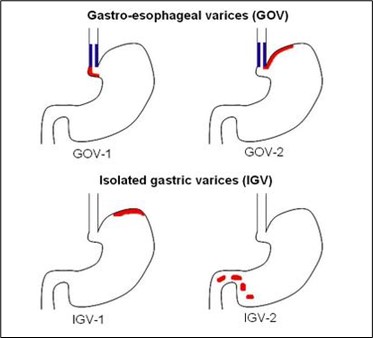
Figure 1: Classification of gastric varices
Risks of glue therapy
The risks of glue therapy are to the patient, staff, and endoscopy equipment.
Patient
-
Protect patient’s eyes with a towel over the forehead and eyes to avoid contact with eyes and skin (if practical).
-
Tissue necrosis due to para-variceal injection
-
Embolisation (incidence: rare) with reports of glue deposition in pulmonary vessels, cerebral vessels, mesenteric vessels, and others (1). Portal and splenic vein thrombosis presenting with severe abdominal pain staring 30 minutes after glue injection.
-
Mediastinal sepsis, or sterile inflammation
-
Oesophageal fistulae
-
Failure of haemostasis: early rebleeding after three of four days following injection due to necrosis around site of injection
-
Allergy: Patients with an allergy to iodine should not receive this therapy because Lipidiol ® is an iodized oil emulsion
-
Avoid Contact with mucous membranes especially eyes and skin.
Staff
- All staff working with Histoacryl should wear gloves and goggles
Equipment
- Occlusion of endoscope’s working channel (irreparable).
Protocol
- Identify the glue and Lipiodol® ampoules
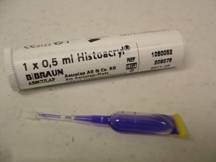
Figure 2: Histoacryl ampoule
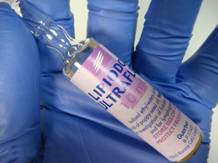
Figure 3: Lipiodol® ampoule
-
Wear goggles/face mask and gloves
-
Preparation
Prepare a tray with 3 x 2ml Luer lock syringes, 4 x 10ml syringes and two variceal injection needles
Draw sterile water for injection into the 10ml syringes.
Into the 2ml syringes draw up 0.5ml Lipiodol.
- Injection
When the endoscopist confirms that injection is required: open a histoacryl glue ampoule and draw the 0.5ml into a lipiodol containing 2ml syringe. Mix by inverting the syringe several times.
Prime the injector needle with 2mls sterile water
Endoscopist inserts needle into varix
Inject 1-2mls sterile water to confirm intra-luminal position (no mucosal swelling, blanching, excessive resistance)
Inject the glue/lipiodol mixture
Inject with further 2mls sterile water to flush glue from the ‘dead space’ in the needle
Remove needle slowly, do not wait for glue to solidify
Observe varix
Flush with further sterile water into the gastric lumen to ensure no glue at needle tip
Assistant pulls needle back into sheath
Remove needle from scope
Repeat until haemostasis achieved
If needle ‘sticks’ to the glue mass in the varix, can try to abut scope to varix and apply gentle pressure to see if needle can be freed. If not, remove scope while leaving injector needle in place (having cut the proximal end)
If there is uncontrolled bleeding insert Sengstaken tube and inflate gastric balloon with air, and refer for TIPSS.
Following successful glueing of the varix
Ensure the medical management of the patient’s portal hypertension has been addressed.
First Aid Advice in case of inadvertent contact with skin, eyes, or mucous membranes
Skin
Do not attempt to pull the surfaces directly apart. In the event of accidental adhesion of the skin, the bonded surfaces may be separated after application of acetone, prolonged soaking in warm (not hot) soapy water, and/or mixtures of alcohol and water.
Application of liquid paraffin may help in removal from the skin. If necessary, the surfaces may be peeled or rolled apart with the aid of a spatula; Acetone and alcohol should not be used near or in the eyes. Solvents such as nitromethane, toluene, or xylene may be used to aid skin detachment from solid objects. Solvents should be used with care and should not be introduced into the oropharynx.
Eyes
Eyelids stuck together or bonded to the eyeball should be washed thoroughly with saline or water at room temperature for 15 minutes and a gauze patch applied; the eye will open without further action in 1 to 4 days. Manipulative attempts to open the eyes should not be made. Although cyanoacrylate introduced into the eyes may cause double vision and lachrymation there is usually no residual damage.
Lips
If lips are accidentally stuck together plenty of warm water should be applied and maximum wetting from saliva inside the mouth encouraged. Lips should be peeled or rolled apart and not pulled. Adhesive introduced into the mouth solidifies and adheres, but saliva will lift the adhesive in ½ to 2 days. Care should be taken to avoid choking.
Thrombin protocol for Gastric Varices 2,3. (4)
-
Reconstitute the 2500 unit vial of thrombin with 10mL of 0.9% saline by gently swirling until completely dissolved. The final concentration of the thrombin will be 250 units per mL.
-
Use a standard 23G injection needle. Prime with the thrombin solution.
-
For gastric varices it is suggested to inject 2-3mls at one or 2 sites depending upon size and degree of bleeding. Hold needle in place for up to 10 seconds before retracting needle to reduce bleeding from puncture site.
-
Don't try to use the last ml in the needle as this requires flushing with further fluid thus diluting the effect of the thrombin.
-
We recommend repeating the thrombin injections twice more at 1-2 weekly intervals. The endoscopist should assume responsibility for booking the next OGD and therapy.
-
Re-bleeding seems rare after 3 sessions
-
Consider using Endoscopic Ultrasound to detect thrombosis of varices and/or to target varices in some patients
(Off-label use of thrombin component from Floseal haemostatic matrix (Baxter Inc) 2500 units. Unit price for kit in 2021: £287.83)
Full version control record
This guideline has been registered with the trust. However, clinical guidelines are guidelines only. The interpretation and application of clinical guidelines will remain the responsibility of the individual clinician. If in doubt, contact a senior colleague or expert. Caution is advised when using guidelines after the review date.
This guideline is for use in Frimley Health Trust hospitals only. Any use outside this location will not be supported by the Trust and will be at the risk of the individual using it.
Version History
Related Documents