Key Points
-
To be used in all patients 16 years and older being discharged from the Adult or Paediatric Emergency Department with lower limb immobilisation in EITHER a plaster cast for non-weight bearing OR Black Boot for weight bearing as tolerated (including time out of the boot).
-
Guidelines for the assessment of additional patient venous thromboembolism risk factors balanced against bleeding risk
-
Rivaroxaban (unlicensed indication) should be the first line discharge medication unless contraindicated.
This is a controlled document. If you are using a printed copy, check it against the guidelines site to ensure you are using the latest edition.
Print copies must be destroyed after use.
Abbreviations
Introduction
-
This guideline aims to reduce the risk of developing VTE (deep vein thrombosis and pulmonary embolism) in ED patients discharged with lower limb immobilisation – POP or Black Boot, regardless of weight bearing status.
-
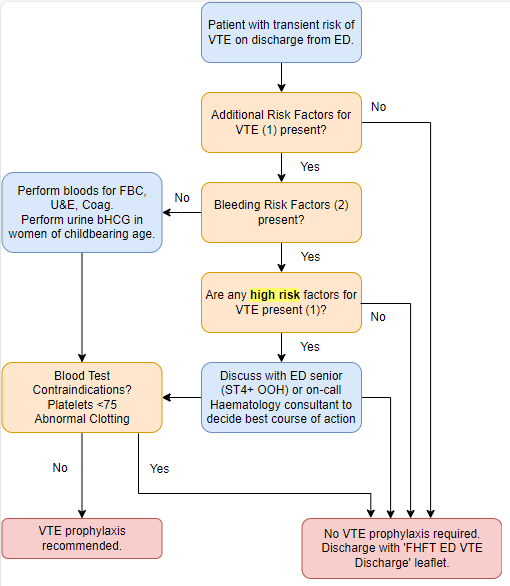
In line with NICE1 and RCEM2 guidelines, all patients over the age of 16 who have an injury being managed with lower limb immobilisation (defined as any clinical decision taken to manage the affected limb in a way that would prevent normal weight-bearing status or use of that limb, or both) should have a risk assessment documented regarding their risk of VTE.
-
This includes an assessment of additional risk factors for VTE – immobilisation in itself is not an indication for VTE prophylaxis.
-
This risk should be balanced against an assessment of risk factors for bleeding.
-
If the risk of VTE outweighs the risk of bleeding (with no contraindications for VTE prophylaxis identified), patients should be counselled as to the recommendation to take VTE prophylaxis medication on discharge.
-
If patient has high risk factors for VTE AND risk factors for bleeding AND not already on an anticoagulant - then the case should be discussed with an ED senior or haematologist to decide upon the best course of action for the patient. Out of hours this discussion should be with ST4+ (grey top registrar) and above or the on-call haematologist.
-
The first line for all patients (including 16/17 year olds) is rivaroxaban 10mg PO OD.
A 14 day TTA pack should be supplied from ED on discharge, with the ongoing need risk assessed and further prophylaxis prescribed when the patient is seen in fracture clinic if required.

VTE and Bleeding Risk Assessment Guide
Transient Risk Factors for VTE
Immobilisation (non-weight bearing) in POP (slightly higher risk).
Injury being managed in a Black Boot, including those who are weight bearing.
(1) Additional Risk Factors for VTE
- Personal history of VTE (high risk)
- Suspected or proven achilles tendon rupture (high risk)
- Known thrombophilia (high risk)
- Age >60
- Active cancer or cancer treatment
- Obesity (BMI >30)
- Any significant comorbidity (heart disease, metabolic, endocrine or respiratory pathology, acute infection, inflammatory conditions)
- Family history of VTE (first degree relative)
- Varicose veins with phlebitis
HRT or oestrogen-containing contraception
- Pregnant or < 6 weeks post-partum
(2) Bleeding Risk Factors
- On anticoagulants (e.g., DOAC or warfarin with INR >1.5) No thromboprophylaxis required
- Active bleeding
- Inherited bleeding disorders (e.g., Haemophilia, von Willebrand's)
- Acquired bleeding disorder (e.g., liver failure)
- Acute stroke
- Recent cerebral haemorrhage or cranial surgery
- Uncontrolled hypertension (>250/120 mmHg)
- Lumbar puncture within last 4 hours, or expected within next 12 hours
- Gastric ulcer / extensive varices
VTE Prophylaxis
First Line: Rivaroxaban 10mg OD (unlicensed indication)
Contraindications to rivaroxaban
-
Pregnant/breast feeding
-
Antifungals (Azoles)
-
HIV Protease Inhibitors
-
Phenytoin/Fosphenytoin
-
Sertaline/Fluoxetine
-
eGFR < 30
Second Line: Dalteparin (sc)
Contraindications to dalteparin
Dalteparin Dosing (subcut) for THROMBOPROPHYLAXIS
*Graduated syringes 10,000 units in 1ml available for administration. If patient/family unable to administer safely at home, then a discussion with patient about the hypothetical risk of thromboembolism should be held to determine whether they are willing and able to attend AECU for daily unfractionated heparin. If not then you may pragmatically opt not to provide thromboprophylaxis.
-
14-day TTA packs of rivaroxaban and dalteparin are kept in ED
-
If patients are being discharged with dalteparin, the SC administration form should also be completed and uploaded to Epic (this is linked in the Epic risk assessment).
-
Ongoing prophylaxis up to 42 days should be considered by the fracture clinic.
-
Patients should be provided with the information leaflet “FHFT ED VTE DISCHARGE LEAFLET”. This can be added to their After Visit Summary from ‘Dispo tab’ Instructions area after setting their disposal to discharge.