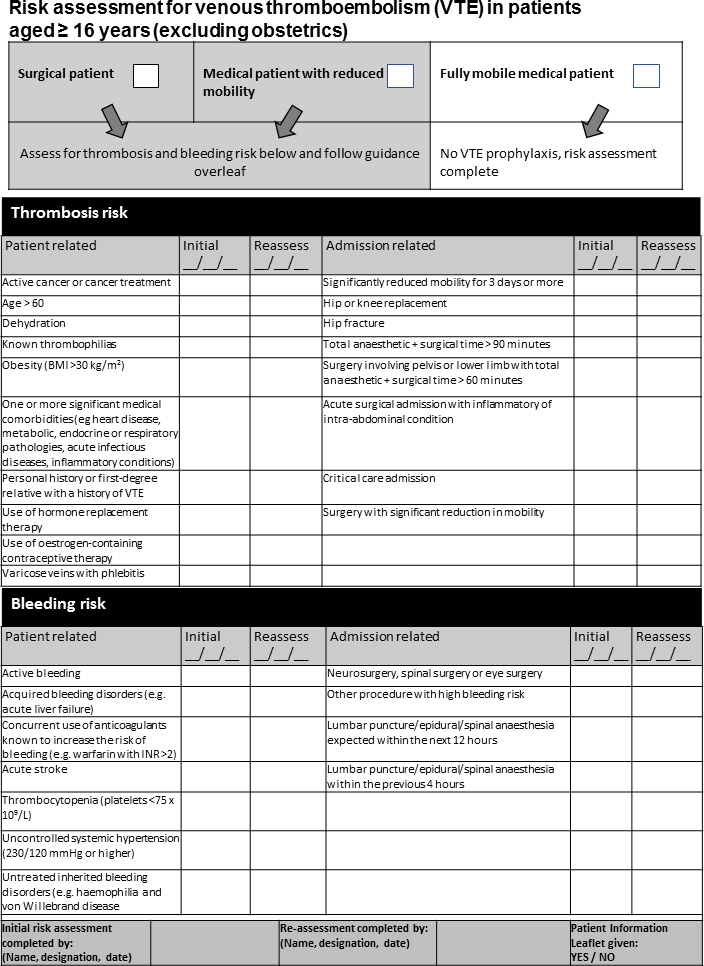
6.1 Orthopaedic surgery
6.1.1 All patients undergoing major orthopaedic surgery of the pelvis or lower limb should receive calf or foot pumps.
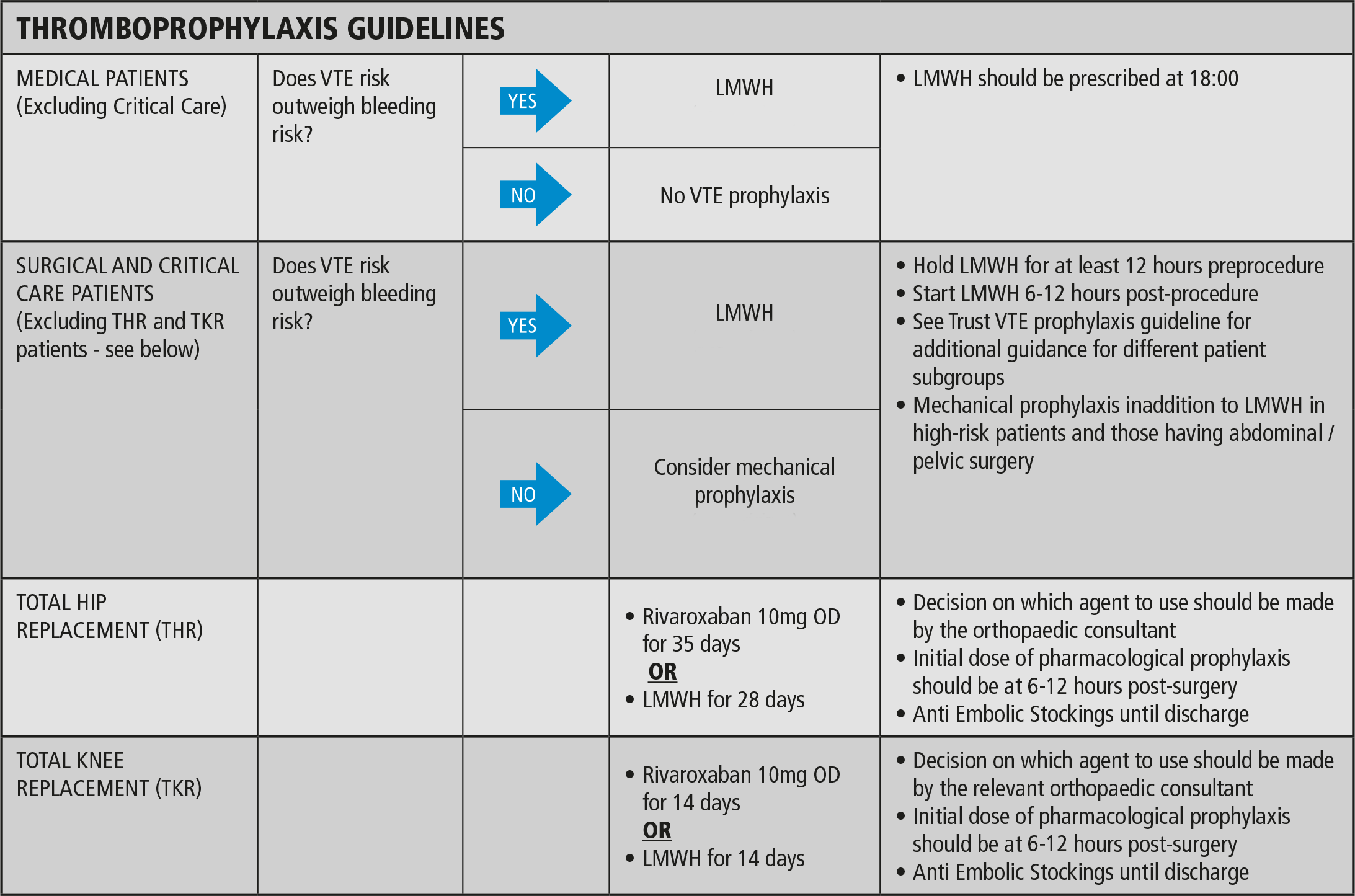
6.1.2 Elective hip replacement surgery
Offer VTE prophylaxis to people undergoing elective hip replacement surgery whose risk of VTE outweighs their risk of bleeding. Choose from the following options:
Start DOAC or LMWH at 6-12 hours post-surgery (see 4.8.1).
6.1.3 Elective knee replacement surgery
Offer VTE prophylaxis to people undergoing elective knee replacement surgery whose risk of VTE outweighs their risk of bleeding. Choose from the following 3 options:
Start DOAC or LMWH at 6-12 hours post-surgery (see 4.8.1).
6.1.4 Other lower limb surgery
Consider LMWH for 14 days (starting 6-12 hours after surgery) if: total anaesthesia time is more than 90 minutes or the person’s risk of VTE outweighs their risk of bleeding. Rivaroxaban 10mg OD can be used as an alternative. We would recommend pharmacological prophylaxis in any individuals with a personal history of VTE. Aspirin may be considered for VTE prophylaxis in individuals who are considered low risk and have no previous VTE history who are undergoing low-risk foot and ankle procedures.
6.1.5 Lower limb immobilisation: Consider pharmacological prophylaxis with LMWH or Rivaroxaban 10mg OD (unlicensed indication) for people with lower limb immobilisation whose risk of VTE outweighs their risk of bleeding. We would recommend its use in any individuals with a personal history of VTE. Consider stopping prophylaxis if lower limb immobilisation continues beyond 42 days.
6.1.6 Fragility fractures of the pelvis, hip or proximal femur. Offer LMWH prophylaxis for 35 days. Start LMWH at 6-12 hours post-surgery. Consider pre-operative VTE prophylaxis if surgery is delayed beyond the day after admission, stopping 12 hours before surgery. Consider IPC for people at the time of admission, particularly if pharmacological prophylaxis is contraindicated. Continue until the person no longer has significantly reduced mobility relative to their normal or anticipated mobility.
6.1.7 Upper limb surgery: VTE prophylaxis is generally not needed if giving local or regional anaesthetic for upper limb surgery. Consider LMWH prophylaxis for people undergoing upper limb surgery if the person’s total time under general anaesthetic is over 90 minutes or where their operation is likely to make it difficult for them to mobilise.
6.1.8 Spinal surgery. Offer mechanical VTE prophylaxis with anti-embolism stockings (AES) or intermittent pneumatic compression (IPC) to people undergoing elective spinal surgery. Continue until the person no longer has significantly reduced mobility relative to their normal or anticipated mobility. Consider adding LMWH prophylaxis for people undergoing elective spinal surgery whose risk of VTE outweighs their risk of bleeding, taking into account individual patient and surgical factors and according to clinical judgement. If using LMWH for people undergoing elective spinal surgery, start giving it 24-48 hours postoperatively according to clinical judgement. Continue until the person no longer has significantly reduced mobility.
6.2 Major trauma patients
6.2.1 Offer mechanical VTE prophylaxis with IPC on admission to people with serious or major trauma. Continue until the person no longer has significantly reduced mobility relative to their normal or anticipated mobility.
6.2.2 Reassess risk of VTE and bleeding at least daily.
6.2.3 Consider pharmacological VTE prophylaxis as soon as possible when the risk of VTE outweighs the risk of bleeding.
6.3 Abdominal surgery (GI, gynaecological, urological)
6.3.1 Start mechanical VTE prophylaxis on admission for people undergoing abdominal (GI, gynaecological, urological) surgery who are at increased risk of VTE using AES or IPC. Continue until the person no longer has reduced mobility relative to their normal or anticipated mobility.
6.3.2 Add LMWH prophylaxis for a minimum of 7 days for people undergoing abdominal surgery whose risk of VTE outweighs their risk of bleeding. Consider extending pharmacological prophylaxis to 28 days postoperatively for people who have had major cancer surgery in the abdomen.
6.3.3 Offer VTE prophylaxis to people undergoing bariatric surgery.
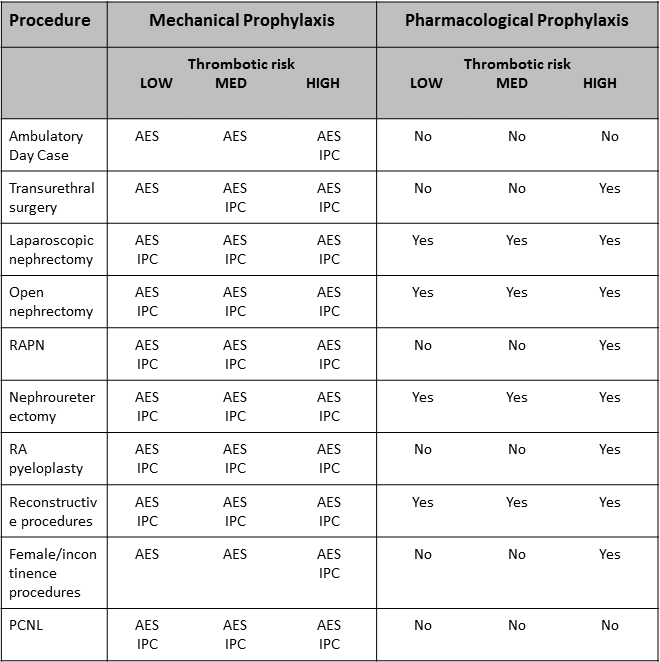
6.3.4 The urology department have produced specific guidelines on their preferred choice of VTE prophylaxis, according to procedure (see Appendix D).
6.4 Vascular surgery
6.4.1. Consider LMWH for a minimum of 7 days for people undergoing the following procedures, if risk of VTE outweighs risk of bleeding:
6.4.2 Where pharmacological prophylaxis is contraindicated, consider mechanical VTE prophylaxis with AES or IPC until the person no longer has significantly reduced mobility relative to their normal or anticipated mobility.
6.4.3 Consider LMWH for 7 days for patients undergoing varicose vein surgery if the total anaesthesia time is more than 90 minutes or the person’s risk of VTE outweighs their risk of bleeding.
6.5 Oral or maxillofacial (OMF) surgery and ear/nose/throat (ENT) surgery
6.5.1 Consider LMWH prophylaxis for a minimum of 7 days for people undergoing OMF or ENT surgery whose risk of VTE outweighs their risk of bleeding.
6.5.2 Consider mechanical VTE prophylaxis with AES or IPC where pharmacological prophylaxis is contraindicated, continued until the person no longer has significantly reduced mobility relative to their normal or anticipated mobility.
6.5.3 Individuals undergoing certain minor ENT procedures under local anaesthetic are included in Appendix B as a cohort group that do not require individualised VTE assessment.
6.6 Palliative care patients
6.6.1 Consider pharmacological VTE prophylaxis with LMWH for people who are having palliative care. Take into account temporary increases in thrombotic risk factors, risk of bleeding, likely life expectancy and views of the person, their family members, carers, and the MDT.
6.6.2 Do not routinely offer VTE prophylaxis to people in the last days of life. Review VTE prophylaxis daily for these patients.
6.7 Critical care
6.7.1 Provide LMWH to people admitted to the critical care unit if pharmacological VTE prophylaxis is not contraindicated.
6.7.2 Consider mechanical VTE prophylaxis, particularly if pharmacological prophylaxis is contraindicated. Continue until the person no longer has reduced mobility relative to their normal or anticipated mobility.
6.7.3 Reassess VTE and bleeding risk daily for people in the critical care unit, or more frequently if the person’s condition is changing rapidly.
6.8 Acute stroke patients
6.8.1 Clinical assessment of VTE risk should be made in all acute stroke patients on admission. Stroke patients are deemed to be at risk of VTE if:
6.8.2 IPC should be prescribed in all at-risk stroke patients within 24 hours of admission.
6.8.3 IPC should be provided for 30 days, or until the person is mobile or discharged, whichever is sooner.
6.8.4 LMWH should not be used within the first 14 days of an index stroke event unless decided upon by a consultant stroke physician or consultant neurologist.
6.9 Covid-19 positive patients
6.9.1 Covid-19 infection is associated with increased risk of thrombosis, though rates of VTE are now lower than those we saw with the early waves of Covid infection when patients were unvaccinated. Patients should be risk assessed as usual and given standard doses of pharmacological thromboprophylaxis where indicated. PE should be considered in the differential in patients with unexplained desaturations. Selected patients with Covid-19 infection who are not on ITU can be considered for a treatment dose of LMWH if felt to be at particularly high thrombotic risk with low bleeding risk.