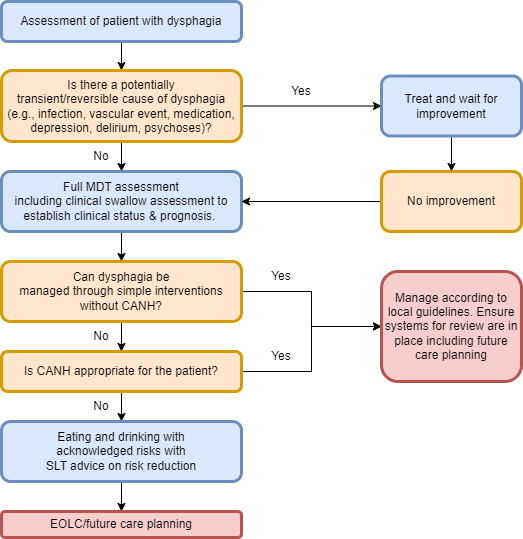
Eating and drinking with acknowledged risks refers to the decision to continue eating and drinking despite the associated risks from having dysphagia. These risks may refer to aspiration, malnutrition, dehydration and choking. (RCSLT 2021)
If a patient is deemed to be at risk of aspiration with oral intake but is unsuitable for alternative nutrition / hydration or fluid / diet modification, then eating and drinking with acknowledged risks should be considered. It should also be considered if a patient is non-compliant with SLT recommendations.
If a patient wishes to make a decision that is contrary to medical/SLT recommendations, this decision must be documented by the medical team in the electronic patient record.
For patients who lack capacity to make a decision regarding their nutrition and/or hydration, a Best Interests multidisciplinary decision should be made in a timely way and documented in the electronic patient record.
When discharged from hospital, the discharge summary should contain details of any decision made regarding eating and drinking with acknowledged risks including ceilings of care agreed.
Version:
5.0
Date Issued:
15 November 2023
Review Date:
November 2026
Key words:
Eating and drinking with acknowledged risks, risk feeding
This is a controlled document. If you are using a printed copy, check it against the guidelines site to ensure you are using the latest edition.
Print copies must be destroyed after use.
Abbreviations
CANH
Clinically Assisted Nutrition and Hydration refers to alternative means of receiving nutrition enterally.
EDAR
Eating and drinking with acknowledged risks
EOLC
End of Life Care. Care given during the final period (hours, days, weeks, months) in a patient’s life in which it is medically obvious that death is imminent or a terminal moribund state cannot be prevented
MCA
Mental Capacity Assessment
NBM
Nil by mouth. A patient care instruction advising that the patient is prohibited from ingesting food, drink, or medicine.
SLT
Speech and Language Therapists
Summary - Eating and drinking with acknowledged risks: Multidisciplinary team guidance (adults)
Full MDT assessment to include:
Patient’s capacity (LPA or need for MCA)
Patient’s wishes (including previous or advance wishes, e.g., ReSPECT)
Views of NOK/carer/advocate
History of recurrent chest infections
Introduction
Eating and drinking with acknowledged risks refers to the decision to continue eating and drinking despite the associated risks from having dysphagia. These risks may refer to aspiration, malnutrition, dehydration and choking (RCSLT 2021).
If a patient is deemed to be at risk of aspiration with oral intake but is unsuitable for alternative nutrition / hydration or fluid / diet modification - then eating and drinking with acknowledged risks should be considered. It should also be considered if a patient is non-compliant with SLT recommendations.
2. Purpose
2.1 To provide guidance for clinicians to ensure timely discussion and documentation for the management of patients who may require an eating and drinking with acknowledged risks decision (see Summary, above).
2.2 To support an organised decision-making process which includes patient choice (including Mental Capacity Assessment when indicated), relevant carer input and multidisciplinary clinical judgement.
2.3 To acknowledge the feeding dilemmas that may be associated with patients who are approaching End of Life where multiple other factors need to be considered when making a decision of whether to start, continue or cease feeding.
2.4 To ensure consistent and timely documentation of decisions within the electronic patient record and on discharge.
3. Clinical Evaluation of Swallow
3.1 A clinical evaluation of swallowing should be conducted by an SLT or designated nurse undertaking swallow screens (see Management of Adult patients with Dysphagia), complementing the MDT assessment, to establish the underlying nature of a dysphagia and likely prognosis. Appropriate interventions and support to reduce risk to the patient will be documented in the electronic patient record, verbally handed over to nursing staff and written above the patient’s bed. When an eating and drinking with acknowledged risks decision is required, this will be highlighted in the patient’s electronic record.
3.2 Where senior clinicians choose to allow a patient to eat and drink against the advice of the SLT team, their decision and reasons for reaching this decision should be clearly documented in the electronic patient record, along with details of the discussion between the patient and/or next of kin regarding the risks of oral intake.
3.3 For patients where there is uncertainty of appropriateness of eating and drinking with acknowledged risks, consideration should be given to seeking a second opinion from a senior clinician not directly involved in the patient’s care. Alternatively, a trial of CANH (e.g., NG feeding) may be appropriate with clear documentation of how long the trial is to last and the criteria by which its success or failure will be judged.
3.4 In EOLC circumstances, patient comfort should be paramount and any decision to place NBM be carefully considered in the clinical context. It should be appreciated that distress is caused to relatives where ‘NBM’ signs are placed above the bed of a dying patient where eating and drinking with acknowledged risks would be appropriate.
4. Mental Capacity Assessment
4.1 If a patient wishes to make a decision that is contrary to medical/SLT recommendations, this decision must be documented by the medical team in the electronic patient record. This may be a decision to eat/drink before SLT assessment, to eat/drink when NBM has been advised, or to eat/drink food/fluid consistencies that are contra-indicated (based on assessment) and therefore likely to lead to aspiration/choking/pulmonary complications.
4.2 Patients must be made fully aware of the potential complications of eating and drinking with acknowledged risks. If a patient has the mental capacity to make his/her own decisions and chooses not to follow advice, then they should be allowed to do so. It is good practice for clinicians to discuss with the patient and document the ceiling of treatment (resuscitation status, antibiotic treatment in the event of subsequent aspiration pneumonia).
4.3 For patients who lack capacity to make a decision regarding their nutrition and/or hydration, a Best Interests multidisciplinary decision should be made in a timely way and documented in the electronic patient record. Again, a senior clinician involved in the patient’s care should clearly document the ceiling of treatment of the patient’s care. This should include resuscitation status, plans for escalation of care, as well as plans for managing any resulting aspiration pneumonia. Every attempt should be made to discuss these issues with the patient (where appropriate) and next of kin/designated advocate, to determine whether the person had previously expressed wishes regarding eating/drinking decisions and to support their best interests. This should be clearly documented in the electronic patient record.
5. Discharge from hospital
5.1 When discharged from hospital, the discharge summary should contain details of any decision made regarding eating and drinking with acknowledged risks including ceilings of care agreed.
5.2 For patients who are eating and drinking with acknowledged risks at the time of discharge, the Palliative Care team should involved, if appropriate. This will give the opportunity for the development of community advance care plans to be implemented to achieve the patient/family’s wishes and reduce the incidence of inappropriate hospital re-admissions.
5.3 The SLT team will provide a letter and advice for the patient and/or carers. Where indicated, a referral to community SLT may also be made by the inpatient SLT team.
National Institute of Health and Care Excellence (NICE) (2018) Dementia: assessment, management and support for people living with dementia and their carers. NG97. Available at: https://www.nice.org.uk/guidance/ng97
Cocks, N. and Ferreira, H. (2012) 'What information do UK speech and language therapists use when making oral versus nonoral feeding recommendations for adults with oropharyngeal dysphagia?', Dysphagia, 28(1), pp. 43-57. https://doi.org/10.1007/s00455-012-9411-3
Derek Hilton – Consultant Stroke Physician Judith Anderson – Head of Speech and Language Therapy Clare Coles – SLT Clinical Lead (FPH) Verity Stokes – SLT Clinical Lead (WPH)
Lead Director / Chief of Service:
Amy Olley, Associate Director for Women’s and Children’s Services
Library check completed:
6 September 2023
Ratified at:
Therapies Clinical Governance Committee 9 November 2023 Medical Directorate Clinical Governance Committee (FPH and WPH) 15 November 2023
Date Issued:
15 November 2023
Review Date:
November 2026
Pharmaceutical dosing advice and formulary compliance checked by:
N/A
Key words:
Eating and drinking with acknowledged risks, risk feeding
This guideline has been registered with the trust. However, clinical guidelines are guidelines only. The interpretation and application of clinical guidelines will remain the responsibility of the individual clinician. If in doubt, contact a senior colleague or expert. Caution is advised when using guidelines after the review date.
This guideline is for use in Frimley Health Trust hospitals only. Any use outside this location will not be supported by the Trust and will be at the risk of the individual using it