Key Points
-
New Stroke patients who are referred for a communication assessment will be seen within 72 hours of admission (FPH HASU)
-
New Stroke rehab patients (Wexham SRU) will be seen within 1 working day
-
Any other patient referred for a communication assessment will be seen within 2 working days of receipt of referral.
-
Referrals will be accepted for patients with an acute onset or sudden deterioration of a pre-existing communication impairment.
-
Referrals for patients with stable chronic impairments will not usually be accepted.
This is a controlled document. If you are using a printed copy, check it against the guidelines site to ensure you are using the latest edition.
Print copies must be destroyed after use.
Abbreviations
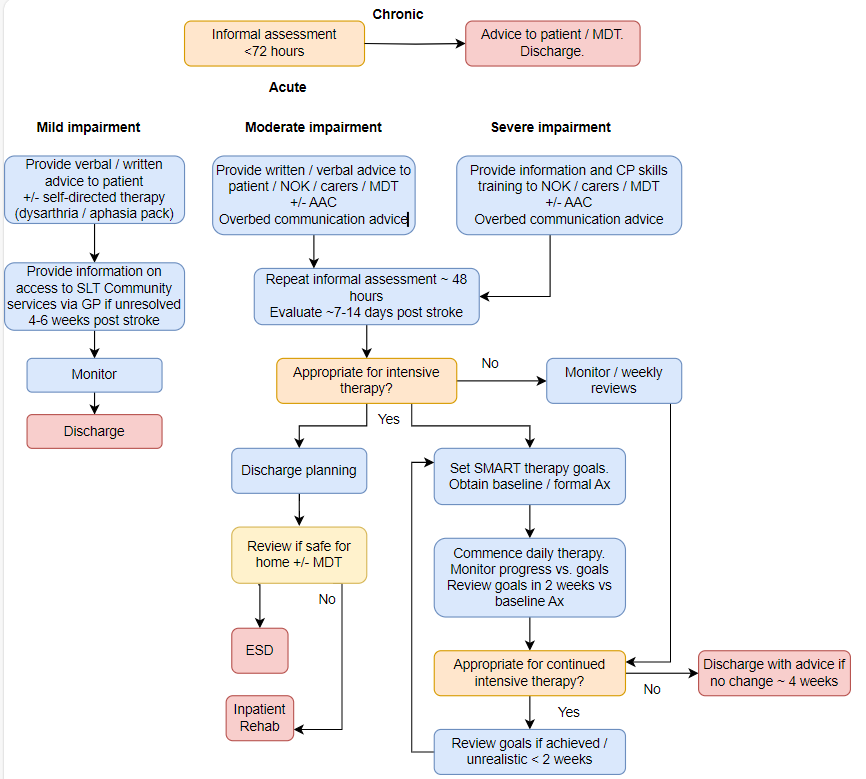
Summary flow diagram
1.0 Introduction
This guideline identifies the role of the Speech and Language Therapy (SLT) team in the assessment and management of patients with communication impairment.
Communication impairment is common when the language centres in the brain and/or cranial nerves are affected as a result of a variety of neurological disease processes. Communication diagnoses can include dyspraxia, dysphasia and dysarthria. Additionally, dysphonia can occur when there is damage to or disruption in the nerve supply to the vocal cords.
Communication disorders can range from mild to severe and in severe cases there can be profound psychosocial consequences as the individual is unable to communicate their needs, thoughts and wishes. This can be particularly distressing in an acute hospital environment. The role of the SLT is to assess and diagnose the nature of the communication impairment and work with patient, family and staff to provide general advice as to what form of communication will be optimal in the hospital setting. Patients on the stroke unit who meet the criteria will be seen for intensive rehabilitation. Appropriate onward referral will be instigated to ensure that the patient receives the necessary follow up once their acute episode is over.
2.0 Referrals
2.1 Referrals should be made via EPIC
2.2 Following receipt of referral, the patient will be prioritised according to departmental guidelines and with reference to National Stroke guidance (See Appendix ).
2.3 Referrals will be accepted for patients with an acute onset or sudden deterioration of a pre-existing communication impairment. Referrals for patients with stable chronic impairments will not usually be accepted.
2.4 Patients will be allocated by the senior staff member working that day.
2.5 New patients will be added to the current caseload whiteboard in the department with appropriate annotations that they are waiting to be assessed.
3.0 Response Times
3.1 New Stroke patients who are referred for a communication assessment will be seen within 72 hours of admission (FPH HASU)
3.2 New Stroke rehab patients (Wexham SRU) will be seen within 1 working day
3.3 Any other patient referred for a communication assessment will be seen within 2 working days of receipt of referral.
4.0 Consent
4.1 Verbal explanation of the SLT role will be given to the patient prior to SLT intervention.
4.2 Consent will be obtained verbally if possible, using supported communication as appropriate. If the patient is unable to give consent the SLT will proceed in their best interests if the patient is compliant and does not seem in any distress.
5.0 Assessment
5.1 For all patients, initial assessment will include taking a full case history, liaising with nursing staff regarding functional communication skills on the ward and carrying out an initial face to face assessment using an informal communication screen. When necessary, the SLT will also gather information on the patient’s baseline abilities from the carers/family/community SLT team.
5.2 A full formal assessment of language and communication by an SLT is recommended in the Intercollegiate stroke guideline (2023) for “any patient found to have aphasia on screening or suspected of having it on clinical grounds”.
5.3 A full formal assessment is not always possible or appropriate in either the stroke or general medical acute setting. For example if the patient is;
-
Too unwell
-
Drowsy
-
Non-compliant
-
Resolving quickly
-
Displaying very severe impairments
-
Significantly cognitively impaired
-
Affected by environmental factors e.g. noise.
In these cases, the SLT will use clinical judgement to determine the most useful form of on-ward assessment, e.g., informal observation or using sections of formal assessments in an informal manner.
5.4 Once assessed, verbal and/or written advice on how best to communicate with the patient will be provided. SLT can be contacted via the nursing staff should families/ carers require any updates or have further questions. Where appropriate written advice will be provided in the form of a laminated notice above the patient’s bed.
6.0 Ongoing intervention
6.1 Once assessed, the departmental whiteboard will be updated to reflect the patient’s care plan. The board is updated daily.
6.2 Reviews are carried out for a variety of reasons such as delivering a programme of therapy, determining if there has been any change and assisting the Multi Disciplinary team (MDT) in determining an appropriate discharge destination.
6.3 New stroke patients will be offered daily rehabilitation if they are able to tolerate it – up to 45 minutes per day. The type of therapy offered will be dependent on the patient’s needs and may be impairment based, functional and/or indirect.
6.4 Clinicians will determine if the patient is appropriate for daily 45 minute therapy sessions. Considerations will include:
-
Medical status;
-
Level of impairment;
-
Patient’s motivation and compliance;
-
Patient’s level of alertness;
-
Attention skills;
-
Ability to engage in structured tasks;
-
Ability to tolerate 45 minutes of intensive work.
6.5 Once a patient has been identified for intensive therapy, baseline measurements will be completed and SMART goals set. Goals should be clearly documented on the patients EPIC notes.
6.6 Patients who are not appropriate for intensive therapy as outlined above will receive ongoing input. The form this takes will vary and the SLT will use clinical judgement to determine appropriate intervention e.g. short therapy sessions, less intensive therapy; sessions, group sessions, review, monitoring via the MDT.
6.7 Treatment programmes for new stroke patients may be delegated to a Speech and Language Therapy Assistant to administer.
6.8 Non stroke patients do not have national targets for treatment intervention and are therefore Priority 3 (see Appendix).
6.9 Where possible a member of the SLT team will attend any MDT meetings or case conferences arranged regarding the patient as required.
7.0 Discharge
7.1 Patients will be discharged if
7.2 When a patient is transferred to another hospital for ongoing rehabilitation, a hand-over will be given along with a discharge report in the appropriate format if required.
7.3 If a patient is discharged home or to a care home, and requires ongoing communication therapy, they will be referred to the appropriate outpatient/community SLT team or Stroke Early Support Discharge service. A brief report will be sent in the appropriate format.
7.4 On discharge, if the patient has on going communication impairment but is not appropriate for further intervention, the SLT team will communicate this to the patient / carers / discharge destination as appropriate. In certain cases the patient / carers may be provided with details on how to self-refer if further input is required at a later date.
8.0 Liaison with family/carers
8.1 Stroke: The SLT team’s contact number is provided on the laminated notice placed above a patient’s bed and in the stroke information folder provided to each patient on admission. If the team receive a message from relatives/cares requesting contact / advice, the most appropriate therapist will be identified to ring back / arrange a meeting as soon as possible. Joint sessions will be offered where appropriate.
8.2 In addition, where possible, the most appropriate member of the SLT team will attend any relative clinics or case conferences booked for the patient.
9.0 Documentation
9.1 Consent will be recorded for every SLT intervention in the patient’s EPIC notes
9.2 If a patient does not consent to SLT intervention this will be recorded in the patient’s EPIC notes and discussed with the MDT. It may be appropriate to return at a later date to attempt further intervention.
9.3 Assessment findings and review contacts will be fully documented in the patient’s EPIC notes.
9.4 Contact data is recorded on EPIC and is used to inform SSNAP on performance with reports produced three times a year.
10.0 Health and Safety
10.1 All staff attending will be up to date with mandatory infection control, manual handling and basic life support training.
10.2 All staff will adhere to current infection control policies regarding PPE.
10.3 Handwashing will be carried out between patients.
References.
National Institute for Health and Care Excellence [NICE] (2023) Stroke rehabilitation in adults. NG236. Available at: https://www.nice.org.uk/guidance/ng236
National Clinical Guideline for Stroke for the UK and Ireland (2023) Intercollegiate Stroke Working Party
Appendix: Prioritisation of Referrals for Speech and Language Therapy
Priority 1 (P1)
-
Interventions required to facilitate discharge that day
-
Swallow assessment/review - NBM with no alternative feeding
-
Swallow assessment/review - on oral intake but concerns re aspiration / nutritional intake
-
Communication assessment - impairment 2* to acute stroke
Priority 2 (P2)
-
Interventions required to facilitate discharge that week
-
Swallow assessment/review - NBM with alternative nutrition in place
-
Swallow assessment/review - on limited oral intake + alternative nutrition
-
Communication assessment - impairment 2* acute illness / injury
-
Swallow review – on full oral intake but significantly off baseline (2 + steps away) with discharge paperwork in place
-
Swallow / communication rehab for stroke patient
Priority 3 (P3)
-
Swallow review - on full oral intake and near previous / new baseline with discharge paperwork in place
-
Communication assessment - impairment 2* chronic condition
-
Swallow / communication for non-stroke patient
-
Eating and drinking with acknowledged risk with discharge paperwork in place
Full version control record
This guideline has been registered with the Trust. However, clinical guidelines are guidelines only. The interpretation and application of clinical guidelines will remain the responsibility of the individual clinician. If in doubt, contact a senior colleague or expert. Caution is advised when using guidelines after the review date.
This guideline is for use in Frimley Health NHS Foundation Trust hospitals only. Any use outside this location will not be supported by the Trust and will be at the risk of the individual using it.
Version History
Related Documents
None