Key points
-
GCA is the most common large vessel vasculitis
-
It is a medical emergency and can cause blindness in up to 20% of patients
-
Patients with suspected GCA should be commenced immediately on steroids and be referred, via a fast-track pathway, to Rheumatology for further investigation and management.
-
Patients with visual disturbance require a same day referral to ophthalmology, in addition to Rheumatology.
This is a controlled document. If you are using a printed copy, check it against the guidelines site to ensure you are using the latest edition.
Print copies must be destroyed after use.
Abbreviations
What is Giant Cell Arteritis?
Giant cell arteritis (GCA), also known as Temporal Arteritis, is the commonest large vessel vasculitis with a predilection for temporal arteries and the aorta. GCA is a medical emergency. It is a common cause of acute blindness with visual loss occurring in up to 20% of patients with GCA. If one eye is affected there is a high risk (up to 50%) of bilateral visual loss and total blindness without appropriate treatment. GCA can also be associated with aortitis which can present as systemic upset, limb claudication, bruits and asymmetrical pulses and blood pressure.
Classic Features of GCA
These may not all be present. GCA may not present in a textbook way.
Suspicion of GCA
- Age over 50? (GCA extremely unlikely under the age of 50)
- Abrupt onset unilateral/temporal headache
- Scalp tenderness
- Jaw / tongue claudication
- Visual disturbance (amaurosis fugax / diplopia / blurred vision)
- Symptoms of PMR
- Limb claudication
If the patient does not meet the criteria above, consider an alternative diagnosis.
Consider wide range of differential diagnoses if not classical features, particularly if CRP normal or age below age 50. For example:
- Herpes Zoster (Shingles)
- cluster headache or migraine
- acute angle closure glaucoma
- retinal transient ischaemic attack and embolic visual deficits
- TMJ pain
- sinus disease
- ear problems
- cervical spondylosis
- upper cervical spine disease
- myeloma
- serious intracranial pathology
- connective tissue disease
(NICE CKS GCA).
Patient with suspected GCA
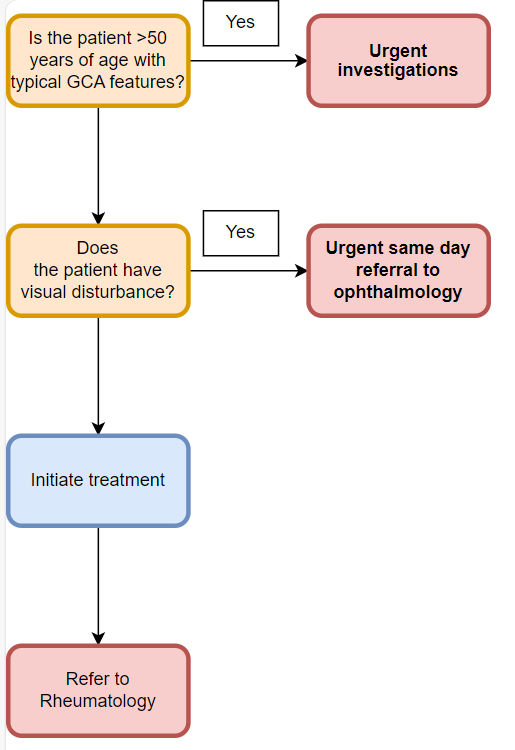
Urgent investigations
FBC, U&E, LFT, bone profile, CRP, ESR, immunoglobulins, HbA1C
Urgent same day referral to ophthalmology
in addition to initial investigations - Wexham/Frimley Eye casualty, ext. 136854
Initiate treatment
Do not delay starting steroids in those with strong clinical suspicion for GCA or in context of visual disturbance
Refer to Rheumatology
Wexham
-
If ED/acute med - refer via Epic and, 9am -5pm Mon – Fri, contact Rheumatologist of the week or Rheumatology registrar via switchboard or rheumatology phone 07956185484.
-
GP – Contact Rheumatologist of the week or Rheumatology registrar via switch within working hours. Send written referral on ERS.
Rheumatology Onward GCA Pathway
Wexham Park
Patient referred via ED/Ambulatory Care/GP to rheumatology consultant of the week
To request F2F appointment
To request Urgent USS temporal artery
-
Request as urgent on Epic under Ultrasound doppler
-
Inform the radiology appointments team on fhft.radiologyusscanshwph@nhs.net. This is key, as otherwise the request will not be prioritised.
-
It will be booked in for within 7 days of receiving request and email
To request temporal artery biopsy
-
Contact on call surgical consultant or ambulatory care surgeon requesting a TAB. Specify laterality of the artery.
-
Surgeon will book on Epic
-
Waiting list team will contact patient to arrange local anaesthetic biopsy and notify rheum consultant via email regarding date of biopsy. Anticoagulation and clopidogrel must be stopped.
-
Patient has biopsy as a day case. Sample sent for histology. No surgical follow up unless wound issue, infection, or bleeding.
Frimley Park
Patient referred via ED/Ambulatory Care/GP to rheumatology
To request Urgent USS temporal artery
- Temporal artery US – daily reserved slot available at 1300. Please contact sonographer in AECU or Vascular Ultrasound (by ward F2) and ask in person
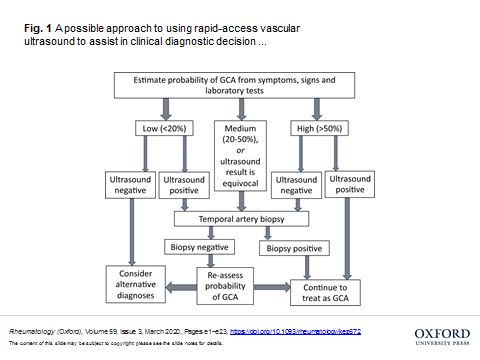
See decision flow chart above
To request temporal artery biopsy
- Contact vascular team SpR on 133727. This should only be done after discussion with Rheumatology
Management
A typical glucocorticoid tapering schedule for GCA
- Aim to reach 20 mg prednisolone once the patient has been in remission for 4–8 weeks
- If symptoms suggestive of GCA relapse occur during taper step up as below
Examples of symptoms that may signify relapse of GCA during glucocorticoid taper that require further evaluation and, if judged to be due to GCA relapse, escalation of glucocorticoid treatment
2010 BSR Guideline for GCA
Glucocorticoid-Sparing agents
Methotrexate
MTX might be considered for GCA, in combination with a glucocorticoid taper, in patients at high risk of glucocorticoid toxicity or who relapse. There is insufficient evidence to recommend any other oral immunosuppressive agent in GCA, including azathioprine, leflunomide or mycophenolate mofetil. (BSR Guideline 2020)
Tocilizumab
Tocilizumab can be considered for GCA, in combination with a glucocorticoid taper, especially in patients at high risk of glucocorticoid toxicity or who relapse. TNF inhibitors are not recommended in GCA. (BSR Guideline 2020)
Tocilizumab, when used with a tapering course of glucocorticoids (and when used alone after glucocorticoids), is recommended as an option for treating giant cell arteritis in adults, only if:
-
they have relapsing or refractory disease
-
they have not already had tocilizumab
-
tocilizumab is stopped after 1 year of uninterrupted treatment at most and
-
the company provides it with the discount agreed in the patient access scheme.