Key Points
-
A quarter of the world’s population are estimated to be infected with latent (dormant) tuberculosis infection (LTBI) which may reactivate resulting in active TB disease
-
Targeted and biologic drugs modify the action of the immune system to supress inflammation but can also affect pathways that protect against infection
-
Some of these drugs increase the chances of reactivation of LTBI, some have no proven risk, and others carry an indeterminate risk – this guideline includes a traffic light guide detailing which drugs require TB screening prior to initiation
-
Screening for latent TB infection is conducted even in patients with no known TB exposure so that prophylactic treatment can be given to reduce the risk of reactivation to active TB disease
-
Screening tests can be falsely negative, especially in immunosuppressed patients. Advice should be given about symptoms of active TB infection, and treating teams should be vigilant for these developing during treatment, particularly in those with risk factors for TB infection
Abbreviations
Summary
This guideline will simplify the process of TB screening prior to targeted and biologic agent prescribing. It outlines the process of screening and which groups of patients require it.
Introduction
Targeted and biologic agents including anti-TNF drugs (e.g. adalimumab) are being recommended for an increasing number of inflammatory and malignant conditions e.g. Inflammatory Bowel Disease, Rheumatoid Arthritis and Psoriasis. These drugs modify the action of the immune system to supress inflammation but can also affect pathways that protect against infection. The recent decade has seen a significant expansion in the number of agents available, the molecular targets of the drugs, and the diseases that have been demonstrated to respond to these treatments.
A quarter of the world’s population are estimated to have latent TB infection (LTBI), with the highest rates being in those born outside the UK in areas of high TB incidence [1,2]. Some immunomodulatory agents have an associated risk of reactivating this latent infection into active TB disease.
Screening for latent TB is required so that prophylactic treatment can be given to substantially reduce the risk of reactivation to active TB disease. Some immunomodulators have no proven association of LTBI reactivation, and others carry an indeterminate risk. For the agents with an indeterminate risk there is no clear guidance regarding who should be tested, and unnecessary testing leads to uncertainty for both clinicians and patients. This evidence-based guideline simplifies the screening process by dividing the agents into high, intermediate and low risk with a red, amber and green traffic light system which will allow prescribing specialists to determine who to screen and which drugs carry the highest risk of reactivating latent TB disease.
Scope
This applies to all specialties that prescribe targeted and biologic drugs and the respiratory teams who review patients with suspected active or latent tuberculosis.
Full Guideline
The Targeted and Biologic Drug Traffic Light Drug List for TB Risk denotes which patients require TB screening (Appendix A).
Patients who are prescribed a ‘GREEN’ biologic drug DO NOT require a TB screen before commencing treatment.
Patients who are prescribed a ‘RED’ or ‘AMBER’ biologic drug DO require a TB screen before commencing treatment.
‘AMBER’ drugs represent a lower risk of TB reactivation than ‘RED’ drugs and where possible these should be selected in preference to ‘RED’ drugs in cases where patients are considered to have a risk of TB reactivation and prophylaxis has not been given (i.e., when biologic treatment is required urgently).
Steroids and immunosuppressants such as methotrexate, mycophenolate, and cyclophosphamide do not require LTBI screening as routine. Further information about non-biologic immunosuppressant drugs and whether TB screening is required can be found at www.medicines.org.uk/emc ([5] search for the drug, then under ‘clinical particulars’, and ‘special warnings and precautions for use’ - TB will be specifically listed if screening is required).
When a patient is offered a drug that does not require LTBI screening but there is a high chance they will be offered a drug that DOES require this in the future, it is reasonable to offer LTBI testing prior to any immunosuppression because the testing is likely to be more accurate.
TB Screening Pathway
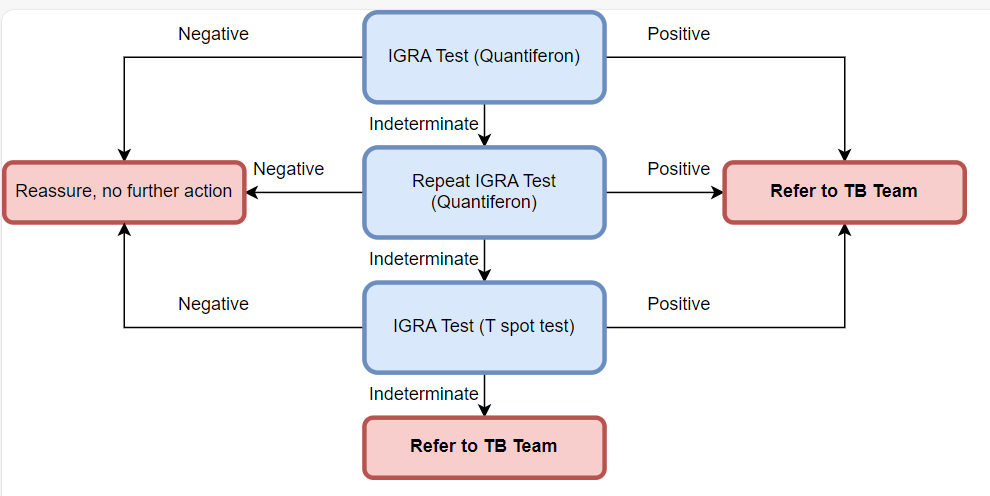
If patient is to receive an AMBER or RED drug, please follow the screening pathway in Appendix B.
It is imperative that the screening team asks the patient about symptoms of active TB infection and organises the necessary investigations if present (detailed on the screening pathway).
It is acknowledged that there is a risk of false-negative Interferon-gamma (IGRA) testing, particularly in patients who are taking immunosuppressants, or have taken them in the recent past. On reviewing 21 years of experience of using biologic therapy in Rheumatology at Wexham Park Hospital with IGRA screening beforehand, to our knowledge only two patients in this timeframe have presented with active TB infection following a negative screening result. We have therefore opted to treat based on IGRA testing rather than the likelihood of previous TB exposure, although this will be kept under constant review.
People born in areas of the world with a high TB incidence, or those who have spent 3 months or more living in areas with high TB incidence [1, 2] have a higher risk of having latent TB infection. Clinical teams should be particularly alert to the possibility of these patients developing symptoms of active TB infection if they have tested negative on IGRA screening. Active TB symptoms are notably: constitutional symptoms such as loss of appetite, weight loss, fevers and night sweats, and persistent symptoms from the site of disease such as a persistent cough, enlarged or painful lymph node or soft tissue swelling, abdominal pain or distention (including ascites) or severe spinal pain.
Referrals
Referrals to the TB team should be made using the Epic order ‘Outpatient referral to TB’ and must include the name of the intended biologic treatment. We endeavour to see patients within 4-6 weeks of referral; for more urgent referrals please contact the TB team directly as well as submitting a referral.
Duration of Treatment
Treatment of LTBI usually takes 12 weeks to complete. It is recommended that patients wait until TB treatment has been completed before starting biologic therapy. The risk of reactivating TB reduces the further into the course the patient can get before starting biologic treatment; this risk should be balanced with the urgency of treating their underlying disease. LTBI testing and treatment should never delay the urgent treatment of serious disease and can be done in parallel if required. Completing even one month of LTBI treatment prior to starting biologic treatment has been shown to be preferable to not starting treatment at all with regards to preventing reactivation of TB disease. The TB teams are happy to discuss individual cases to assist in decision-making in this regard.
Palliative Patients
LTBI testing can be performed in patients who are being treated with palliative intent, however these patients are unlikely to benefit from LTBI treatment (with its possible side effects) because TB reactivation risk is cumulative over years of a lifetime. TB reactivation has been reported after only short courses of immunomodulating treatments, so identifying LTBI in this subgroup is helpful because it will lower the threshold for TB-specific investigations should any symptoms or signs of active TB disease arise during the course of treatment. Treatment of active TB can help improve symptoms of cough, fevers and night sweats for example, and improve quality of life.
Chemotherapy
When prescribing chemotherapy please refer to the Electronic Medicines Compendium www.medicines.org.uk/emc [5] for LTBI screening requirements for individual agents.
Additional Advice
Please contact the TB teams for further information:
Wexham Park: fhft.tbteamwexham@nhs.net 0300 614 6070
Frimley Park: fhft.frimleytbteam@nhs.net 0300 613 3739
Referrals via Epic EPR: “Outpatient referral to TB”
Appendix A: The Targeted and Biologic Drug Traffic Light Drug List for TB Risk.
Adapted from Imperial College Healthcare NHS Trust Tuberculosis Screening for Targeted & Biologic Agents FINAL version Sept 2020
Key: red is proven higher risk for TB reactivation, green relatively low risk and amber uncertain [3,4]
*In studies in rheumatoid arthritis; ** Psoriatic arthritis and Ankylosing spondylitis meta-analysis [6].
***Evidence unclear, consider testing in additional risk factors; SPC: Summary product characteristics ; ESGICH: European society of Clinical Microbiology and Infectious Diseases Study Group for Infections in Compromised Hosts
Other immunomodulatory Drugs used for the treatment of Multiple sclerosis
Appendix B: TB Screening Flowchart Before Biologic/Targeted Therapy
Abbreviations
Points to consider when considering starting biologic treatment:
-
Try to screen for TB before starting immunosuppression
-
Ideally hold off biologic therapy until TB treatment completed (usually 3 months in latent TB), although in some cases parallel treatment is required
-
In extreme cases, biologic treatment should not be withheld whilst TB screening takes place.
Screening Steps
-
Arrange a chest x-ray (CXR)
-
Screen for active TB symptoms:
-
Loss of appetite, weight loss, fevers, drenching night sweats
-
Cough > 3 weeks, node or soft tissue swelling, other site-specific symptoms of TB (e.g., spine/abdomen)
Refer urgently to TB team if symptomatic or abnormal CXR, if productive cough send 3 sputum samples for AFB smear and culture and 1 for TB PCR
-
If past history of TB treatment, only screen for active TB (as above) as IGRA test is unhelpful.
-
Then follow flow chart below
References
-
UK Health Security Agency (2022) Tuberculosis by country: rates per 100,000 people. Available at: https://www.gov.uk/government/publications/tuberculosis-tb-by-country-rates-per-100000-people (Accessed: 05 January 2023).
-
Ding, C. et al. (2022) 'Prevalence trends of latent tuberculosis infection at the global, regional, and country levels from 1990-2019', International Journal of Infectious Diseases, 122, pp. 46-62. Available at: https://doi.org/10.1016/j.ijid.2022.05.029
-
UK Health Security Agency (2017) Contraindications and special considerations: the green book, chapter 6. Available at: https://www.gov.uk/government/publications/contraindications-and-special-considerations-the-green-book-chapter-6 (Accessed: 05 January 2024)
-
Fernández-Ruiz, M. et al. (2018) 'ESCMID Study Group for Infections in Compromised Hosts (ESGICH) Consensus Document on the safety of targeted and biological therapies: an infectious diseases perspective (Introduction)', Clinical Microbiology and Infection, 24 (Suppl 2), pp. S2-S9. Available at: https://doi.org/10.1016/j.cmi.2018.01.029
-
Electronic medicines compendium. Available at: https://www.medicines.org.uk/emc (Accessed: 05 January 2024).
-
Cantini, F. et al. (2017) 'Risk of tuberculosis reactivation in patients with rheumatoid arthritis, ankylosing spondylitis, and psoriatic arthritis receiving non-anti-TNF-targeted biologics', Mediators of Inflammation, 2017, article number 8909834. Available at: https://doi.org/10.1155/2017/8909834 Cantini, F. et al. (2017) 'Risk of tuberculosis reactivation in patients with rheumatoid arthritis, ankylosing spondylitis, and psoriatic arthritis receiving non-anti-TNF-targeted biologics', Mediators of Inflammation, 2017, article number 8909834. Available at: https://doi.org/10.1155/2017/8909834
Full version control record
This guideline has been registered with the trust. However, clinical guidelines are guidelines only. The interpretation and application of clinical guidelines will remain the responsibility of the individual clinician. If in doubt, contact a senior colleague or expert. Caution is advised when using guidelines after the review date.
This guideline is for use in Frimley Health Trust hospitals only. Any use outside this location will not be supported by the Trust and will be at the risk of the individual using it.
Version Control Sheet
Related Documents
None