Key Point
Pleurodesis should only be performed under the guidance of the Chest Physicians or Oncologists.
This is a controlled document. If you are using a printed copy, check it against the guidelines site to ensure you are using the latest edition.
Print copies must be destroyed after use.
Abbreviations
Procedure
N.B. Using sterile technique
Pre-procedure preparation
1 x assistant
Materials Required
4g vial of sterile talc
20mls 1% Lidocaine
100ml bag of 0.9% normal saline
20ml syringe x 2
50ml luer lock syringe
Sterile pack
Green needle x 3
Sterile gloves x 2
Anaesthetise the pleura
Pleurodesis
Prepare the talc slurry
-
Draw 50mls 0.9% normal saline into the 50ml syringe
-
Upside down, remove the needle from the end of the syringe and almost withdraw the plunger
-
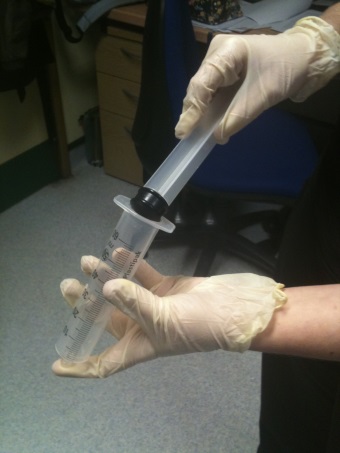
Place a finger over the end of the 50ml syringe, turn downward and pull the plunger out of the top of the syringe (as illustrated)
-
Ask your assistant to pour the talc into the top of the 50ml syringe
-
Place the plunger back into the syringe, turn it upside down and shake the syringe to mix its contents.
-
Inject the mixture into the drain
-
Flush the drain with 20 ml of normal saline
-
Close the 3-way tap for 1 hour
Post Procedure
-
After 1 hour, open the drain to the underwater seal bottle.
-
The chest drain can be removed when output is less than 150mls/day (excluding flushes) or 24-48 hours post procedure.
-
Make sure that prophylactic Low Molecular Weight Heparin is prescribed (unless contraindicated).
-
Prescribe analgesia (Paracetamol, Codeine - not NSAIDs).
-
Prescribe 10mls Normal Saline drain flushes qds.
Observations: ask the nursing staff to perform ½ hourly observations for 2 hours and then 6 hourly, and inform a doctor if the patient becomes unwell.
Other Considerations
Concomitant medications- systemic corticosteroids may decrease the success of talc pleurodesis due to their anti-inflammatory properties, as can (potentially) NSAIDs.
Reference
Roberts, M.E. et al. (2023) 'British Thoracic Society Guideline for pleural disease', Thorax, 78(Suppl 3), pp. s1-s42. Available at: https://doi.org/10.1136/thorax-2022-219784
Full version control record
This guideline has been registered with the Trust. However, clinical guidelines are guidelines only. The interpretation and application of clinical guidelines will remain the responsibility of the individual clinician. If in doubt, contact a senior colleague or expert. Caution is advised when using guidelines after the review date.
This guideline is for use in Frimley Health NHS Foundation Trust hospitals only. Any use outside this location will not be supported by the Trust and will be at the risk of the individual using it.
Version History
Related Documents
None