Summary
Pain measurement using the verbal descriptor scale
0 = No pain
1 = Mild pain
2 = Moderate pain
3 = Severe pain
Functional activity score FAS (adapted from LTHT5)
When to assess pain
- On admission - establish baseline pain level and history
- During routine observations and interactions
- On rest and movement
Referral to the inpatient pain team
Analgesia should be titrated to optimise function rather than reduce pain intensity
Patients with pain scores persistently 2 or 3 (moderate or severe) despite regular administration of analgesia are to be referred to Inpatient pain team:
WPH Inpatient Pain Service
Monday – Saturday 08:30 – 16:30. Ext: 154435 - please leave a message
- New inpatient referral can be made via EPIC orders: Inpatient consult to pain management
- For enquiries in working hours please EPIC message: WPH Acute pain team
Out of hours medical staff could contact on-call anaesthetist mobile 07824012652 or referral by EPIC.
FPH Inpatient Pain Service
Monday – Saturday 08:30 – 16:30 Ext: 132642 – please leave a message
- New inpatient referral can be made via EPIC orders: Inpatient consult to pain management
- For enquiries in working hours please EPIC message: FPH Acute pain team
Out of hours medical staff could contact on-call anaesthetist on bleep 5002
HWD Inpatient Pain Service
Tuesday – Saturday 08:30 – 16:30 Please refer to the inpatient pain team via Epic or call mobile 07776633562.
HWH On call anaesthetic cover Monday-Saturday bleep 2501- or ring mobile 07787002726 - (10:00-22:00)
Out of hours medical staff could contact on-call anaesthetist at WPH on 07824012652.
Definition of terms
- “Pain is an unpleasant sensory and emotional experience, associated with, or resembling that associated with, actual or potential tissue damage” (1)
- Pain is always a personal experience that is influenced to varying degrees by biological, psychological, and social factors.
- Although pain usually serves an adaptive role, it may have adverse effects on function and social and psychological well-being.
- Verbal description is only one of several behaviours to express pain; inability to communicate does not negate the possibility that a human experiences pain” (1)
Pain assessment: is a multidimensional observational assessment of a patient’s experience of pain.
Pain measurement tools: instruments designed to measure pain
Assessment
Pain assessment is a broad concept involving clinical judgement based on observation of the type, significance and context of the individual’s pain experience.
It is the responsibility of every healthcare professional to assess a patient’s pain using a recognized pain assessment tool to provide effective and timely pain management. Administration of analgesia should facilitate function such as deep breathing, coughing or engaging in rehabilitation, not to completely alleviate pain (2).
Self-report is the gold standard for pain assessment.
Assessing pain may be challenging for patients with cognitive impairment, communication difficulties or language and cultural barriers. In these cases, age-specific and person-centred pain assessment should be used.
Benefits of pain assessment
Consistent and accurate pain assessment provides the foundation for appropriate pain management and supports improved patient outcomes. Key benefits include:
- Improved patient comfort and wellbeing
- Informed clinical decision-making
- Evaluation of treatment effectiveness
- Prevention of clinical complications
- Enhanced patient safety
- Strengthen communication and continuity of holistic care
- Support for patient-centred care
When to assess pain
- On admission - establish baseline pain level and history
- During routine observations and interactions
- On rest and movement
- During procedures or treatments
- After analgesics are administered
- IV medications: Reassess pain in 15-30 minutes.
- Oral medications: Reassess pain in 60-90 minutes.
- Continue reassessment until pain is adequately managed.
- If pain is not controlled - increase the frequency of pain assessments
- With changes in condition - reassess pain when there are sudden changes in vital signs, agitation, confusion, or functional decline.
- Regularly assess pain to evaluate the effectiveness of analgesics. Proactively offer PRN analgesia before potentially painful experiences such as mobilization and physiotherapy.
- If the patient is using specific pain management methods like regional, epidural or patient-controlled analgesia, follow the specific Trust guideline for pain assessment
Assessment process
The aim of the assessment process is to identify all the factors, both physical and non-physical, that affect a patient’s perception of pain.
- Establish baseline pain level and history.
- Explore the history of the presenting complaint with the help of the SOCRATES structured framework:
S - Site
O - Onset
C - Characteristic
R - Radiation
A - Associated symptoms
T - Time/duration
E - Exacerbating/relieving factors
S - Severity
Discuss causes of pain, known expressions of pain (including behavioural changes), preferred and failed treatments.
Pain assessment tools
At Frimley Health NHS Foundation Trust there are many pain assessment tools available which have been developed specifically for use in different patient groups (e.g. children/young people, adults, older people and people with cognitive impairment).
Careful consideration is required to ensure that the appropriate assessment tool is selected for each individual patient.
Use age-appropriate or condition-specific tools for:
- Infants and children
- Cognitively impaired patients
- Non-verbal patients
- Patients receiving palliative or end-of-life care
Children/young people
There are three main tools used for the neonate, infant and child 3-18 years - these tools reflect a combination of self-report and behavioural assessment:
Important
Under review: this mentions tools for the neonate, but the youngest tool on this page, FLACC, starts at 2 months. See Questions for the authors.
Careful consideration needs to be given:
- cognitive ability
- environment (hospital)
- anxiety
- cause of pain (eg: post-operative)
1. FLACC
2 months-7 years and used for up to 18 years for children with cognitive impairment and/or developmental disability. It is important to take behavioural cues identified by parents and caregivers to improve pain assessment in children.
Note: Each of the five categories Face (F), Legs (L), Activity (A), Cry (C) and Consolability (C) is scored from 0-2, which results in a total score between 0-10 (Merkel et al 1997).
2. Wong-Baker faces pain scales – 3-18 years old – Self-report
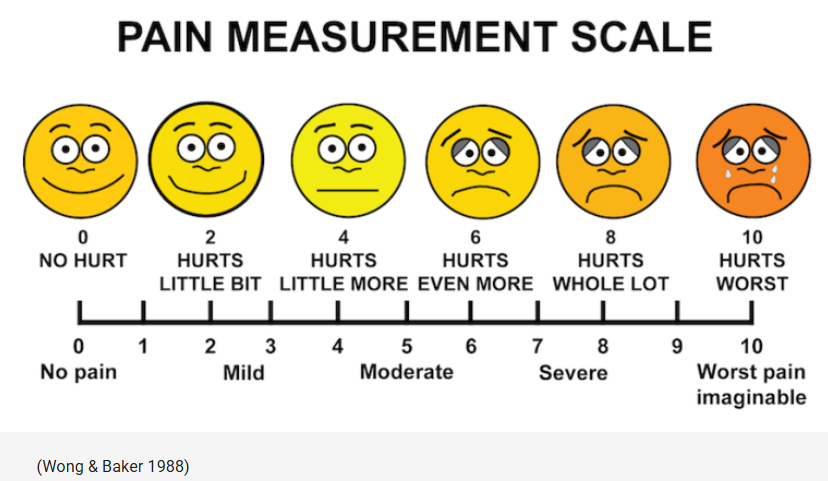
3. Visual analogue scale – 8 years and older – Self-report
Ask the child using numbers from 0=no pain through to 10 being the worst pain

Adults
The verbal descriptor scale, also known as a verbal rating scale, is a commonly used method for assessing pain. This scale asks the patient to describe their pain intensity using words. It can range from a simple scale with few options (no pain, mild pain, moderate pain, severe pain) to a more detailed scale with additional word choices to express different levels of pain.
The patient chooses the word that best describes their level of pain. Using a verbal descriptor scale provides a more detailed understanding of the pain, allowing you to gain a better insight into the patient’s experience. Verbal descriptor scales can be helpful when patients find it challenging to use numerical scales.
Patients who are able to communicate, including those with mild cognitive impairment
Verbal Descriptor Scale
0 = No pain
1 = Mild pain
2 = Moderate pain
3 = Severe pain
Numerical Rating Scale – 0-10
0 = no pain 10 = worst pain ever

Patients who are non-speaking or language barriers
Faces – patients can point to the faces to indicate what level of discomfort they are experiencing
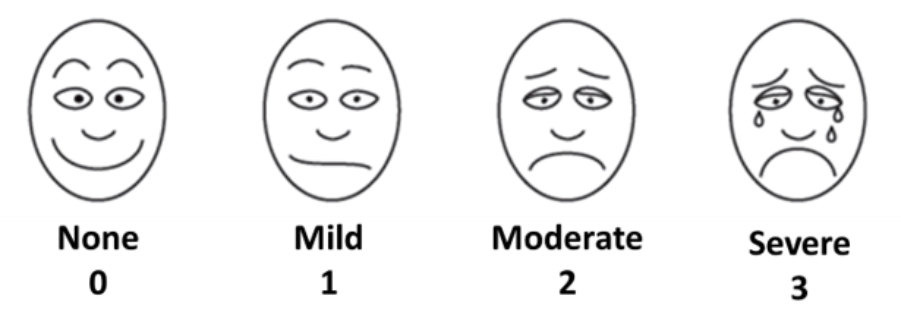
Bolton Pain Assessment Tool – observes patients' behaviours and physiological signs
- Establish baseline behaviour on admission, with input from family carers
- Utilise and refer to the ‘This is ME’ booklet containing personal information
- Consider factors including pain location, onset, triggers, characteristics, severity, relieving/exacerbating factors, and associated symptoms
Important
Under review: the bands go from 3-7 (mild) to 9-13 (moderate), so a score of 8 is in no band. The Trust's Bolton Pain Assessment Tool on EPIC sheet gives 3-8. See Questions for the authors.
Functional Pain Assessment
It is now recognised that the sole use of the numerical pain score to guide analgesic interventions may lead to harm through overuse of opioids, leading to oversedation and increasing the risks of opioid use disorder. (3)
There is uncertainty regarding the comparative efficacy of unidimensional pain assessment tools, and it is increasingly recognised that pain assessment used to guide analgesic management should be based on function. (4)
Functional pain assessment focuses on how pain affects a patient’s ability to perform daily activities, participate in therapy, and maintain physical, emotional, and social functioning. It complements traditional pain scoring by offering a more holistic and clinically meaningful picture of the patient’s condition.
LTHT Functional Activity Score (FAS) (5)
When assessing mobility please consider patient’s baseline
Why Functional Pain Assessment Matters
- Provides clinically relevant information beyond a numerical pain score.
- Better reflects real-world patient needs and rehabilitation progress.
- Improves interprofessional communication—especially between nursing, physiotherapy, and medical staff.
- Supports patient-centred care and measurable outcome tracking