Key Points
-
Women in the third trimester are at higher risk of developing hyponatraemia than non pregnant women.
-
Hypotonic hyponatraemia or ‘dilutional hyponatraemia’ can occur during labour due to excessive oral and intravenous fluid intake.
-
Maternal hyponatraemia can present with non-specific signs and symptoms and an acute fall in sodium level can result in life-threatening symptoms.
-
Dilutional maternal hyponatraemia can also lead to neonatal hyponatraemia leading to seizures and apnoea.
-
Increased awareness, accurate fluid balance and early detection is key.
This is a controlled document. If you are using a printed copy, check it against the guidelines site to ensure you are using the latest edition.
Print copies must be destroyed after use.
Abbreviations
1. Introduction
Women during labour are at higher risk of developing hyponatraemia than non pregnant women due to a lower baseline plasma sodium, an inability to excrete water in the third trimester and exposure to the anti-diuretic effect of oxytocin1.
An additional, important risk factor is the total volume of intravenous and oral intake during labour causing a dilutional hyponatraemia otherwise known as hypotonic hyponatraemia. The risk of hyponatraemia increases with increasing fluid intake, with those receiving less than 1 litre in labour being less likely to develop hyponatraemia than those who receive more than 2.5 litres (1% vs 26%)1,2.
Maternal hyponatraemia can present with non-specific signs and symptoms that can often be attributed to pregnancy and labour (table 1). An acute fall in sodium level can result in cerebral oedema and life-threatening symptoms. Dilutional maternal hyponatraemia can also lead to neonatal hyponatraemia due to the free passage of water across the placenta causing a lowered fetal blood sodium concentration. This can lead to serious neonatal implications including seizures and apnoea2.
Table 1: Signs and symptoms of maternal hyponatraemia
2. Definitions
Hyponatraemia in pregnancy as defined as a blood sodium concentration below 130 mmol/L. This guideline focuses on the prevention and management of dilutional hyponatraemia caused by excess fluid intake in labour and the peripartum period.
3. Prevention and Diagnosis of Hyponatraemia in Labour
Healthy labouring women in a neutral fluid balance are the least likely to develop hyponatraemia. It is therefore important to measure fluid balance during labour and clearly document when blood sodium testing is necessary.
4. Guidance on Peripartum and Intrapartum Fluid Balance
4.1 The importance of accurate fluid balance monitoring during labour should be explained to all women.
4.2 Fluid balance observations should be commenced and recorded on a fluid balance chart.
4.3 Women should have oral intake documented at least 4 hourly.
4.4 Women should have intravenous (IV) intake documented hourly.
4.5 IV fluids should have a documented reason and be prescribed in millilitres (mls) per hour and administered by volumetric pumps.
4.6 IV fluids are not routinely required with epidural analgesia.
4.7 Women should be encouraged to void 2-4 hourly to have urine volume measured and recorded.
4.8 Women should have other fluid losses (e.g., vomit) measured and recorded.
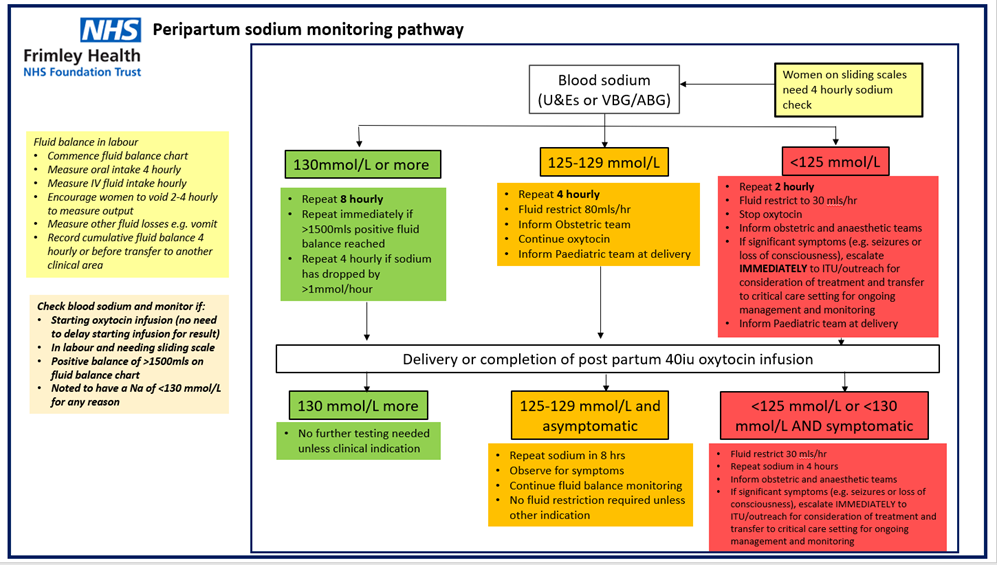
4.9 Women require a blood sodium level and sodium monitoring (see Peripartum Sodium Monitoring Pathway – Appendix 1) if:
i. An oxytocin infusion is started (for augmentation or treatment of post partum haemorrhage),
ii. In labour and requiring IV insulin and dextrose,
iii. Greater than 1500 mls positive balance,
iv. Noted to have a serum sodium of <130 mmol/L for any reason.
4.10 Where a woman has been labouring on the Birth Centre and found to be in positive balance of >1500mls, a sodium level should be checked and if <130mmol/L, an obstetric review should be requested to assess for transfer to Labour ward.
4.11 Before transfer to another clinical area (e.g., labour ward to post natal ward), a cumulative balance total should be recorded on the fluid balance chart.
5. Sodium Monitoring
Peripartum (see Peripartum Sodium Monitoring Pathway – Appendix 1)
5.1 A sodium level (either serum sample for U&Es or VBG/ABG), should be measured if:
i. An oxytocin infusion is started (for augmentation or treatment of post partum haemorrhage),
ii. In labour and requiring IV insulin and dextrose,
iii. Greater than 1500 mls positive balance
iv. Noted to have a serum sodium of <130 mmol/L for any reason
5.2 It is not necessary to wait for the result before starting an oxytocin infusion.
5.3 Ensure blood samples are not taken from a limb attached to intravenous fluids as this will lead to inaccurate results.
5.4 If sodium levels are equal or greater than 130 mmols/L, further testing can occur 8 hours later.
5.5 4 hourly monitoring is required if changes in sodium concentration is greater than 1 mmol/L per hour (e.g. 10mmol/L over 8 hours).
5.6 Women requiring sliding scale infusions (insulin/dextrose) should have a sodium level checked at least 4 hourly.
5.7 A further sodium level should be checked immediately if a fluid balance of more than 1500mls is reached.
5.8 The paediatric team should be informed of any babies born to hyponatraemic mothers.
5.9 If a sodium level is <125 mmol/L, oxytocin should be stopped and senior clinical review requested.
Postpartum
Once a blood sodium level is equal or > 130mmol/L, no further checks are required unless clinically indicated.
6. Management of Symptomatic Hyponatraemia
6.1 In patients with significant clinical signs (e.g., seizures, loss of consciousness) thought to be secondary to hyponatraemia, immediate escalation to ITU/outreach is required for consideration of 200 mls of 2.7% saline given as a bolus over 30 minutes.
6.2 Further multi-disciplinary discussion involving senior obstetricians, anaesthetists and ITU/outreach is required to guide further treatment and consider 20 mg IV Frusemide if fluid overloaded.
6.3 Following administration of hypertonic saline, monitor sodium levels 2-4 hourly, aiming for a rise of no more than 12 mmol/L in 24 hours.
6.4 Rapid increases in blood sodium concentration can cause serious harm including central pontine myelinolysis.
6.5 Transfer woman to critical care environment for ongoing management.
Appendix 1 - Peripartum Sodium Monitoring Pathway