All HIV positive women should have a care plan as to their mode of delivery. It is well documented that pre-labour caesarean section significantly reduces the risk of transmission from mother to child when the viral load is detectable >50 copies/mL and this had become the standard of care in UK. However, with the introduction of ART women who have an undetectable plasma HIV-1 and/or HIV-2 RNA vaginal delivery is recommended unless there are obstetric reasons to the contrary. 4,5,6,7 If vaginal delivery is planned a shorter interval between rupture of membranes and delivery will reduce the risk of transmission from mother to baby.
Offer caesarean section to women:
Discuss caesarean section with women
Explain there is no reduction in the rate of mother to child transmission with caesarean section for women
On the day of delivery (SVD or CS), please take one EDTA purple bottle for Maternal HIV viral load. (This result will be available after delivery). On Epic order [HIV viral load].
If a vaginal delivery is planned:
-
Inform on call obstetric team
-
Use universal precautions (see below) including eye protection for managing all patients
-
HIV is not an indication for continuous electronic fetal monitoring
-
Try to leave membranes intact for as long as possible.
-
If SRM in labour, have a low threshold to augment.
-
If ARM is needed for augmentation, start oxytocin straight after the ARM (unless contracting frequently already).
-
Continue the woman’s normal antiretroviral drugs during labour
-
Check the woman’s care plan to see if an intrapartum zidovudine infusion is necessary (see below).
-
Avoid ARM (artificial rupture of membranes) unless in the 2nd stage and delivery is imminent
-
Avoid the use of fetal scalp electrode (FSE)
-
Cord clamping can be delayed
-
In the case of need for instrumental delivery, forceps are advisable as they are associated with less fetal scalp trauma. If choosing to use ventouse, a silastic or silk cup is preferable over a Kiwi or metal cup, but the preference is to use forceps.
-
Individuals who choose to give birth in water should be supported to do so where the viral load is <50 copies/mL
-
Universal precautions – All staff assisting in the delivery as well as all theatre staff must wear eye protection, masks and aprons until the baby is delivered and any bleeding is under control. Staff scrubbed in should use double gloves and blunt needles (9997) for closing the uterus and rectus sheath.

Intrapartum IV zidovudine should be used:
-
For women with viral load > 1000 HIV RNA copies/ml plasma who present in labour or with SROM or admitted for planned caesarean section.
-
Untreated women presenting in labour or with SROM where viral load is not known.
-
Can be considered in women on ART with HIV viral load 50-1000 RNA copies/ml
-
IV zidovudine should be given for the duration of labour until the cord is clamped.
If there is pre-labour rupture of membranes:
-
Confirm with speculum and take HVS
-
If planned for vaginal delivery augment immediately with oxytocin as prolonged rupture of membranes increases the risk of transmission
-
If very unfavourable and there is a low probability of delivery within ten hours consider CS
-
If planned for CS expedite as soon as possible
If planned for pre-labour CS and requiring IV zidovudine:
-
Admit the woman the night before the delivery and site an IV cannula
-
Commence zidovudine at 06.00 hours to run for 4 hours prior to CS if the mother’s HIV viral load is >50 copies/mL (see below)
-
Do not discontinue any other antiretroviral drugs
-
Blunt needles (9997) should be used to close the uterus and rectus sheath.
-
ST 3-7 experienced in caesarean section or consultant to do the caesarean section
-
If a woman with a planned pre-labour CS attends in advanced labour, consider vaginal delivery if it is likely to occur within 4 hours. Give Zidovudine as per protocol.
Zidovudine infusion
-
If intrapartum zidovudine is planned it should be commenced at the onset of labour or 4 hours prior to CS and stopped when the cord is clamped.
-
The usual dose is 2mg/kg (based on pre-pregnancy weight) for 60 minutes using an infusion pump, followed by a continuous intravenous infusion of 1mg/kg/hour
-
Add the contents of 1vial (20mL) 200mg of zidovudine to 30mL 5% dextrose to give a concentration of 4mg in 1mL
-
Infuse at a rate of 0.5mL (2mg)/kg/hr for 60 minutes and then 0.25mL (1mg)/kg/hr via a syringe driver until the umbilical cord is clamped
-
For example, for a 75 kg woman infuse at 75 x 0.5mL/hour = 37.5mL/hour for the 1st hour then 75 x 0.25mL/hour =18.75mL/hour thereafter until umbilical cord is clamped.
Complications in pregnancy
Pre-term delivery
-
Preterm labour has been associated with women on ART
-
Preterm delivery is a risk factor for HIV mother to child transmission
-
Give IV zidovudine from onset of labour until umbilical cord is clamped
-
HVS must be taken
-
If less than 34 weeks give antenatal steroids as usual
-
Tocolysis may be used if indicated
Pre-term pre-labour rupture of membranes (PPROM)
-
After 34 weeks delivery of the baby should be expedited regardless of maternal viral load and therapy
-
Before 34 weeks the risks of prematurity will need to be balanced against the risk of HIV infection in the baby by a multi-disciplinary team involving the obstetrician, paediatrician, GU physician and the woman.
Care of the newborn of HIV positive mother
-
Inform the screening team at Wexham Park, when the baby has delivered onX153301 (leave a message or e-mail if out of hours).
-
Inform the screening team at FPH when baby has delivered on Ext 136989 or email: fph-tr.antenatalscreening@nhs.net
Postnatal Prophylaxis (PNP) Recommendations for Infants at Risk of HIV
PNP should be started as soon as possible after birth, and no later than 4 hours after delivery.
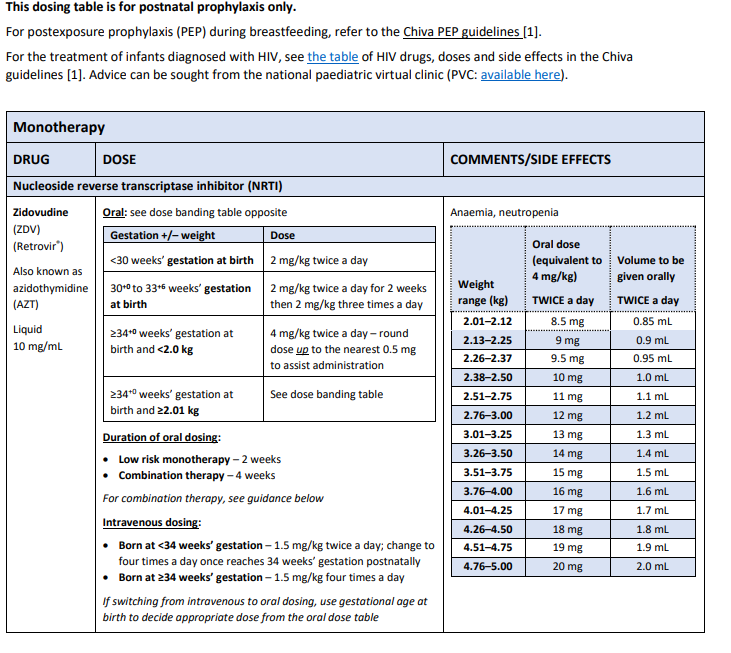
For infants at low risk of acquiring HIV, we recommend 2 weeks of zidovudine monotherapy, provided all the following criteria are met in the mother or birthing parent:
-
Antiretroviral therapy (ART) was initiated at least 10 weeks prior to delivery;
-
There is evidence of good engagement with maternity, antenatal, and HIV care services;
-
At least one viral load measurement was taken within the 6 weeks prior to delivery;
-
All viral load measurements in the 10 weeks prior to delivery, including the measurement on the day of delivery, show levels <50 copies/mL.
If there is uncertainty about recent adherence or the viral load is unknown, zidovudine monotherapy is not recommended.
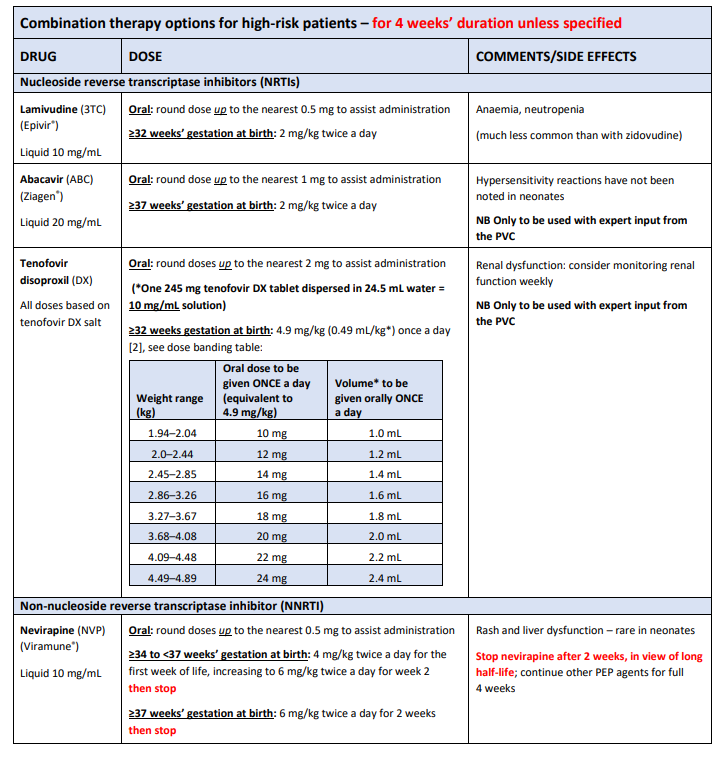
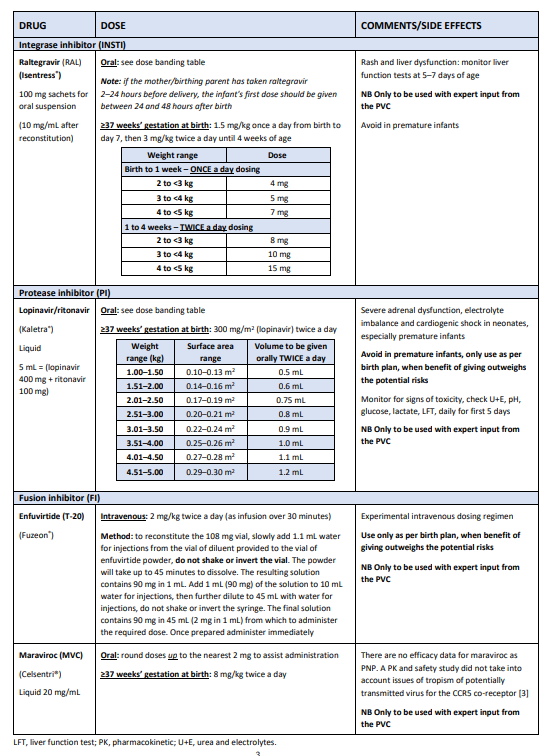
In infants at high risk of acquiring HIV, we recommend use of combination PNP if the above criteria for low-risk infants are not met, especially if the mother/birthing parent is known or likely to have a viral load >50 copies/mL on the day of delivery, if there is uncertainty about recent adherence or if the viral load is unknown.
For standard combination PNP, we recommend a regimen of nevirapine for 2 weeks, together with zidovudine and lamivudine for 4 weeks
Intravenous ART may be considered for neonates unable to tolerate oral medication or who are at significant risk of necrotising enterocolitis due to prematurity
HIV RNA PCR results for both the woman/birthing parent and infant should be available within 24 hours of sample receipt by the laboratory
In cases where the infant is at high risk of acquiring HIV (i.e., combination PNP is indicated), and there is a documented history of genotypic resistance in the mother or birthing parent, expert consultation is recommended. If immediate advice is unavailable, begin standard three-drug PNP (zidovudine, lamivudine, and nevirapine) until further guidance is obtained
If combination PNP is initiated due to uncertainty or high-risk status, but the maternal viral load at delivery is later confirmed to be <50 copies/mL, simplifying the infant’s regimen to zidovudine alone to complete a total of 2 weeks should be considered. This decision should involve a paediatrician with expertise in prevention of vertical HIV transmission.
At WPH all three PNP drugs can be found as stock on the neonatal unit. At FPH zidovudine liquid can be found on Maternity A. The opened bottle/s MUST be labelled with dosing information by pharmacy prior to discharge. All efforts must be made to plan discharge and dispensing from pharmacy during working hours.
Delay BCG vaccination if indicated until PCR results are known