Key Points
- Fertility can return by day 21 after delivery.
- Effective contraception should be commenced as soon as possible after delivery.
- Prompt contraception allows individuals to avoid unplanned short inter-pregnancy intervals with their associated poorer pregnancy outcomes.
This is a controlled document. If you are using a printed copy, check it against the guidelines platform to ensure you are using the latest edition.
Printed copies must be destroyed after use.
Abbreviations
Purpose of the guideline
Effective contraception should be started as soon as possible after childbirth as fertility returns rapidly (within 21 days in some cases). The Faculty of Sexual and Reproductive Healthcare (FSRH) guidance recommends that effective contraception is commenced as soon as possible after delivery by both breastfeeding and non-breastfeeding mothers. This allows individuals to plan any subsequent pregnancy and avoid unplanned short inter-pregnancy intervals with their associated poorer pregnancy outcomes.
The most effective long-acting reversible contraceptive (LARC) methods, including the non-hormonal copper coil (IUD), the levonorgestrel-releasing hormone coil (IUS), the contraceptive injection (Depo-Provera) and the hormonal implant can be inserted at, or immediately after delivery in the maternity setting, by appropriately trained clinical staff. LARC methods have the significant advantage of providing immediate, user-independent contraception that is effective for several months or years without requirement for routine follow up.
Forms of contraception available within the maternity department
Copper IUD (Cu-IUD)
The Cu-IUD can be inserted by a clinician already trained in the technique at the time of caesarean section, immediately after vaginal delivery or at any time up to 48 hours post-partum. If the IUD is not inserted within 48 hours, insertion should be delayed until 4 weeks after the birth to reduce the risk of uterine perforation.
Levonorgestrel intrauterine system (LNG-IUS)
The 52mg LNG-IUS can be inserted by a clinician already trained in the technique at the time of caesarean section or immediately after vaginal delivery or at any time up to 48 hours post-partum. If the IUD is not inserted within 48 hours, insertion should be delayed until 4 weeks after the birth to reduce the risk of uterine perforation.
Medroxyprogesterone Acetate Depot injection (DMPA)
The DMPA is extremely safe and there are few contraindications to its use. After taking the appropriate history, it may be prescribed by a doctor and administered by a midwife, nurse or doctor trained in the administration of intramuscular injections.
The DMPA can be started immediately after delivery (or by Day 21) without any requirement for additional contraceptive precautions. If started more than 21 days postpartum, additional contraceptive precautions are required for 7 days.
Etonogestrel implant (ENG-IMP)
The ENG-IMP can be inserted anytime post-delivery. No routine follow up is required after post-partum initiation of the ENG-IMP. There is a risk of neurovascular injury and migration therefore women should be advised on how to locate the implant, informed to check this occasionally and report any concerns. If inserted by Day 21 after childbirth, no additional contraceptive precautions are required.
This is currently only provided by certain clinicians within the maternity department who will assess suitability on an individual basis. If an appropriate clinician is not available, then women considering ENG-IMP should be provided with a three-month supply of the POP or a single dose of Depo-Provera and referred to their GP or local family planning services.
Individuals for whom LARC methods cannot be provided, those that decline LARC and those for whom LARC is unsuitable can be given a 3-month supply of the desogestrel progestogen-only pill (POP) prior to discharge.
Desogestrel Progesterone only pill (POP)
The POP is extremely safe and there are few contraindications to its use.
The desogestrel POP can be started immediately after delivery (or by Day 21) without any requirement for additional contraceptive precautions. If started more than 21 days postpartum, additional contraceptive precautions are required for 2 days. The POP is highly user-dependent and may not be suitable where there is concern about adherence to pill-taking.
One pill is taken at the same time every day. The pill can be taken up to 12 hours late without affecting contraceptive effectiveness; subsequent pills should be taken at the intended time. If the pill was more than 12 hours overdue, additional contraceptive precautions must be used for 2 days.
Follow up
Intrauterine contraception
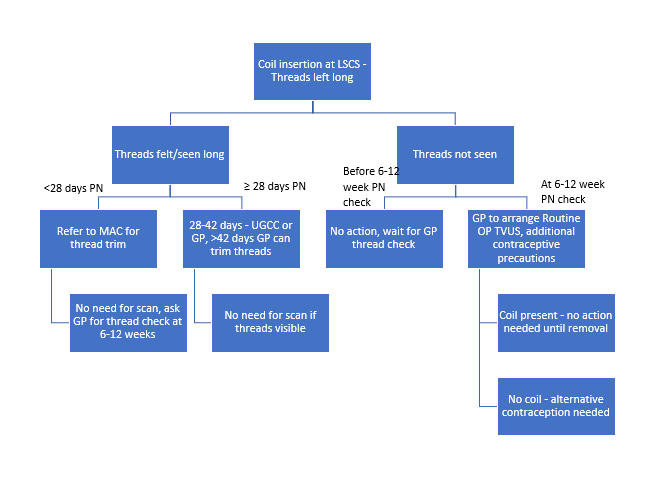
Women who have had insertion of intrauterine contraception after childbirth require follow up with their GP or family planning clinic to check for and trim threads. If threads are not visible, the woman will require an ultrasound scan to confirm the placement of the device. Additional contraception will be required until the device location is confirmed. Please see Appendix 2 for more details. They may also require follow up for pain, bleeding, or expulsion. Women are advised to contact their GP to manage these relatively common problems. Clear advice must be provided to users as to how to follow these pathways.
Progestogen-only pill
No routine follow up is required after post-partum initiation of the desogestrel progestogen-only pill.
Other forms of contraception
Combined hormonal contraception (CHC)
Contraception is required from Day 21 after childbirth unless the woman is fully breastfeeding and amenorrhoeic. CHC should not be started until 6 weeks after delivery in either breastfeeding women or non-breastfeeding women with additional risk factors for venous thromboembolism (VTE).
Please note: caesarean section is a VTE risk factor. Individuals who are not breastfeeding and have no additional VTE risk factors may consider use of CHC from 3 weeks after childbirth. There are, however, significant potential health risks associated with use of CHC, therefore prior to provision, medical eligibility must be carefully assessed, blood pressure and BMI measured, and users advised about CHC-associated health risks. CHC will not be offered for immediate postnatal contraception within the maternity department.
Lactational amenorrhoea
It is recognised that breastfeeding individuals can rely on lactational amenorrhoea for contraception for the first six months after delivery, so long as they remain amenorrhoeic AND continue to breastfeed exclusively. An individual may, however, reduce breastfeeding or have their first period at any time, with resulting loss of contraceptive effect. It is recommended, therefore, that breastfeeding individuals commence additional contraception as soon as possible after delivery.
Female sterilisation
Existing guidance recommends that, because of concern about potential regret, written consent to female sterilisation at the time of caesarean section should be obtained at least two weeks prior to delivery. Additional guidance recommends that this should have been discussed on more than one occasion during the antenatal period.
Provision of contraception in the immediate postnatal period
Community Midwives should discuss contraception with women during their 28 week antenatal appointment. This information should be given in a range of formats including providing women with the Frimley Health contraception leaflet and sign posting women to the Frimley Health Maternity website and FSRH guidance.
Women who are having an elective caesarean should be offered the insertion of an IUS/IUD when the caesarean is requested. Consent should be taken for the insertion of the IUS/IUD when women are consented for the caesarean section.
Midwives should discuss contraception as part of the discharge process and women who have not had an IUS/IUD inserted should be offered the Depo Injection or a 3-month supply of the progesterone only pill.
The obstetric team covering the relevant area of discharge should prescribe a 3-month supply of the POP with a TTO letter. The supply from pharmacy should be provided and explained to the woman prior to discharge and she must be informed to contact her GP for further prescriptions. The woman’s GP should be informed of the method of contraception provided as part of the discharge process.
References
Faculty of Sexual and Reproductive Healthcare (2017) Clinical Guideline Contraception After Pregnancy. Available at: https://www.fsrh.org/standards-and-guidance/documents/contraception-after-pregnancy-guideline-january-2017/
Faculty of Sexual and Reproductive Healthcare Clinical Effectiveness Unit (2020) Provision of contraception by maternity services after childbirth during the Covid-19 outbreak. Available at: https://www.fsrh.org/documents/fsrh-rcog-rcm-statement-postpartum-contraception-covid19/
Appendix 2: Intrauterine contraception thread check
Full version control record
This guideline has been registered with the trust. However, clinical guidelines are guidelines only. The interpretation and application of clinical guidelines will remain the responsibility of the individual clinician. If in doubt, contact a senior colleague or expert. Caution is advised when using guidelines after the review date.
This guideline is for use in Frimley Health Trust hospitals only. Any use outside this location will not be supported by the Trust and will be at the risk of the individual using it.
Version History
Related Documents