Key Points
- This policy outlines the operational policy for both the Lavender Homebirth Team and Community Team situated at Frimley Park Hospital and the Community Team at Wexham Park Hospital.
- Women should be able to decide where they would prefer to give birth, whether at home, in a midwifery unit or in an obstetric unit. They should be provided with the support they need to make an informed decision.
- Continual risk assessment from the point of booking to discharge postnatally.
- Prompt escalation of concerns in a timely and appropriate manner.
This is a controlled document. If you are using a printed copy, check it against the version on the intranet to ensure you are using the latest edition.
Abbreviations
Introduction
This document provides guidance for all maternity staff involved in providing care to women planning to give birth at home. The document applies to all cases of homebirth, including cases of BBA.
Purpose
All women have the right to make an informed choice regarding their place of birth (NHS (National Health Service) England, 2016, Birthplace in England Collaborative Group, 2011, Hutton et al., 2019). Low-risk women who plan to give birth at home have a higher likelihood of normal delivery with less intervention (NICE, 2017). Women will be offered the choice of place of birth at booking and throughout pregnancy, although they may change their minds at any stage in their pregnancy.
Multiparous women are as safe having their baby at home as in hospital (Birthplace in England Collaborative Group 2011), with fewer interventions and untoward maternal outcomes noted for all women (Reitsma et al., 2020). Nulliparous women should be informed that there is an increased chance of needing to transfer to the hospital and a small increased risk of an adverse outcome for the baby (NHS England, 2016).
Booking
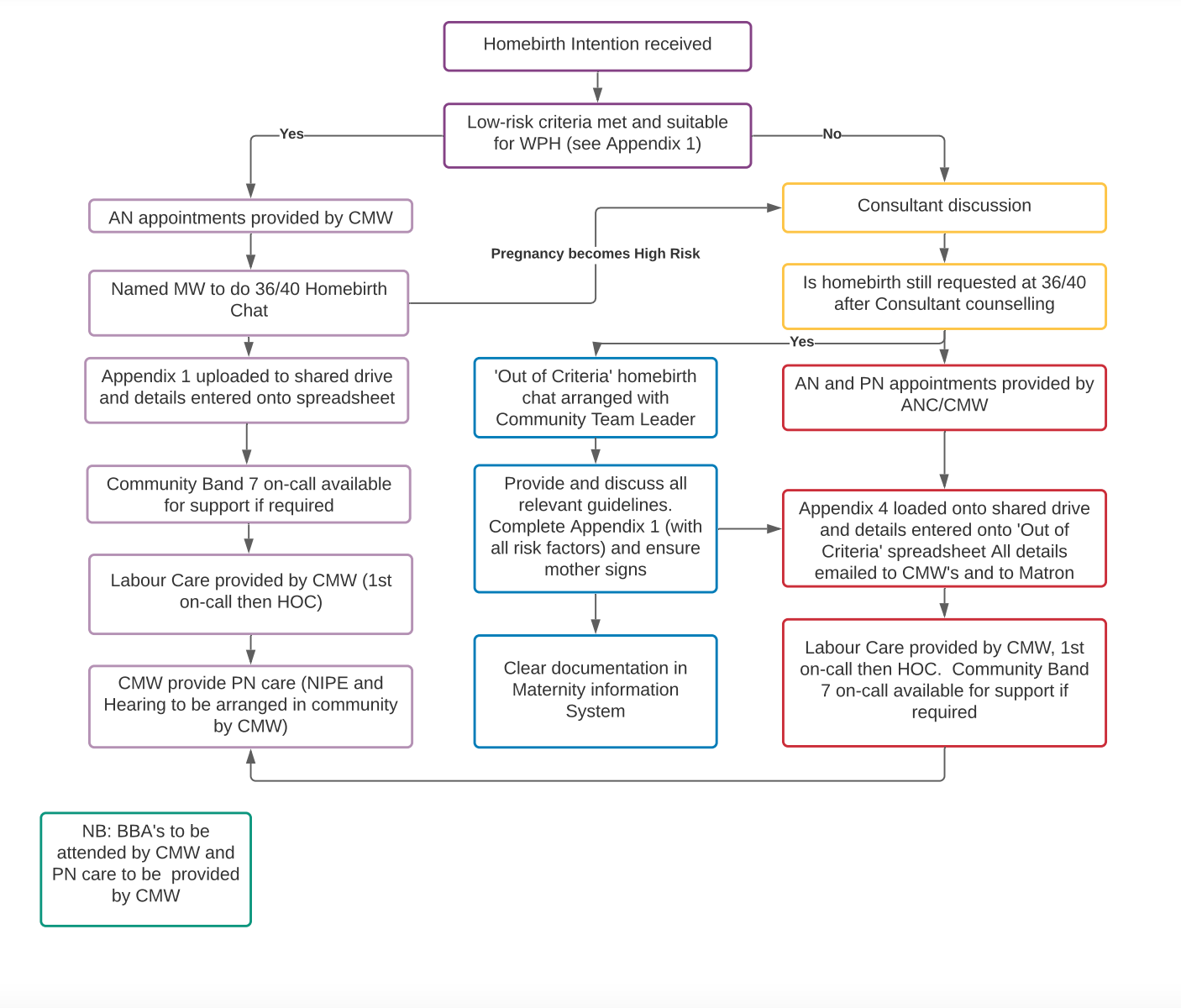
Homebirth should be offered and discussed with women when considering the place of birth. For a woman considering a homebirth, this can be booked at any stage in her pregnancy. The community care pathway for homebirths for FPH (see Appendix 2) and WPH (see Appendix 3).
The following should occur in cases where a woman wishes to have a homebirth where the medical or obstetric history or conditions fall outside the criteria for midwifery-led care. The CMW should fully explain the risks to the prospective parents and document them clearly in EPIC. An appointment should also take place with an obstetric consultant/consultant midwife; all risk factors should be explained to ensure a fully informed decision by the woman has been made. All discussions must be recorded in the patient Electronic Patient Record (EPR).
At WPH, a CMW (band 7) or above should be informed, and, depending on the circumstances, they may decide to visit the woman to perform an “out of criteria” discussion. The CMW should update the Complex Plans (Out of criteria) spreadsheet with the details of the woman and the discussion (at WPH in the Maternity shared drive).
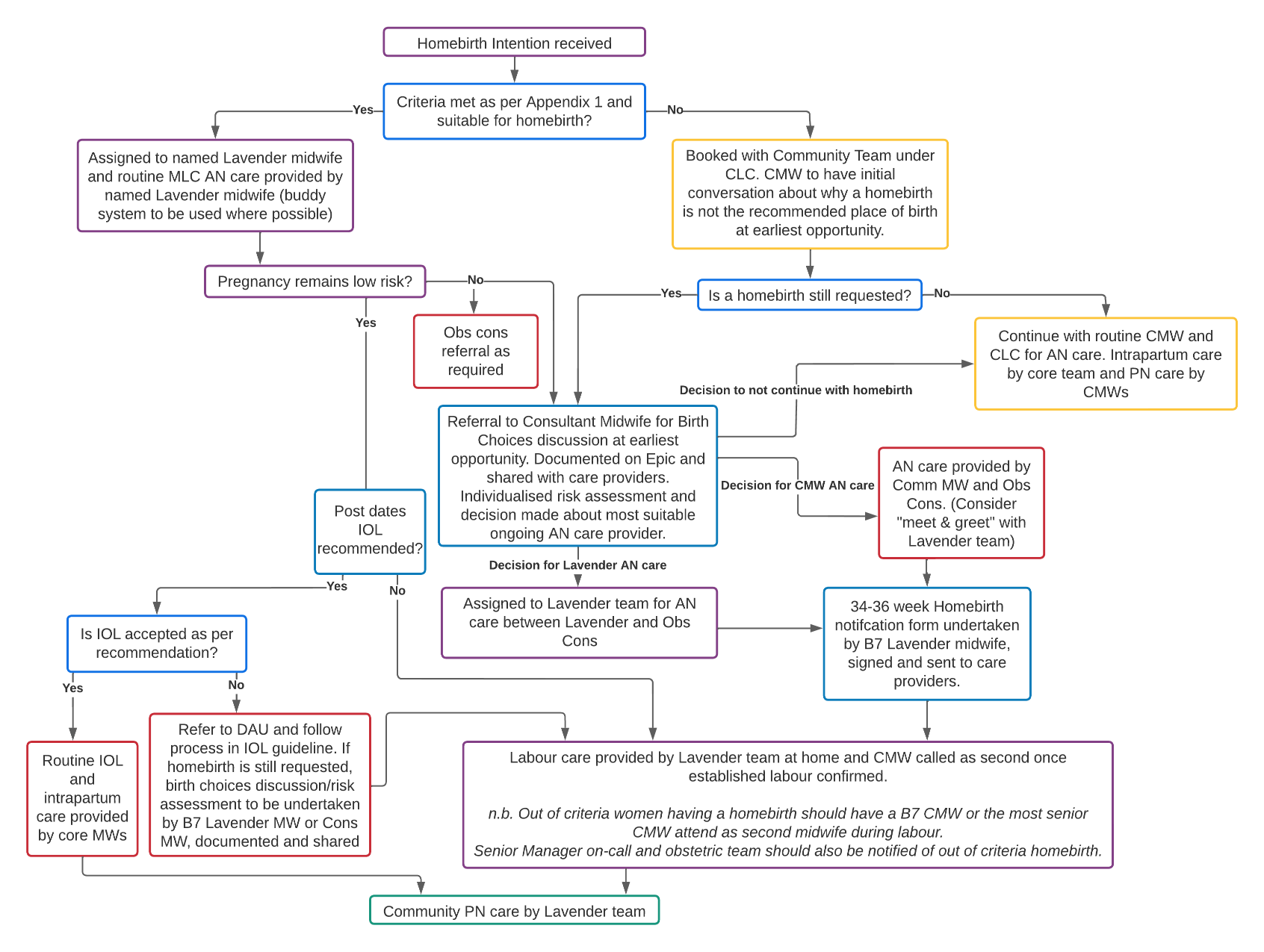
At FPH, following a consultant midwife discussion, an individualised decision can be made about the most suitable team to undertake ongoing antenatal care for women out of homebirth criteria (See Appendix 1 and Appendix 2). This will either be the Homebirth team, or the Community Midwifery Team.
At WPH, women who choose to have a homebirth will be supported by the CMW team.
Women should also be offered an obstetric appointment in the same way if they have been receiving midwifery-led care but then become high risk. For example, if the woman declines an IOL for postdates and wants spontaneous labour and homebirth.
36 Week Appointment
The 36-week antenatal assessment by the CMW/Lavender team should take place in the family home to complete the following: environmental assessment, homebirth checklist, leave a contact number and give advice on preparations to be made. The Notification of a Woman’s intention to have a homebirth form (see Appendix 4) should be completed.
When the Notification of Homebirth form is completed, copies should be made and distributed as follows:
-
CMW office (folder at FPH).
-
LW Homebirth file (FPH only)
-
Homebirth Team spreadsheet (FPH only)
-
Community team members - if out of criteria.
-
Community Matron – if out of criteria (WPH) (including all Senior Managers On Call, Homebirth Team Leader, CMWs and consultants at FPH alongside a copy of the out of criteria letter).
-
Scanned copies to be uploaded onto the shared drive and documented on the spreadsheet (WPH only).
-
Documented in EPIC.
Intrapartum Care
At FPH, when the woman believes herself to be in labour, she should contact the Homebirth Team who will contact the Labour Ward who will contact the on-call midwife. At WPH, women should contact the MAMAs line who will contact the on call CMW. It should be clear to the woman how to contact the midwives when she is in labour. The designated midwife will contact the woman to make arrangements to visit and assess the progress of labour.
FPH Call out structure:
-
The Homebirth Team are 1st to attend any homebirth (planned or unplanned), carrying the homebirth equipment in the pool car.
-
The community on-call system is then structured to ensure the 2nd midwife is called at the desired time of the attending midwife.
-
Should a subsequent homebirth take place, the 3rd on-call should be sent, calling the 4th on call to support at the time desired of the attending midwife.
-
The CMW (band 7/senior midwife) is available to all CMWs for advice and support; however, they should be called out as a 2nd once an initial assessment has been made for women who are out of criteria for a homebirth.
-
CMW homebirth kits are stored in the community hubs and restocked in the hospital once used/out of date.
Wexham Park Call out structure:
-
The 1st on-call, carrying the homebirth equipment, is the first to attend a homebirth.
-
The HOC (Homebirth on-call) will be called to support when the 1st on-call deems it necessary. Should the HOC be unavailable, the 2nd on-call may attend as a second midwife.
-
Should the 1st and HOC be already in attendance at a homebirth, the band 7 on-call is available as a second midwife to the second homebirth if both 1st and HOC on-call midwives must remain at the first homebirth.
-
The band 7 is available to all CMWs for advice and support, especially when caring for women out of criteria for a homebirth.
-
Should the LW require support from the on-call midwives in times of pressure, this should be discussed first with the on-call manager. The 2nd on-call midwife is the first in line to be called into the unit, followed by the HOC and then the 1st on-call. This is to ensure the homebirth kit remains in the community in the case of homebirth.
-
The homebirth kits are stored in the community hubs; a 2nd kit is held on W22 should it be needed.
The on-call CMW should document in EPIC when she is called and when she arrives at the house. Depending on her findings and assessment, the CMW may leave the woman and continue her daily duties (unless at night, when she may return to FPH/home until labour establishes). The CMW will give the woman a contact number and be advised to make contact once she feels labour has progressed or requires further advice.
Latent Phase of Labour
This is a period of time when there are painful, but not necessarily continuous, contractions and some cervical change, including cervical effacement and dilatation up to 4 cm.
-
At WPH, when women think they may be in labour, they will contact the MAMA’S line, who will ask the CMW to contact them to provide support and give advice. At FPH, women will contact the homebirth team directly.
-
At WPH, women should be invited into the hospital on the 3rd telephone call to the CMW to discuss the latent phase of labour. At FPH, the homebirth team should visit the woman at home on the 3rd telephone call, if not required sooner.
-
Planned homebirth women without complications can stay at home with clear information about when to call the CMW, e.g., SROM, bleeding, increasing contractions.
-
Women who require more than one attendance in the latent phase from the CMW/Homebirth team should be offered an obstetric team review or offered admission to the Antenatal Ward.
-
If the woman declines at this 2nd attendance, the same offer of obstetric team review or admission to the Antenatal Ward must be made and the decision documented at every subsequent attendance.
-
If the offer is declined at the second attendance, the midwife must escalate to the LW coordinator and/or LW obstetrician to inform them of the situation.
-
Discuss strategies for coping with contractions, e.g., warm bath, mobilisation, simple analgesia, relaxation, and massage.
In addition:
-
If there is uncertainty about whether the woman is in established labour, a VE may be helpful after a period of assessment but is not always necessary.
-
If the woman appears to be in established labour, offer a VE (refer to Pre labour rupture of membranes at term).
Include the following in any assessment of labour:
-
Ask the woman how she is, about her wishes and expectations, and if she has any concerns.
-
Ask the woman about the baby's movements, including any changes.
-
Give information about what the woman can expect in the latent 1st stage of labour and how to work with any pain she experiences.
-
Give information about what to expect when she accesses care
-
Agree on a plan of care with the woman, including guidance about who she should contact next and when to provide guidance and support to the woman and her birth companion(s).
-
The CMW should document the guidance that she gives to the woman on EPIC, which can be viewed on the My Frimley app.
Once labour is established, the homebirth midwife or CMW must remain with the woman to provide care as per the Care of Women in Labour guideline. The homebirth midwife or CMW should inform the LW coordinator of the woman’s name, address, telephone number, hospital number and time of arrival. By alerting LW, they can be on standby to admit should an emergency arise. In addition, this is to monitor the patient's safety and monitor the homebirth midwife / CMW safety as per the Lone Worker guideline.
The CMW in attendance should obtain information (name, contact number) of the 2nd on-call midwife and alert when the 2nd stage is approaching or earlier if she needs support. Once the 2nd and 3rd stages and suturing are complete, the LW coordinator should be informed.
Pre-labour Rupture of Membranes.
The woman may be seen at home if she suspects pre-labour rupture of membranes over 37 weeks. Following confirmation, follow Trust guidance on Pre labour rupture of membranes at term. If augmentation is deemed necessary and the woman declines, she should be advised to attend the hospital to see a consultant to discuss the plan of care, including risk information, and arrange appropriate fetal surveillance. Advice from the LW coordinator, a CMW (band 7) or a senior CMW should be sought.
If a woman births at home and has had a prolonged rupture of membranes (>24 hours at the time of birth), whether Group B strep is known about or not, the woman must be advised to attend the postnatal ward for neonatal observations and a review, as per the guidance for Immediate Care of the Newborn guidelines.
Prolonged pregnancy
As the pregnancy progresses, the woman will receive her antenatal care as per the Antenatal Care and Booking guidelines.
Prior to formal methods of IOL, all women should be offered a VE and a membrane sweep at 40 and 41 weeks for primipara and 41 weeks for multipara whilst at their routine antenatal appointments. An appointment at the postdates clinic should be considered for eligible women. Research suggests that membrane sweeping may be effective in promoting labour and may reduce formal induction. (Finucane et al., 2020). At WPH, the Post Dates Clinic can be booked for low-risk women requiring membrane sweep and Complementary Therapy. An IOL should be arranged by adding an order in Epic.
If the woman declines IOL
-
Please follow the expectant management in the Induction of Labour guideline.
-
The woman should be asked to attend the hospital for an appointment with a consultant either in Antenatal Clinic, MAC (WPH) or DAU (FPH) to discuss further monitoring of fetal wellbeing.
-
If IOL is declined for any reason, a CMW (band 7) or above must be informed who should have a full discussion with her as to the reasons why she is declining IOL. The woman should be given the reason(s) as to why guidance suggests birth by 42 weeks (or earlier if medically indicated). If declining IOL could increase the risk of an IUD, women should be counselled about this possibility. These discussions should be documented.
-
The CMW should also update the Complex Plans (Out of criteria) spreadsheet with the details of the woman and your discussion (WPH in maternity shared drive) or an email to all LW coordinators, consultants, and Homebirth Team Leader (FPH).
Care following the birth
A full assessment of trauma to the vagina and perineum must be carried out using adequate lighting and pain relief. A PR and PV examination should be offered to all women post-delivery, even if the perineum is intact.
Suturing should be completed as per the Management of perineal trauma guideline. A full postnatal examination to include weighed blood loss, swab and needle count, and full observation of the woman documented on MEOWS charts. The CMW must not leave the house until the baby has fed and the woman has been up, is well and has passed a good volume of urine. This should be recorded into EPIC.
The following should also be completed prior to leaving the house:
-
Initial newborn check to include weight, temperature, and vitamin K.
-
Arrangements for further visits from CMW should be made.
-
Arrangements for NIPE before 72 hours of age and hearing screening.
-
Clearing up and disposal of all waste, including the placenta.
-
Ensure the parents are aware of signs and symptoms of potential problems for the mother and baby and when to seek medical advice. Document your discussion.
-
Ensure that the parents are provided with contact numbers for any concerns.
Once the homebirth midwife/CMW has left the house:
-
The homebirth midwife/CMW will return to FPH or WPH as soon as able to complete the documentation; this must not be delayed to the next day.
-
The homebirth/CMW should ensure that any waste, including the placenta, is disposed of safely. The placenta and any hazardous waste should be transported back to the hospital in a suitable container in the boot of the car.
-
The kit should be fully restocked.
-
The community office clerks/administrators should be notified of the birth so that subsequent visits can be passed on to the appropriate CMW.
-
In cases where a BCG vaccination for the baby is required, the CMW should ensure that the mother has been informed and offered an appointment.
BBA – Born Before Arrival
The Homebirth Team or CMWs on-call will be called to BBA’s. Every effort should be made for two midwives to attend as it is an unplanned birth at home with potential additional complications. In cases where the midwives on-call are already attending another homebirth, then the mother and baby should be transferred to the hospital by the ambulance service.
Homebirth Emergencies
In the event of a homebirth emergency, the mother and baby must be transferred to the hospital as soon as possible if the baby has undergone extensive resuscitation, transfer directly to the NNU (WPH only). The neonatal registrar should be called and be informed of the upcoming admission. Any delay in transfer for serious complications of pregnancy has potentially fatal consequences. This list is not exhaustive and does not replace the clinical judgement of the CMW.
Reasons for emergency transfer into hospital via ambulance, with the midwife present, include (although not exclusive to):
-
Any meconium-stained liquor
-
Abnormal fetal heart rate/fetal distress
-
Prolapsed cord
-
Pre-eclampsia/eclampsia or hypertension
-
Any neonatal emergency
-
Antepartum haemorrhage
-
Prolonged 1st or 2nd stage of labour
-
Prolonged third stage
-
Shoulder dystocia
-
Postpartum haemorrhage
-
Maternal collapse
-
Anaphylaxis
-
Following neonatal resuscitation (even if neonatal resuscitation was required, performed and the baby appears well).
-
Any neonatal emergency
-
Retained placenta
-
Uterine rupture
-
Uterine inversion
-
Suspected 3rd/4th-degree tear, clitoral or urethral tear requiring suturing and needing further assessment or pain relief.
Emergency transfer to the hospital
Call 999 and ask for a paramedic ambulance to transfer a woman and baby from home to hospital. Document the time of decision, time of calls and discussions made with the woman, LW/NNU and ambulance service, including the reason(s) for transfer. The request should include the words “time-critical” for emergencies.
Whether a woman agrees or not to the transfer, a ‘999’ ambulance should be called. If a woman declines transfer, the advice/attendance of a CMW (band 7) or the LW coordinator should be sought. It should be requested that the ambulance ideally remains at the house, although it is known that this may not be possible. Timely and compassionate communication of the need for transfer can help reduce the likelihood of the offer of a transfer being declined.
Once the woman arrives on the LW, an obstetric opinion should be obtained immediately. The CMW will hand over the care of the woman to the hospital midwife unless the CMW chooses to stay and continue care. A clinical incident form (RL) should be completed. Where the CMW has travelled in an ambulance with woman, the LW coordinator may authorise a taxi back to the woman’s house to collect her car.
Community Midwifery Drug List (see Appendices 6 and 7)
All drugs should be checked monthly to ensure they have not passed their expiry date.
Auditable Standards
Criteria met for homebirth. Transfer in from home Care in labour compliance.
Monitoring Compliance
This guideline will be subject to three-yearly audits. The audit midwife is responsible for initiating the audit. Results are to be presented to the departmental clinical audit meeting. Action plans will be monitored at the quarterly obstetrics and gynaecology clinical governance committee.
References
Birthplace in England Collaborative Group (2011) Perinatal and maternal outcomes by planned place of birth for healthy women with low-risk pregnancies: The Birthplace in England national prospective cohort study. BMJ, 343: d7400. Available at: https://www.bmj.com/content/343/bmj.d7400 (Accessed: 9 November 2022).
Finucane, E., Murphy, D., Beisty, L., Gyte, G., Cotter, A., Ryan., E., Boulvain, M., Devane, D. (2020) Membrane sweeping for induction of labour. Cochrane Database of Systematic Reviews 2020. 2, CD000451. Available at: https://www.cochranelibrary.com/cdsr/doi/10.1002/14651858.CD000451.pub3/full (Accessed: 9 November 2022).
Hutton, E.K. et al. (2019) Perinatal or neonatal mortality among women who intend at the onset of labour to give birth at home compared to women of low obstetrical risk who intend to give birth in hospital: A systematic review and meta-analyses. EClinicalMedicine, 14, pp. 59-70. Available at: https://www.thelancet.com/journals/eclinm/article/PIIS2589-5370(19)30119-1/fulltext (Accessed: 9 November 2022).
NHS England (2016) Better births: improving outcomes of maternity services in England: a five year forward view for maternity care. https://www.england.nhs.uk/wp-content/uploads/2016/02/national-maternity-review-report.pdf. (Accessed: 9 November 2022).
NICE (2017) Intrapartum care for healthy women and babies. CG190*.* Available at: https://www.nice.org.uk/guidance/cg190 (Accessed: 9 November 2022).
NICE (2021) Antenatal care. NG201. Available at: https://www.nice.org.uk/guidance/ng201 (Accessed: 9 November 2022).
NICE (2021) Antenatal care. QS22. Available at: https://www.nice.org.uk/guidance/qs22 (Accessed: 9 November 2022).
NMC (2018) The Code: professional standards of practice and behaviour for nurses, midwives and nursing associates. Available at: https://www.nmc.org.uk/standards/code/ (Accessed: 9 November 2022).
NMC (2020) Standards for midwives. Available at: https://www.nmc.org.uk/standards/standards-for-midwives/ (Accessed: 9 November 2022).
RCOG & RCM (2007) Joint statement No 2 Homebirths. London: RCOG.
Reitsma, A., Simionia, J., Brunton, G., Kaufmana, K., Huttona, E. (2020) Maternal outcomes and birth interventions among women who begin labour intending to give birth at home compared to women of low obstetrical risk who intend to give birth in hospital: A systematic review and meta-analyses. The Lancet, 21 pp: 100319. Available at: https://www.thelancet.com/journals/eclinm/article/PIIS2589-5370(20)30063-8/fulltext (Accessed: 9 November 2022).
Wastlund, D., Moraitis, A., Dacey, A., Sovio, U., Wilson, E., Smith, G. (2019) Screening for breech presentation using universal late-pregnancy ultrasonography: A prospective cohort study and cost-effective analysis. PLOS Medicine 16(4) pp: e1002. Available at: https://journals.plos.org/plosmedicine/article?id=10.1371/journal.pmed.1002778 (Accessed: 9 November 2022).
Appendix 1 Lavender Team Referral Criteria
Green criteria – suitable for homebirth
Guided by NICE https://www.nice.org.uk/guidance/cg190/chapter/Recommendations#place-of-birth (accessed 17/05/2021) and Frimley Health (2021). Booking and antenatal care, including the management of Non-attendance to Antenatal Appointments. Version 1.2.
Appendix 2 Communication flowchart for Lavender Homebirth Team (LHT) Care Pathway
Appendix 4 Notification of a mother’s intention to have a homebirth. General information
Pregnancy History
Do you believe the woman clearly understands the points below to make an informed choice for her homebirth?
-
Specialist emergency care is only available by transferring to hospital in an ambulance.
-
Frimley Health has no control over the timing of the arrival of an emergency ambulance.
-
What will happen in the event of complications (as may occur in any birth, whether at home or in hospital?
-
Potential reasons for emergency transfer to be documented in handheld notes.
-
Does the woman have any contraindications for a homebirth? If yes, please give details.
-
If any contraindications exist, please discuss them with your Team Leader, and if the woman is in agreement, she will visit the woman’s home to discuss further.
Homebirth Risk assessment to be completed by community midwife:
Appendix 5 Emergency transfer of Mother and/or baby to Hospital
To be used in the event of transfer to hospital for planned homebirth, BBA, or unplanned homebirth.
Mother’s details:
Full version control record
Version Control Sheet
Related Documents