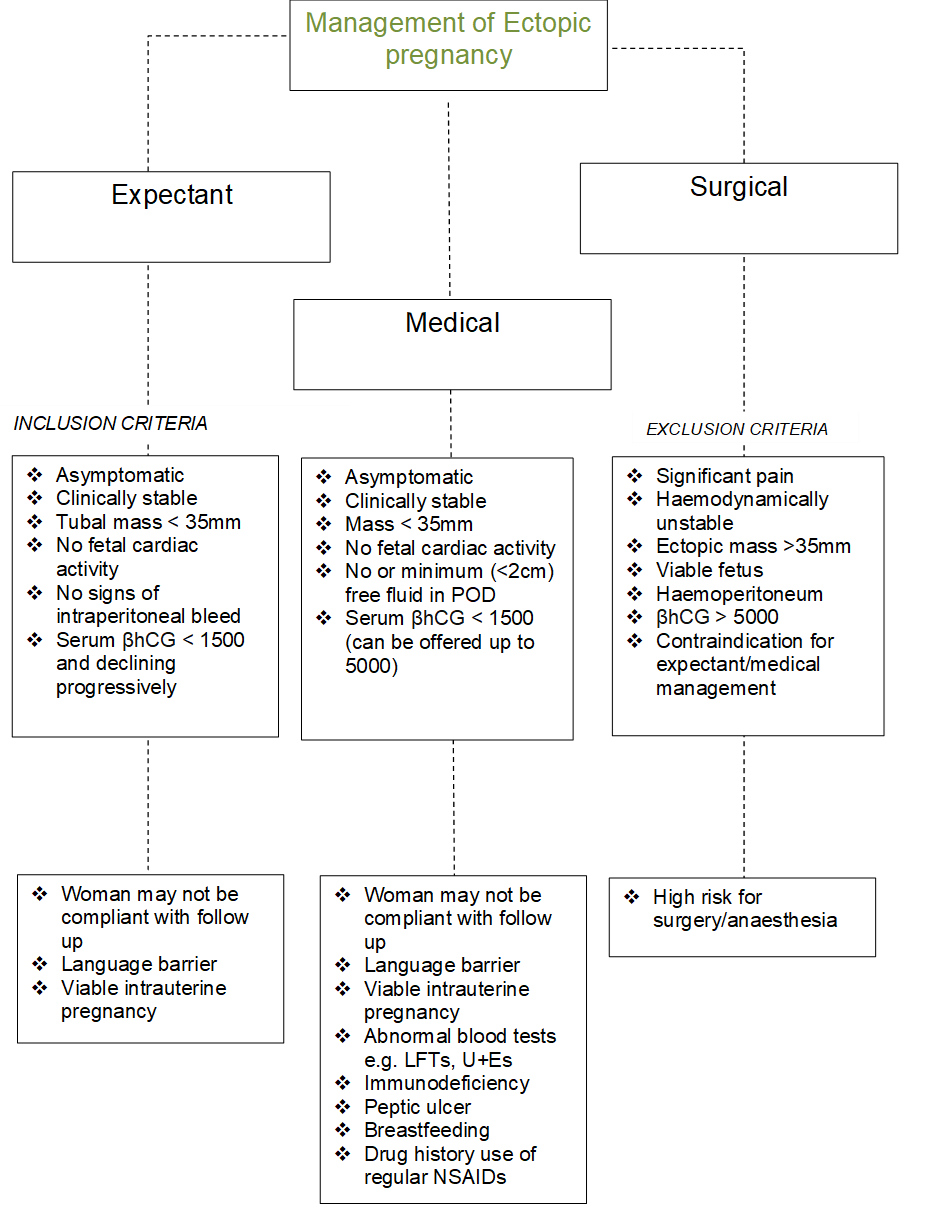
Ectopic pregnancy can be managed expectantly, medically or surgically.
2.1 Expectant Management of Ectopic Pregnancy
-
Spontaneous resolutions of ectopic pregnancy are seen in 20% of all ectopic pregnancies.
-
In selected cases expectant management is a useful management form. The decision to adopt a conservative approach must be individualised for each woman and made by the EPU consultant or consultant in charge of the women’s care.
2.2 Inclusion criteria
2.3 Counselling should be done by a senior clinician/Consultant which includes:
-
Information re: diagnosis and safety net advice – if women experience dizziness, syncope or abdominal pain, they should go directly to A&E
-
That there is no significant difference between expectant and medical management in:
-
the risk of tubal ectopic rupture
-
the clinical need for further treatment however the woman may need urgent admission if the clinical condition deteriorates
-
health status, anxiety and depression scores
-
the time taken for ectopic pregnancy to resolve
-
the fertility outcomes
-
Giving the woman the relevant information leaflet.
-
Anti-D Immunoglobulin is NOT needed for non-sensitised rhesus negative women.
2.4 Perform serial βhCG levels on days 2, 4 and 7 after diagnosis of the ectopic
-
If βhCG levels reduce by 15% or more than the previous values on day 2, 4 and 7 – weekly βhCG levels can be taken till a negative result (< 20 IU/L) is seen.
-
If βhCG levels do not reduce by 15%, stay the same or increase from the previous values, the woman’s case will need to be reviewed and a senior clinician needs to be consulted.
2.5 EPU will take over the care of these women as outpatients on discharge.
2.6 Women should be provided with EPU contact number to contact for advice if any time during the course of the expectant management.
2.7 Medical Management of Ectopic Pregnancy
2.8 The decision to administer methotrexate is made at Consultant level and should be documented accordingly in the notes.
2.9 Methotrexate is an antimetabolite, interfering with the synthesis of DNA by inhibiting the action of dihydrofolate reductase in the conversion of dihydrofolic acid to tetrafolic acid. The safety of methotrexate in reproductively active women, with respect to future pregnancies, has been extensively proven in studies since the 1970’s, involving its use in the treatment of gestational trophoblastic disease.
2.10 Studies suggest that 15% of women will require a second dose of methotrexate and 7-10% will require surgical intervention despite medical treatment. However, this can be reduced with proper selection of cases and expertise involvement in the management.
2.11 Although currently not licensed for use in the medical management of ectopic pregnancy its use is well documented in the literature and recommended in the RCOG/ NICE guidelines for use in suitable cases.
2.12 Methotrexate can be given on a first visit when a viable intrauterine
pregnancy has been excluded and there is a definitive diagnosis
of an ectopic pregnancy.
2.13 Inclusion criteria:
2.14 Indications
-
Women with tubal ectopic pregnancy who fulfils the inclusion criteria for medical management
-
Management of cervical/scar pregnancy diagnosed on pelvic ultrasound scan
-
For the direct injection into an interstitial pregnancy under ultrasound guidance or IM injection
-
For the treatment of persistent trophoblast after salpingotomy
-
The management of persisting pregnancies of unknown location
2.15 If a woman does not fulfil the criteria above, the case should be discussed with the EPU Consultant/ Consultant on call with a view to individualising a management plan.
2.16 Surgery is the first line management for ectopic pregnancies with βhCG levels >5000 IU/L, however in exceptional circumstances medical management may be necessary e.g. contraindication to surgery, gross obesity and multiple previous abdominal surgeries.
2.17 Contraindications:
2.18 Pre-treatment counselling:
2.19 Side effects:
2.20 Drug interactions
-
Women on long term NSAIDs should be changed to Paracetamol for 2 weeks. Drug interaction with NSAIDs can cause GI toxicity, aplastic anaemia, bone marrow suppression.
-
Folate antagonists (Trimethoprim & Co-trimoxazole) are an absolute contraindication and should not be used till pregnancy test is negative. Even a short course of Trimethoprim can cause life threatening bone marrow suppression.
2.21 Administration
-
The decision to administer Methotrexate is made at Consultant level and should be documented accordingly in the notes. Symptomatic women may still be administered Methotrexate at the discretion of EPU consultant/ Consultant in charge of their care.
-
Obtain informed written consent.
-
Check the results for FBC, G&S, LFT, U&E - if abnormal do not administer Methotrexate and discuss with Consultant regarding alternative management.
-
Ensure Day 0 βhCG levels are done.
-
Calculate the dosage (see below) and prescribe on EPIC under orders tab. Pharmacist will recheck the dosage and rounded to nearest 5mg (for most women it will be between 75 - 90 mg).
-
Methotrexate should be administered intramuscularly in the buttock by Senior clinician/ EPU Specialist nurse/Consultant.
-
Women can go home 30 minutes after injection is given, if remains stable and well.
-
Discard the syringe in a cytotoxic bin (purple lid).
-
Inform nurse in charge as regards to disposal of cytotoxic bins.
-
Ensure βhCG follow up book is up to date.
-
Give the woman contact numbers for EPU in case they need any advice.
-
Anti D Immunoglobulin is not required for medical management of ectopic pregnancy for Rh Negative women.
2.22 Dosage (50mg/m2 body surface area)
-
Record height (cm) and weight (kg)
-
Calculate the body surface m2 (see Appendix 1)
-
Cross check the dose with pharmacy (Dose is 50mg/m2)
2.23 Follow up
Day 0 – Methotrexate administration:
- Serum βhCG, FBC, G&S, liver and renal function
Day 4:
-
Serum βhCG
-
An increase in the level of βhCG of <15% is acceptable between day 0 and day 4.
-
Increase of more than 15% (from day 0 to day 4) may be a sign of treatment failure. If this is the case discuss with EPU consultant.
-
If any concerns discuss with EPU Consultant / Consultant on call.
Day 7:
-
Serum βhCG, FBC, liver and renal function tests.
-
If a 15% fall has been achieved weekly monitoring may then commence.
-
If the βhCG level has plateaued, then an interval βhCG may be considered at the discretion of the EPU Consultant.
-
If the level rises a further dose of Methotrexate may be administered - discuss with the consultant.
-
Weekly serum βhCG until levels < 15 IU/L
2.24 All Methotrexate cases will be discussed at the weekly EPU clinical meeting
until they are resolved.
2.25 Signs of Treatment failure:
-
Increasing abdominal pain
-
Deterioration of clinical condition
-
βhCG levels fall less than 15% or increases between day 4 to day 7
-
If βhCG levels fall less than 50%, after 1 week, in case of salpingotomy (these women have 3 times likelihood of persistent tissue)
2.26 Surgical treatment
2.27 Offer surgery as a first-line treatment to women who are unable to return for follow-up after methotrexate treatment or who have any of the following:
-
an ectopic pregnancy and significant pain
-
an ectopic pregnancy with an adnexal mass of 35 mm or larger
-
an ectopic pregnancy with a fetal heartbeat visible on an ultrasound scan
-
an ectopic pregnancy and a serum βhCG level of 5000 IU/litre or more
-
ruptured ectopic pregnancy with significant haemoperitoneum
2.27 Once the decision for surgical management is made:
-
Insert an IV cannula – (2 cannulas if ruptured ectopic or haemodynamically unstable)
-
Send FBC, G&S and cross match 2 units if required
-
Clotting screen if haemodynamically unstable
-
Women to be kept nil by mouth if they need to be taken to theatre or until a clinical management decision is made
-
If admission needed, liaise with the bed manager
-
Book women on emergency theatre list, consent and complete all necessary paperwork including fetal remains consent form and prescribe Anti D if required (Rh negative)
2.28 Laparoscopy vs. Laparotomy
A laparoscopic approach to salpingectomy is superior to laparotomy because it allows the following:
a. Less intraoperative blood loss
b. Shorter hospital stay
c. Lower analgesic requirements
d. Faster recovery from surgery
e. Increased subsequent rate of intrauterine pregnancy
f. Decreased recurrent ectopic pregnancy rate
g. Decreased post-operative formation of pelvic adhesions
2.29 Salpingectomy vs Salpingotomy
Choice of Tubal Surgery:
-
Salpingectomy is the treatment of choice if -
-
Tube is severely damaged
-
Contralateral tube is normal
-
Uncontrolled bleeding from the tube
-
Women have completed their family
-
Salpingotomy should be considered as the primary treatment when managing tubal pregnancy in the presence of contra lateral tubal disease and the desire for future pregnancy.
-
There is no confirmed evidence that salpingotomy improves fertility rates when the other tube appears normal.
-
Recurrent ectopic pregnancy rate is higher in women who undergo linear salpingotomy (up to 18%) compared with salpingectomy (8%).
-
Persistent trophoblastic disease occurs in up to 11% of salpingostomy cases and consequently these women need serum βhCG follow up, on a weekly basis, until it reaches <15 IU/l.
-
Inform women having a salpingotomy that there is a small risk that they may need further treatment in the form of methotrexate and/or a salpingectomy
-
Do not instrument the uterus until ectopic pregnancy is diagnosed on Laparoscopy.
-
Routine curettage is not indicated for negative laparoscopy.
2.30 Follow-up
OR
-
if there is any suspicion of incomplete removal of ectopic pregnancy (e.g. Interstitial pregnancy)
-
If negative laparoscopies - perform βhCG and follow PUL guideline
-
Advise women who have had salpingectomy to perform a urine pregnancy test in 3 weeks and if positive to contact EPU for further assessment