Key points
-
All babies should be offered the national screening newborn blood spot (NBBS) heal prick test on day 5
-
The sample card is sent to a specialist newborn screening laboratory for testing for rare conditions including congenital hypothyroidism (CHT), sickle cell diseases (SCD), cystic fibrosis (CF) and 6 inherited metabolic disorders:
- phenylketonuria (PKU)
- medium chain acyl-CoA dehydrogenase deficiency (MCADD)
- maple syrup urine disease (MSUD)
- Isovaleric aciduria type 1 (IVA)
- glutaric aciduria type 1 (GA1)
- Homocystinuria (pyridoxine unresponsive) (HCU)
-
Severe Combined immunodeficiency (SCID). Evaluation project. SCID screening currently depends on the laboratory responsible for testing the NBBS therefore not all babies at Frimley Health will be offered SCID screening.
-
All parents should be given written and verbal information and consent should be obtained prior to completing the test.
-
Parents should be informed how they will receive the results.
This is a controlled document. If you are using a printed copy, check it against the guidelines site to ensure you are using the latest edition.
Print copies must be destroyed after use.
Abbreviations
Introduction
Newborn blood spot screening identifies babies who may have rare but serious conditions. The National Screening Committee recommend that all babies are offered screening for congenital hypothyroidism (CHT), sickle cell diseases (SCD), cystic fibrosis (CF) and 6 inherited metabolic disorders:
-
phenylketonuria (PKU)
-
medium chain acyl-CoA dehydrogenase deficiency (MCADD)
-
maple syrup urine disease (MSUD)
-
Isovaleric aciduria type 1 (IVA)
-
glutaric aciduria type 1 (GA1)
-
Homocystinuria (pyridoxine unresponsive) (HCU)
-
Screening for Severe combined immunodeficiency (SCID). Partial coverage.
Screening for Severe Combined Immunodeficiency (SCID), a condition that makes it very hard to fight off infections like pneumonia and meningitis, is currently part of an evaluation project. Several newborn screening laboratories are part of the evaluation project and for babies whose NBBS is taken by Frimley Park staff either in the maternity unit or in the community, parents will be given additional information and asked to consent to SCID testing. Babies whose NBBS is taken by Wexham Park staff either in the maternity unit or in the community will not have SCID testing. Care must be taken to ensure babies crossing the border or being repatriated may or may not complete SCID testing depending on the local laboratory arrangements and therefore won’t necessarily follow our local pathway.
The aim of screening is to achieve early detection, referral and treatment of babies thought to be affected by the conditions.
Preparation for taking the blood spot sample
-
It is important to offer parents/carers are informed choice about screening for their baby, to gain consent and to prepare them for the blood sampling procedure.
-
In the third trimester of pregnancy and at least 24 hours pre-test, ensure that the parents have access to the digital ‘Screening tests for you and your baby’ information. Where there are specific communication requirements – for example, English is not the parent’s first language, or a parent has a visual/hearing impairment – appropriate interpretation services should be used.
-
Advise parent/carer to ensure that the baby’s feet are kept warm using socks or booties in the hours before the test.
-
Record in EPIC that newborn blood spot screening has been discussed and recommended, that screening information is available, and consent sought. Verbal consent is adequate.
-
If the parent/carer consent to screening, the decision should be recorded in EPIC and personal child health record (PCHR). The test may then proceed.
-
The test should be taken from the infant on day 5 (counting the day of birth as day 0)
-
A full explanation of the procedure should be given to the parent/carer.
-
Where the baby is a new sibling of a child known to have an inheritable disorder detected by NBBS or antenatal screening has identified the baby has a chance of inheriting a major haemoglobinopathy disease, but pre-natal diagnosis has not been completed a sample for earlier testing for these conditions may be requested. This request will be clearly communicated and supported by the screening team and, in these cases, it will still be necessary to repeat the routine sample on day 5.
- For those babies with only one parent known to have a Haemoglobinopathy carrier status (biological father of the baby not tested or tested and normal or mother normal, but biological father of the baby known haemoglobinopathy carrier/affected) routine Day 5 NBBS testing should be offered and any known antenatal Haemoglobinopathy results should be recorded on the NBBS card.
If the parents decline screening
Parents/carers may decline screening for the conditions CHT, SCD and CF individually or all the inherited metabolic diseases (PKU, MCADD, MSUD, IVA, GA1 and HCU). This should be recorded in the maternity record. If all conditions are declined a completed card should still be sent to the screening laboratory marked as ‘DECLINED’.
The midwife should inform the GP and health visitor of the conditions for which the baby has not been screened. Parents/carers should be informed who they should contact if they change their minds or require further information. (Midwife or health visitor). Screening can be completed on all babies under the age of one but note that cystic fibrosis (CF) can only be screened up to 8 weeks of age.
Future research
If a parent/carer does not wish to be contacted about future research on newborn blood spot screening, ‘NO RESEARCH CONTACT’ should be recorded clearly on the blood spot card.
Parent/carers should be aware that for quality and monitoring information will be shared with the national congenital and rare diseases register (NCARDRS) including identifiable data on babies who have suspected or confirmed SCD or thalassaemia.
Performing the blood spot sample
Use of the NHS number on the baby’s blood spot card is mandatory in England. Use of a barcoded NHS number label should be used on the blood spot card.
Attach pre-printed bar-coded labels on the 2 copies of the blood spot card. If no labels are available, please ensure all boxes are completed and care must be taken to transcribe the baby’s NHS Number correctly to avoid the need for a repeat sample to be taken.
When completing the card, take care to avoid contamination through placing the card on a dirty surface or through touch.
-
Confirm the baby’s name and date of birth and the parents’ contact details.
-
Ensure any relevant antenatal screening results are recorded on the card, e.g., carriers of haemoglobin variants.
-
Ensure that the baby is cuddled and in a secure position for taking the sample. Breast feeding or non-nutritive sucking is beneficial.
-
Clean the heel thoroughly by washing with plain water. It is imperative that all trace of meconium is removed. The heel should be allowed to dry completely before taking the sample.
-
Wash hands and apply gloves.
-
Perform the test using a sterile newborn lancet in accordance with the manufacturer’s instructions.
-
The external and internal limits of the calcaneous are the preferred puncture site marked by the shaded areas in the diagram below.
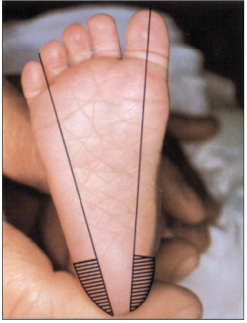
- Avoid the posterior curvature of the heel.
- Allow the foot to hang down to increase blood flow.
- The aim is to fill the circles on the newborn blood spot card completely.
- Wait up to 15 seconds to allow blood to flow. Allow one spot of blood to drop onto each of the circles on the card.
- Allow the blood to fill the circle by natural flow and to seep through to the back of the card.
- Fill each circle completely and avoid layering blood.
- Wipe any excess blood from the heel and apply gentle pressure to the wound with gauze.
- If the blood flow ceases during the test the congealed blood should be wiped away firmly with gauze. Gently ‘massage’ the foot and avoid squeezing.
- If the baby is not bleeding and a second puncture is necessary, this should be performed on a different part of the same foot or on the other foot.
- Apply a spot plaster if required.
After the blood spot sample has been taken
Allow blood spots to air-dry away from direct sunlight or heat before placing in the glassine envelope. The card should be placed into the envelope blood spot end first.
Delivery of the completed Card
Wexham Park site
-
Review the details of the card with a parent/carer, paying particular attention to the identification label and expiry date of the card and ensure all fields are completed correctly.
-
All antenatal carrier results obtained from maternal sickle cell and thalassaemia screening should be included on the card.
-
Sample cards can be taken to the point of care office on the post-natal ward and placed in the BLOOD SPOT BOX and details recorded on the tracking sheet.
-
Screening team collect the blood spot cards from the neonatal unit and the PN ward office daily and cross check the tracking sheet with the NBBS cards to ensure they are all present.
-
Screening team package up the cards and take to laboratory specimen reception for internal transfer to Oxford newborn screening laboratory.
-
Community Hubs who use the hospital transport system to transfer the NBBS cards to laboratory specimen reception package them up and they are collected by the internal transport team. Community teams must adopt a team checking process to ensure all demographic details, sample date etc are completed and correct.
-
Internal transport team couriers the samples to the Oxford newborn screening team daily and leaves at 12:00 pm (Mon-Fri)
-
Staff must record that the test has been taken in the baby’s EPIC record and complete the baby’s body map to show position of NBBS puncture site.
-
Parents/carers should be informed to expect a results letter from the child health records department if all conditions are undetected. If any abnormal results are identified, they will be contacted by the screening team or specialist clinician.
-
Parents will be informed by the screening team if haemoglobinopathy carrier result are identified. The screening team will ensure verbal and written confirmation of all screening results will be included when providing carrier result information.
Frimley Park site
-
Review the details of the card with a parent/carer, paying particular attention to the identification label and expiry date of the card and ensure all fields are completed correctly.
-
All antenatal carrier results obtained from maternal sickle cell and thalassaemia screening should be included on the card.
-
Sample cards can be taken to the community clerk based in the antenatal clinic and placed on her desk for packaging and taking to specimen reception.
-
Community hubs can use the hospital transport system to transfer the NBBS cards to Frimley Park specimen reception and must complete a template with the details of all cards sent and scan this over to the screening team and community clerk.
-
Community Teams must use the white A4 envelopes provided by the screening team, these are clearly labelled with the NBBS laboratory address and stand out when arriving at Frimley Park specimen reception.
-
Daily Frimley transport courier the samples to Southwest Thames newborn screening laboratory and leaves at 13:00 each day Monday- Friday.
-
Record that the test has been taken in the baby’s EPIC record and complete the baby’s body map to show position of NBBS puncture site.
-
Inform the parents/carers to expect a results letter from the child health records department if all conditions are undetected or if any abnormal results are identified they will be contacted by the screening team or specialist clinician.
-
Parents in Surrey and Hampshire will be informed by specialist health visitors if haemoglobinopathy carrier result are identified. Parents in Berkshire will be informed by the screening team. The screening team will ensure verbal and written confirmation of all screening results will be included when providing carrier result information.
Clerical process (Community clerk)
-
Complete community tracking spreadsheet located in maternity reports. This records date sample sent and the name of who completed the screen.
-
Place Newborn blood spot cards in A4 envelope with Laboratory address label attached.
-
Record on the front of the envelope the number of cards that have been placed inside.
-
Take the envelope to pathology reception, lab staff will date and sign our book to confirm sample envelope received.
MUST BE IN PATHOLOGY by 12:30pm
Special circumstances
-
Babies requiring multiple blood samples
-
Preterm babies
-
Babies requiring blood transfusion
Analgesia/comfort measures
-
An assessment of the baby’s level of distress and ability to tolerate handling must be made before initiating comfort measures.
-
Engaging the baby through face-to-face contact, voice and touch may be beneficial.
-
Analgesia in the form of breast feeding or non-nutritive sucking is recommended for babies who undergo multiple invasive procedures.
-
Babies admitted to neonatal unit are likely to have multiple blood samples taken. Venepuncture or venous/arterial sampling from an existing line is an alternative, providing the sample is not contaminated with heparin and the line is clear of infusate.
Babies born before 32 weeks gestation
-
Babies born before 32 weeks gestation should be screened on day 5 as normal but a REPEAT blood spot should be sent at 28 days postnatally or at the time of discharge from hospital (whichever is sooner) for an accurate CHT result. Date of discharge should be clearly recorded on the sample card if baby < 28 days old.
-
Mark the card ‘repeat TSH’ and make sure that the gestation is recorded in weeks and days.
Babies requiring blood transfusion
-
A single blood spot should be taken for Sickle Cell status prior to transfusion where possible.
-
Babies admitted to Neonatal unit (NNU) at less than five days of age should have a single circle blood spot sample taken and marked as ‘PRE-TRANSFUSION’.
-
The ‘PRE-TRANSFUSION’ blood spot card should be stored with the baby’s medical records and despatched to the newborn screening laboratory with the completed day 5 card. For babies who have had a blood transfusion on or before day 5, the blood spot sample can be taken between day 6 and day 8 inclusive. This is to make sure that there is a clear window between the transfusion and the sample being taken. The routine blood spot sample must be taken by day 8 at the latest.
-
Complete all boxes on both cards.
-
Where a baby has already had a blood transfusion either intrauterine or in the newborn period, before the screening blood sample is taken, repeat samples are required 72 hours (three days) after the blood transfusion for PKU, CHT, CF and MCADD as well as at four months for SCD after the last blood transfusion (for intra-uterine transfusion, count date of birth as date of transfusion).
-
The date of the last blood transfusion must be recorded on the blood spot card.
-
In the event of multiple transfusions an initial screening sample should be sent on day eight regardless.
-
Record the date and time of the last blood transfusion on the blood spot card and baby’s discharge records. Inform the baby’s parents/carers, record in the medical records, PCHR and transfer/discharge letters that newborn screening is not completed and identify which tests are outstanding.
Babies new to the area
It is the responsibility of the GP or Health Visitor to ensure all babies under the age of 1 year who have moved into the area and have not been screened or have no documented evidence of NBBS results are sent for screening in line with their local arrangements. At Frimley Health the children’s outpatient’s department will accept referrals from the Health visiting teams and support obtaining the sample for these families if complete NBBS request card has been completed and an appropriate appointment has been scheduled. See related documents section for Movers in standard operating procedure.
Repeat Requests
Avoidable repeats
Good quality blood spot samples are vital to make sure that babies with rare but serious conditions are identified and treated early. Repeat requests should be obtained as soon as possible and within 72 hours of receipt of the request.
Management of repeat requests
Wexham site
-
Screening team log on daily to ‘Omnilab’ Oxford laboratory database
-
Select Reports>Q-Query, >Babies in Hospital Cards Awaiting Info/Action and Cards Awaiting Info/Action, >Select baby by episode number.
-
Print off repeat requests and complete community midwife request sheet
-
Community midwife informed via phone and request sheet emailed to the relevant team to arrange repeat.
-
The repeat is actioned by the Community team and NBBS national failsafe (Northgate) is monitored by screening administrator.
-
NBBS spreadsheet completed.
Frimley site
-
All repeat requests are emailed through the NHS.net email from Southwest Thames Newborn screening lab to the screening team generic email.
-
The email is forwarded to the community midwives’ generic email address and the community clerk’s email for the clerk to action on day of receipt by contacting a member of the team.
-
The repeat is actioned by the community team and NBBS national failsafe (Northgate) is monitored by screening administrator.
-
NBBS spreadsheet completed.
Management action plan avoidable repeats
All avoidable repeats and trends, or training issues are identified and avoidable repeat action plan coordinated by the screening team. The community or ward team leader is informed of every repeat request.
Avoidable repeat action plan
In a single quarter:
-
One repeat request, no further action required but team leader informed.
-
Two repeat requests, team leader is asked to review practice and identify any training needs.
-
Three repeat request, team leader asked to review practice and consider supervised practice and in addition completion of NBBS eLearning, evidence of completion to be received by the screening team within 2 weeks.
Monitoring of performance against KPI NB2 (avoidable repeat rate)
-
Monthly avoidable repeats per team identified (community, PN ward, NNU )
-
Monthly communication sent to community/hospital teams and matrons to include good practice, number of avoidable repeats and advice on how practice could improve, specific to their team/area.
-
Number of avoidable repeats sent to heads of Midwifery monthly and performance monitored on maternity dashboard.
-
Quarterly performance report including avoidable repeat rate and highlighting any specific targeted improvement work presented at quarterly screening board meeting.
Reasons for avoidable repeats
1. Insufficient blood
If the circles contain a small blood spot or blood has not soaked through to the back of the card, there will be insufficient blood to complete screening accurately. This can give a false negative result.
2. Inappropriate application of blood
Applying several small spots of blood to the circle (multi-spotted sample) can give a false negative result.
Applying pressure to the spot to spread the blood out to fill the circle (compressed sample) leads to a significantly higher risk of a false negative result.
Layering one spot of blood directly on top of another or applying blood to the front and back of the blood spot card can give a false positive result.
3. Contamination
Contamination of the sample, for example if the card gets wet, will give an inaccurate result.
4. Taken when the baby was too young
This is when a sample is taken before day 5 (excluding pre-transfusion samples). It is important to calculate day 5 using day of birth as day 0. This can lead to a false positive result for congenital hypothyroidism.
5. Incomplete or inaccurate labelling on the card
Incomplete or inaccurate data on the blood spot card, for example no or inaccurate NHS number, date of sample or date of birth, will result in a repeat request because the baby cannot be accurately identified. This will delay treatment if the baby’s screening result is positive.
6. Expired card
The expiry date is for quality control. After this date, the quality of the filter paper and therefore the results cannot be guaranteed.
7. Pre transfusion/admission and day 5 sample on the same card
This can cause confusion and lead to inaccurate results.
Reasons for unavoidable repeats
1. Prematurity
Prematurity can mask congenital hypothyroidism (CHT). Babies born at less than 32 weeks gestation (less than or equal to 31 weeks + 6 days) need a second blood spot sample in addition to the day 5 sample, to screen for this condition.
The second sample is taken when the baby reaches 28 days of age (day of birth is day 0) or on the day of discharge home from the hospital, whichever is sooner.
Write in the blood spot card comment box ‘CHT preterm’.
Prematurity can also mask sickle cell disease (SCD). Some premature babies who show no haemoglobin A need a second sample to test for SCD.
Inform parents/carers that a repeat sample is recommended because the routine day 5 test may not pick up SCD in premature babies.
Write in the blood spot card comment box ‘SCD preterm’.
2. Borderline congenital hypothyroidism result
This is when the result of the initial blood spot screening test for CHT is borderline. Another sample is required to establish a final screening result.
The repeat sample should be taken 7 to 10 days after the initial sample.
Inform parents/carers of the 2 possible outcomes from this repeat test.
-
CHT not suspected. Most babies requiring a repeat test for CHT will have this result.
-
CHT suspected. About 15% of babies requiring a repeat test for CHT will have this result. In this case, the newborn screening laboratory will refer the baby directly to a pediatrician. If the result is another borderline, the laboratory will also be referred.
Write in the blood spot card comment box ‘CHT borderline’.
3. Inconclusive cystic fibrosis result
This is when the result of the initial blood spot screening test for cystic fibrosis (CF) is inconclusive. Another sample is required to establish a final screening result.
The repeat sample should be taken on day 21 (no later than day 24). If the baby is already older than this, the sample should be collected as soon as possible. If the baby is older than 8 weeks (56 days), the result of the repeat test would be unreliable. Do not collect the repeat sample and explain this to the parents. Inform the screening laboratory immediately.
Inform parents of the 3 possible outcomes from this repeat test.
-
CF not suspected. Most babies requiring a repeat test for CF will have this result.
-
Carrier of CF. About 35% of babies requiring a repeat test for CF will have this result. This means that the baby is a healthy CF carrier. A health care professional will contact the parents to discuss the result.
-
CF suspected. About 20% of babies requiring a repeat test for CF will have this result. In this case, the newborn screening laboratory will refer the baby directly to a CF specialist.
Information sheets on the second immunoreactive trypsinogen (IRT) test are available for healthcare professionals and parents/carers.
Write in the blood spot card comment box ‘CF inconclusive’.
4. Blood transfusions
When a baby has had a blood transfusion before the day 5 sample, another sample is needed at least 3 clear days after the last transfusion. This allows time for metabolite concentrations to return to pre-transfusion levels.
The date of the last blood transfusion must be recorded on the blood spot card. Write in the blood spot card comment box ‘post-transfusion’.
Results
Wexham site
Normal Results: Parents/carers receive a letter from their area Child Health Records Department.
Abnormal Results:
-
Screening team log on daily to ‘life cycle’ Oxford laboratory database
-
Select East Berkshire new born blood spots
-
Positive results identified and acknowledged on the system
-
Metabolic or Congenital hypothyroid disorder identified: Oxford NBBS laboratory will contact Consultant Paediatrician on call.
-
Suspected or confirmed cystic fibrosis result. Regional CF coordinator based at Oxford University Hospitals. Oxford is informed directly by the laboratory and arranges on going care.
-
Positive Haemoglobinopathy result. Screening team at Wexham informed by phone, email and through Omnilab. Patient informed by screening team and appointment given with joint Paediatric/Haematologist. Advice available from Specialist haemoglobinopathy Nurse based at Oxford
-
The national newborn outcome solution (NBO) will email the screening team and the lead paediatric/haematology consultant when a haemoglobinopathy condition has been confirmed on newborn blood spot. The clinical team will accept the notification and update the NBO record with confirmation that parents have been notified of their babies result. This indicates to the laboratory that they can release the result to the child health information service and the newborn blood spot failsafe system. The clinician will update the NBO record further once the baby has been seen in clinic and there is a treatment plan in place. Log in details for the NBO solution system are kept by the screening team.
-
Carrier results: screening team acknowledge the result on the Omnilab system and will send a letter to the parents and include further written information on the specific carrier condition. The screening team will also inform the patients GP and HV.
Frimley Site
Normal Results: Parents/carers receive a letter from their area Child Health Records Department.
Abnormal Results
No results are received directly by the Frimley site. All clinical care pathways for abnormal results are activated by Southwest Thames laboratory directly to the appropriate clinician. Outcome data for high-risk Sickle Cell and Thalassaemia couples can be found on the National Failsafe system and positive Haemoglobinopathy results are managed by the screening team using the Newborn outcome solution (HBO) system.
The NBO system will email the screening team and the lead paediatric/haematology consultant when a haemoglobinopathy condition has been confirmed on newborn blood spot. The clinical team will accept the notification and update the NBO record with confirmation that parents have been notified of their babies result. This indicates to the laboratory that they can release the result to the child health information service and the newborn blood spot failsafe system. The clinician will update the NBO record further once the baby has been seen in clinic and there is a treatment plan in place. Log in details for the NBO solution system are kept by the screening team.
KPI reporting Trust Requirement
NB2: The Proportion of babies from whom it is necessary to take a repeat blood sample due to an avoidable failure in the sampling process.
This guideline is subject to external monitoring by the newborn screening laboratory at St Helier Hospital and Oxford Newborn screening laboratory.
Data provided by the laboratory is submitted to the Screening coordinator to fulfil KPI NB2 requirement.
Tracking Failsafe
Northgate National NBBS failsafe system is monitored by the screening administrator. The system is reviewed a minimum of 3 times a week and is overseen by the screening coordinators.
The administrator’s will investigate and action all babies identified as not having a NBBS sample in the laboratory by day 12 ‘amber’ and by day 17 ‘red’ and ensure all babies transferred in from other providers are accepted appropriately and babies who transfer out are appropriately exported on the national system to ensure accurate tracking of our newborn cohort.
Weekly reports are received via email from Northgate to the screening coordinator, highlighting activity and any AMBER or RED babies to review if action is required.
Northgate national NBBS failsafe system:
https: bloodspot.necsoftware.thirdparty.nhs.uk="" bloodspotweb="" nhsbaby=""
Movers in
All babies under a year of age (up to but not including their first birthday and that have been born abroad) with no documented NBBS results on the Child health records system are eligible for newborn blood spot (NBS) screening for 9 conditions:
Movers in pathway is supported through children’s outpatients and Health Visitors will refer directly. The antenatal screening teams will support outpatient teams with clinical expertise and will manage transport of completed cards to the screening laboratory**.** Management of results will follow the same process as newborn results. Antenatal screening teams will be responsible for communicating Berkshire carrier results. See related documents section for Movers in standard operating procedure.
Monitoring
Avoidable repeat rate is monitored monthly by heads of midwifery and recorded on maternity dashboard.
Actions are monitored quarterly at the Screening board and annually in the screening report submitted to the national screening committee and the obstetric clinical governance meeting.
Communication
If there are communication issues (e.g., English as a second language, learning difficulties, blindness/partial sightedness, and/or deafness) staff will take appropriate measures to ensure the patient (and her partner, if appropriate) understand the actions and rationale behind them.
The Trust interpreting service must be considered.
Full version control record
This guideline has been registered with the Trust. However, clinical guidelines are guidelines only. The interpretation and application of clinical guidelines will remain the responsibility of the individual clinician. If in doubt, contact a senior colleague or expert. Caution is advised when using guidelines after the review date.
This guideline is for use in Frimley Health NHS Foundation Trust hospitals only. Any use outside this location will not be supported by the Trust and will be at the risk of the individual using it.
Version History
Related Documents