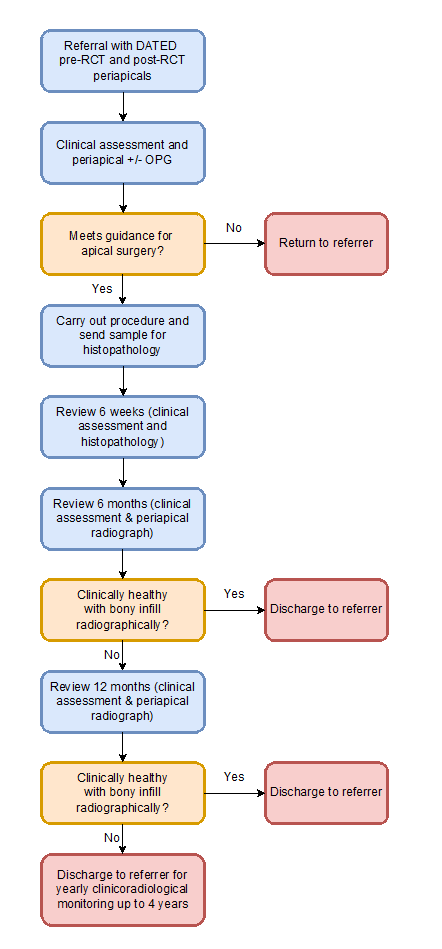
Referral Guidelines - Apical Surgery

Key Points

  • Apicectomy may be appropriate in cases where orthograde RCT has failed and cannot be improved, or where restorative/ surgical factors require root end surgery
  • Poor coronal restoration and suboptimal root fillings generally preclude the provision of apicectomy
  • Apical surgery should be followed by appropriate clinico-radiological monitoring
Version:3.1
Date Issued:10/01/2023
Review Date:01/12/2025
Key words:Apical, surgery, apicectomy, root end surgery, periradicular surgery

This is a controlled document. If you are using a printed copy, check it against the version on the guidelines platform to ensure you are using the latest edition.

Abbreviations

CBCTCone Beam Computed Tomography
RCTRoot Canal Treatment

Introduction

Apical surgery and apicectomy can be considered in cases where primary orthograde root canal treatment has failed and orthograde retreatment is deemed inappropriate or insufficient.

Indications

  • Previous treatment carried out to guideline standard but symptomatic or progressing periradicular disease in an optimally root-filled and restored tooth

    • Symptomatic or progressing periradicular disease in a well root-filled tooth where RCT:

      • Has failed

      • Would be detrimental to the structural integrity of the tooth/restoration

      • Would involve post removal with a high risk of root fracture

    • Where biopsy of periradicular tissue is required

Contraindications

  • Suboptimal quality root filling with scope to improve with orthograde retreatment

    • Insufficient time following RCT to allow bony infill in an asymptomatic tooth

    • Poor coronal seal

    • Unrestorable/ periodontally-compromised tooth

    • Perio-endo lesion

    • Root fracture

Imaging

Referrals for apical surgery should ideally include dated pre-RCT and post-RCT periapical radiographs, alongside any further imaging that demonstrates ongoing periradicular pathosis. Upon assessment, periapical radiography is preferable to an orthopantomogram, unless a more extensive lesion is present. Where conventional radiography does not provide sufficient information to diagnose or treatment plan a case, CBCT imaging may be required. Such instances include lesions close to the inferior alveolar/ mental nerve or the maxillary sinus, assessment of root fractures, iatrogenic damage or resorption.

Since there is good evidence to suggest that endodontic re-treatment has a higher success rate than apical surgery, patients will be advised to pursue a non-operative route if obturation is radiographically incomplete or short of the root apex. In order to prevent recontamination and failure of apical surgery, all patients should also have a satisfactory coronal seal.

Reference/Further Reading

More comprehensive guidelines and evidence-based recommendations are available here:

RCS/ BES Guidelines for Periradicular Surgery 2020

Protocol for Periradicular Surgery and Apicectomy

Full version control record

Version:3.1
Guidelines Lead(s):Mr Michael Amin, Consultant Oral & Maxillofacial Surgeon
Contributor(s):Dr Indriyesha Puri, Dr Alpa Dave
Lead Director / Chief of Service:Lt. Col Nnaemeka Okpala
Library check completed:30/09/2022
Ratified at:OMFS CCG 15/12/2022
Date Issued:10/01/2023
Review Date:01/12/2025
Pharmaceutical dosing advice and formulary compliance checked by:N/A
Key words:Apical, surgery, apicectomy, root end surgery, periradicular surgery

This guideline has been registered with the trust. However, clinical guidelines are guidelines only. The interpretation and application of clinical guidelines will remain the responsibility of the individual clinician. If in doubt contact a senior colleague or expert. Caution is advised when using guidelines after the review date. This guideline is for use in Frimley Health Trust hospitals only. Any use outside this location will not be supported by the Trust and will be at the risk of the individual using it.

Version Control Sheet

VersionDateGuideline Lead(s)StatusComment
1December 2005Consultant Oral & Maxillofacial SurgeonFinal
2December 2020Consultant Oral & Maxillofacial SurgeonFinal
2.1March 2022Clinical Guidelines AdministratorInterimTransferred to new Clinical Guidelines Template
3.0September 2022Consultant Oral & Maxillofacial SurgeonFinalUpdate based on QI project action plan.
3.1January 2023Clinical Guidelines System ManagerInterimRe-worked Periradicular Surgery and Apicectomy flow chart.