Key Points
Ensuring safe and effective management of nutrition screening and oral feeding, to help patients maintain or improve their nutritional status and help prevent weight loss throughout Frimley Health NHS Foundation Trust.
This is a controlled document. If you are using a printed copy, check it against the guidelines site to ensure you are using the latest edition. Print copies must be destroyed after use.
Abbreviations
Introduction
BAPEN 2016 have stated at least 25-34% of patients admitted to hospital are at risk of malnutrition. Stroud et. al. (2003) found that undernutrition may impair immunity, wound healing, muscle strength and psychological drive. Malnutrition can increase the risk of complications with medical and surgical interventions and may increase length of stay in hospital with increased costs.
All hospital patients should have malnutrition screening, which should be complete by a trained healthcare professional (NICE 2017). Jenson et. al. (2010) noted that nutritional therapy is an important supportive measure to facilitate effective medical treatment. Hospitals should aim to provide adequate nutrition to all patients, often this can be supplied from the hospital menu however, some patients may require oral nutritional support and/or supplements or enteral tube feeding to help meet their nutritional requirements.
Treatment and care should take into account patients' needs and preferences. People with malnutrition should have the opportunity to make informed decisions about their care and treatment, in partnership with their health professionals. When patients do not have the capacity to make decisions, healthcare professionals should follow the Department of Health's advice on consent and the code of practice that accompanies the Mental Capacity Act.
Malnutrition Screening and Management
-
Completion of “Malnutrition Universal Screening Tool” (MUST) training is an essential yearly training requirement for all nurses across FHFT.
-
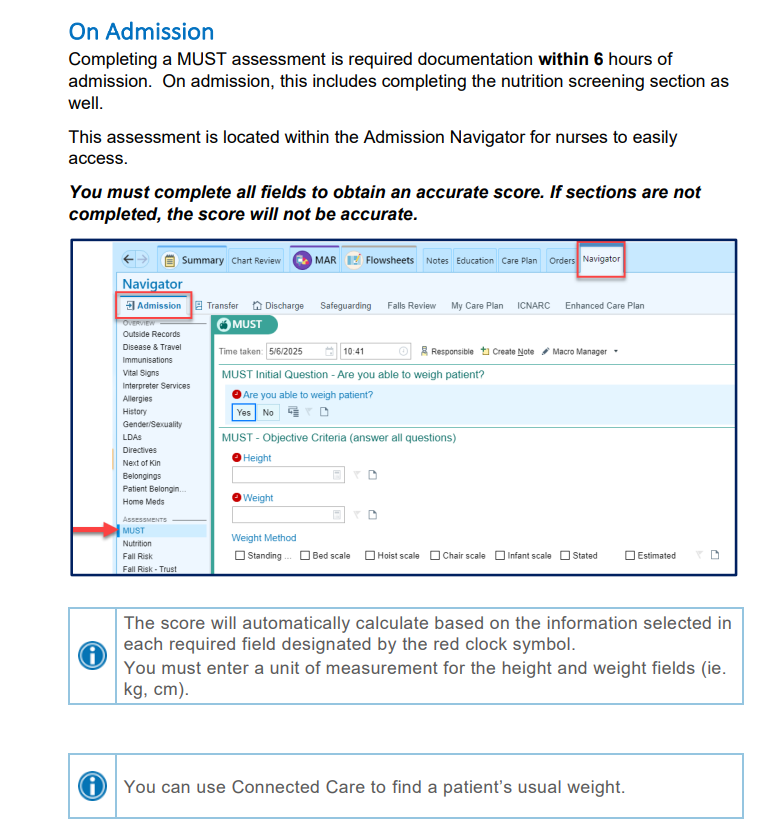
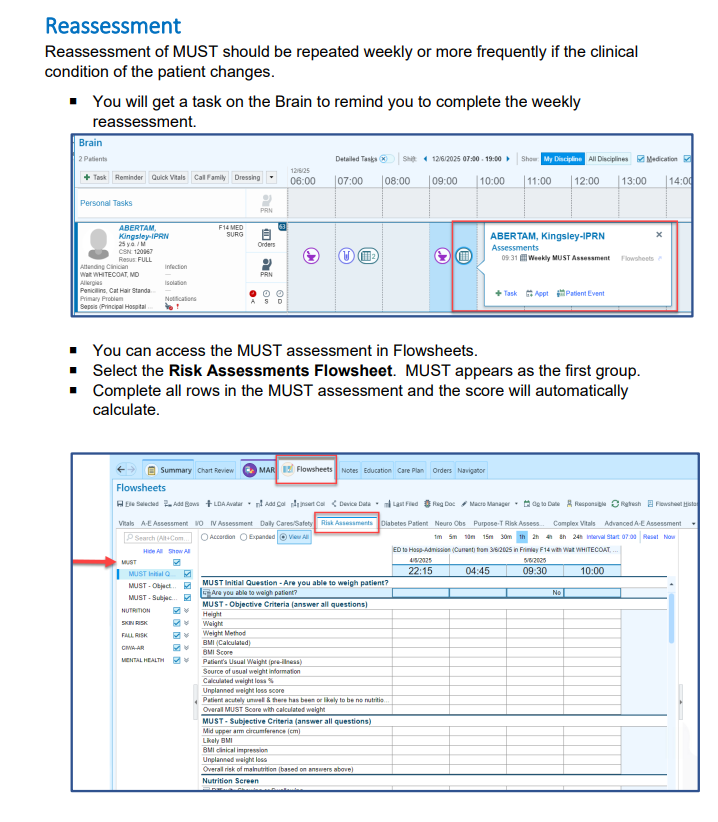
Early nutritional assessment is essential, and the MUST (Appendix 1) should be completed within six hours of admission and repeated weekly.
-
Every patient should be weighed on admission and the weight recorded in the MUST on Epic (this assessment is located within the Admission Navigator for nurses); weight should be repeated and recorded weekly unless otherwise indicated. If it is not possible or if inappropriate to weigh, e.g., if the patient is receiving end of life care, this should be documented on the MUST.
-
If weight cannot be obtained, use mid-upper arm circumference (MUAC) to give an estimated BMI (BAPEN, 2003), and complete sections on subjective criteria for MUST. Further details on measuring and interpreting MUAC can be located in the MUST assessment in Epic.
-
Every patient should have their height recorded on the MUST (on the Admission Navigator under Assessments). If a height measure is not available, ask the patient/family for an accurate height or measure ulna length for an estimated height
-
Please refer to https: https://www.bapen.org.uk/pdfs/must/must_page6.pdf for how to measure ulna length
-
BMI is automatically calculated by Epic provided that the weight and height criteria have been filled. BMI is calculated by using the calculation below:
BMI = weight (kg) / (height (m))2
-
Patients who are at high risk of malnutrition are those who have a MUST score of 2 or more (BAPEN 2003) and should be referred to a Dietitian by completing an Inpatient consult to Dietetics on Epic. If a patient scores MUST less than 2, but using clinical judgement you feel specialist dietetic input is required, please refer to the dietitian and include details of reason for referral. Please note, patients with eating disorders and a low BMI will require specialist multidisciplinary team input. FHFT eating disorder guideline is available on Frimley Guidelines.
-
All health care professionals should be implementing MUST care plan interventions at the point of the initial MUST screening. This supports early nutrition care and reduces the negative impact of poor nutrition on co-morbidities, length of stay and mortality. MUST care plans should be implemented prior to a Dietetic consult and is FHFT’s first line nutritional intervention support.
-
If as a Nurse professional, you have completed the training on first line interventions, you will be able to add first line oral nutrition supplements, Fortisip Protein Compact, to the patient’s Epic orders.
Oral Nutritional Support
MUST care plan interventions
Patients who are deemed to be at medium or high risk of malnutrition should have appropriate MUST care plan oral nutrition support measures initiated at ward-level, unless the patient has issues with swallowing, food allergies or is at risk of refeeding syndrome.
The MUST care plan includes:
-
Weigh and screen patient weekly and document
-
Check that any physical symptoms affecting food intake are adequately controlled e.g. nausea, vomiting, constipation, diarrhoea by liaising with clinical team to ensure correct drug treatment, e.g., anti-emetics, laxatives etc.
-
Check that any psychological factors affecting food intake have been highlighted to the relevant teams, e.g., dementia team, psychiatry liaison team, psychology team, if appropriate.
-
Start fortified menu (FPH) or higher energy menu (WPH) if appropriate (please note at WPH, the higher energy menu options are coded on the main hospital menu). There are also higher energy options available on other sites.
-
Ensure meals are being served on the correct coloured tray:
-
Provide two Fortisip Compact Protein drinks per day (If patient is on thickened fluids or has allergies, please seek advice from SLT or Dietitian)
-
Encourage suitable snacks and drinks between meals, e.g., biscuits, milky drinks, yoghurts.
-
Check if the patient might benefit from a finger food menu
-
Ensure the patient is on the correct therapeutic menu (e.g., puree, easy to chew, low fibre, neutropenic, gluten-free etc.)
-
Commence food record charts and fluid balance charts if appropriate. (After 3 days if the patient is eating half or less of their meals, reassess the patient using clinical judgement and refer to the Dietitian)
Adherence to the management guidance is monitored via the monthly Harm Free Care audit carried out on every ward across the trust.
The MUST care plan can be found on the patient’s care plans once MUST has been completed and patient has been deemed at medium or high risk of malnutrition.
Patients at moderate to high risk of malnutrition (score 1 and above) should be advised on high energy menu choices
At Frimley Park Hospital
The nurse who has fully completed the MUST, should ask the ward host/hostess to give the patient a fortified menu, providing this is appropriate for the patient with regards to swallowing issues and allergies.
At Wexham Park Hospital and Heatherwood Hospitals
The nurse who has completed the MUST, should ask the ward host/hostess to guide the patient in choosing higher energy (HE) coded choices on the menu, providing this is appropriate with regards to swallowing issues and allergies.
At Farnham Hospital
The nurse or dietitian on the ward can order the mini meals extra from the kitchen for certain patients who require them.
Food charts
Documentation of oral intake should be commenced after nutrition screening in accordance with MUST care plan.
To complete these please document on intake section of I/O Flowsheet or on Nutrition section of Daily Cares/Safety Flowsheet.
Documentation of any oral intake of fluids and food and should be documented including the following; snacks, main meals and any additional items brought in by relatives. Please include details of what food and drinks were consumed along with the amount taken. Multiple attempts to encourage the patient to eat or drink without success and therefore refusal of food by the patient should also be documented.
Oral Nutrition Supplements (ONS)
Supplement drinks such as Fortisip Compact Protein are nutritionally balanced and provide additional energy, protein, vitamins and minerals and can be used as a supplement to food.
Nursing staff will arrange for a patient to receive two first-line Oral Nutrition Supplements (ONS) per day if the MUST care plan indicates that it is required and if the International Dysphagia Diet Standardisation Initiative (IDDSI) level is deemed suitable for the patient.
Allergen and cultural diet information can be found on the manufacturers website.
For support with allergies and cultural information in dietetic working hours please contact the dietitians.
Nursing staff who have completed appropriate training as per the “Appropriate prescribing of first-line oral nutritional supplements policy” should add first-line oral nutritional supplements onto the patient electronic system to improve compliance. If nursing staff are unsure if products are suitable for a patient, they are advised not to give supplements and to check suitability with the Dietetics department. Upon assessment, Dietitians may adjust oral nutrition supplements to better meet patients’ nutritional, medical and cultural needs.
Ordering of ONS
All ward areas are responsible for ensuring that a first-in and first-out method is used for nutritional product storage. The ward should regularly be checking their stock levels, discarding any out-of-date products and returning excess stock that is in date.
At Frimley Park Hospital - Wards are responsible for ordering their own supply of Fortisip Compact Protein/FortiJuce from the main kitchen. Ward hosts/hostesses use a proforma to request Fortisip Compact Protein; this is sent to the kitchen with the menus using a C6 form. The order will be sent to the ward on the next lunch trolley. Kitchen staff would be grateful if the ward staff use this method and do not go to the kitchen in person to collect supplement drinks.
At Wexham Park - It is the ward’s responsibility to keep stock topped up, and to order additional products as required. Products can be ordered on PlanetFM. PlanetFM confirmation/summary sheet should be printed and presented in the store area of the catering department between 8am and 3pm at Wexham Park Hospital and wards can take their own order from the store within catering.
Heatherwood Hospital – It is the ward’s responsibility to keep stock topped up, and to order additional products as required. Products can be ordered on PlanetFM. It is the ward’s responsibility to keep stock topped up, and to order additional products as required. Products can be ordered on PlanetFM.
At Farnham Hospital - The dietitian or ward clerks are responsible for checking stock of supplements each week, placing orders for nutritional supplements and stocking the cupboard next to Runfold Ward.
Advice for taking oral nutrition supplements
-
Encourage supplement drinks between meals
-
Supplements are best served cold, however, they do not have to be stored in the ward fridge
-
Encourage slow sips over the course of an hour
-
Some patients may need assistance opening the lid or prefer the supplement in a cup
-
Once opened, any supplement drink not finished after 4 hours should be discarded to comply with Frimley Health Infection Control Guidelines. The amount of supplement taken should be documented on the flowsheets on Epic.
ONS on discharge:
Oral nutritional supplements should not be added to any TTOs unless specifically stipulated by a dietitian. If a patient requires to continue with supplement drinks after discharge from hospital the dietitian will contact the General Practitioner (GP) to arrange a prescription, in line with community ONS formulary. after discharge from hospital the dietitian will contact the General Practitioner (GP) to arrange a prescription. Patient should be advised that the prescription from the GP will likely be different to the product they have used in the hospital. GP should prescribe according to the community ONS formulary and as guided by the dietitian letter. Please notify the dietitian as soon as you know that a patient is going. Please notify the dietitian as soon as you know that a patient is going home.
If the patient has been started on a nutritional supplement initiated by a medium or high nutritional risk (MUST of 1 or above), during their hospital stay but not under a dietitian, the supplement should not be included on TTO’s. The patient should be advised to increase nutritional intake through meals, extra snacks and nourishing drinks and contact their GP if they are losing weight unintentionally.
Progressing oral nutrition support to enteral feeding
Providing adequate and appropriate fluid and nutrients is a basic duty to sick patients (Stroud et al. 2003). Therefore, if patients are not adequately meeting needs orally, an escalation in the levels of nutrition intervention may be required. Progression of oral nutrition supplementation and/or supplementary nasogastric (NG) feeding is likely to be indicated and will be advised by the ward dietitian. The Nutrition Team and ward dietitian can advise on the appropriate level of nutritional escalation.
In certain clinical cases it may not be appropriate to initiate tube feeding. Patient groups who may not be appropriate include those suffering from dementia, those with terminal/palliative disease and patients receiving end of life care. If in certain cases enteral nutrition may provide symptom relief, it can be considered and discussed at a multidisciplinary team (MDT) level. In cases where the benefit of artificial nutrition support are in doubt, a ‘time limited’ trial of feeding may be useful which should be agreed by the medical team/dietitian/family/next of kin (Stroud et al 2003).
Patients with Dementia
Malnutrition risk and risk of low-intake dehydration increases with progression of dementia and is likely to affect over two thirds of this patient group at advanced stages (Royal College of Physicians 2021).
Hospital admission can cause distress, confusion and delirium for a person with dementia (NICE). This can be caused by an unfamiliar environment, faces, routine, food, and can result in longer hospital stays, delays in leaving hospital and reduced independent living.
Each patients' difficulties with eating will be unique to them and their situation. Food refusal can be part of the disease process in advancing dementia.
A prominent clinical feature of dementia is weight loss and becomes more common with the progression of the disease (ESPEN, 2024). Nutritional support should be an integral part of dementia management.
Recommendations from
-
Review ‘This is me’ document for guidance, as this contributes to patient centred care as may explain habits, wishes and preferences.
-
For patients screened at risk of malnutrition, it is essential to follow the malnutrition care plan as detailed in the above section
-
To record eating/drinking problems and behavioural symptoms
-
To consider other causes of malnutrition, such as pain, chewing problems, acute disease effect and side-effects of medications
-
Dietary restrictions should be avoided (where possible)
-
Periods of fasting due to diagnostic procedures or surgery, should be minimised
-
Food and fluid intake may need to be supervised, encouraged and supported. This may include verbal encouragement, cutting food up and offering drinks frequently
-
Use specialist eating and drinking aids with patients with impairments, such as muscle weakness. An occupational therapist may be able to give guidance.
-
Use gentle verbal prompts or ‘hand over hand’ support
-
Ensure enough time is available to support the patient to eat at their own pace
-
‘No’ may not mean’ no’. The patient may be trying to communicate their needs and preferences. The patient may no longer recognise food and drinks. Use with caution the terminology ‘refusal to eat’, as the patient may lack mental capacity to make this decision. This may indicate the patient is in the last days, weeks of life
-
To frequently offer appropriate drinks and snacks
-
Good oral care is fundamental to optimise oral intake
-
Decisions for or against enteral tube feeding should be made on an individual basis with involvement of discussions with the patient, family and MDT
-
Patients in the terminal phase of life, enteral and parenteral nutrition should not be initiated
-
Enteral nutrition is usually a temporary solution for patients with mild to moderate dementia
Each patients' difficulties with eating will be unique to them and their situation. Food refusal can be part of the disease process in advancing dementia.
When assessing patients with dementia for consideration of escalation of nutrition, many feeding and ethical issues need to be considered within the MDT. The right nutritional support can improve quality of life and slow nutritional risk.
NICE guideline 97; dementia: assessment, management and support for people living with dementia and their carers 2018, and the ESPEN 2024 guideline on nutrition and hydration in dementia has provided guidance:
-
Adopt a palliative care approach from diagnosis until death to support the quality of life of people with dementia and to enable them to die with dignity
-
Encourage patients with dementia to eat and drink by mouth for as long as possible (safest consistencies as per speech and language therapist, if appropriate).
-
Ensure that there are adequate dietary provisions at ward level (e.g., finger food menu if in line with Speech and Language recommendations)
-
Always consider inviting friends/relatives to assist with feeding at mealtimes
-
Tube feeding is not routinely used in people living with severe dementia unless indicated for potentially reversal co-morbidities: refer to guideline “Enteral tube feeding for people living with severe dementia, NG 97, 2018)
-
Apply ethical and legal principles to decisions to withhold or withdraw nutritional support
-
As required involve other specialist health care professionals, e.g., dementia specialist nurse
Finger Food Menu
Providing patients are able to tolerate a normal diet and normal fluids, finger foods can be beneficial for a variety of patients, particularly those with dementia, delirium or learning disabilities.
- If patients require an easy to chew diet, some of the finger food menu options will not be suitable and the menus will need to be adapted. Liaise with the speech and language therapist about this.
Benefits include;
-
Improved oral intake
-
Easy to eat
-
Can reduce the need for cutlery for patients with dexterity issues who want to remain independent
-
Stimulate appetite
-
Encourage eating
-
Preserve ability to eat
-
More freedom at mealtimes
-
Many of the options don’t need to be kept warm so allows flexibility around timing of meals
-
Can provide variety and nutritional balance
How to order finger food menu
-
Patient identified by clinical staff e.g. ward nurse, dietitian, speech and language, as someone who would benefit from a finger food menu
-
This should be communicated to the ward host/hostess who will then order the patient the finger food menu
-
This should also be documented on the ward menu board and patient white-board if this is used on the ward
Eating and drinking with acknowledged risk and end of life care
Eating and drinking with acknowledged risks can be defined as ‘A decision to proceed with oral intake where a high risk of aspiration or choking has been identified (following a clinical swallow assessment), where the risk cannot be abolished or further managed and where clinically assisted nutrition and hydration (CAHN) is not clinically appropriate.’
These are some circumstances in which eating with acknowledged risks may be decided;
-
Patient has capacity to make decision on nutrition and hydration
-
Where clinically assisted nutrition and hydration is not appropriate or declined e.g. Nasogastric feeding
-
Where benefit of the nutrition outweighs the risk
Further guidance can be found on the intranet ‘Eating and Drinking with acknowledged risks’.
It may be inappropriate to continue with aggressive nutritional support during end of life care. For the purposes of quality of life and patient comfort and dignity, it is acceptable to offer the patient food and drink if they feel able to tolerate. Please refer to my care plan booklet to help guide discussions and decisions around nutrition.
Considerations could include;
-
MDT expertise advice and care in relation to support of nutrition (E.g. modification of diet, symptom control, hydration considerations)
-
Consideration of individual preferences
-
Discussions on aims of nutritional support
Appendix: Malnutrition Universal Screening Tool (MUST)
NB: Mock patient details
The process information below is taken from the Epic Tips sheet for Inpatient Clinicians. Please access tipsheet via Epic Tipsheets for any updates to this.