Key Points
- Provide information on the initial management of suspected and then confirmed cases of Trisomy 21.
This is a controlled document. If you are using a printed copy, check it against the guidelines site to ensure you are using the latest edition. Print copies must be destroyed after use.
Neonatal management of T21 checklist
Please ensure the following are completed for newborns with T21:
To do whilst inpatient
-
Clinical examination to document specific features of T21
-
Confirmatory genetic testing for T21
-
4 limb blood pressure
-
Spot pre- and post-ductal saturations
-
ECG
-
ECHO (may be inpatient or outpatient, timing depends on ECG result, see details in ‘Health Checks’)
-
FBC and blood film
-
Hearing check (standard new born hearing screen)
-
Visual check (as part of standard newborn physical assessment)
To arrange on discharge as outpatient
-
ECHO (if not inpatient, see ‘Health Check’ section for further details)
-
6-month hearing follow up with King Edwards VII audiology clinic (even if newborn hearing test normal) – to be arranged by named consultant at first outpatient appointment
-
6-week cataract check (as part of 6-week newborn check)
-
If FBC and blood film are abnormal in first 6 weeks, follow up or repeat blood testing will likely be necessary until age 5. This will be led by paediatric haematology.
Incidence
Approximately 1 in 1000 babies are born with Trisomy 21. The risk increases with maternal age (1 in 1500 age 20, 1 in 800 at 30, 1 in 270 at 35, 1 in 100 at 40 and 1 in 50 at 45).
Diagnosis and Parental Information.
Diagnosis and Parental Information
Antenatal diagnosis:
Nuchal screening at 10-14 weeks is combined with ‘quadruple blood test’ (AFP, βHCG, oestriol & Inhibin-A) plus maternal age to give an adjusted risk and this should identify over 75% of cases. Non-invasive prenatal testing is offered in high-risk pregnancies, using cell-free DNA (cfDNA) from maternal blood to provide another level of screening test. However, this is not a diagnostic test. Diagnostic testing via CVS/amniocentesis offered to those with a high risk NIPT. However, some parents will decline testing, and some babies with Trisomy 21 will have had low risk screening results.
Postnatal diagnosis:
Most babies can be recognised by experienced staff, though the features may be much less clear-cut in preterm infants. Common clinical signs include – hypotonia, small brachycephalic head, epicanthal folds, flat nasal bridge, upward slanting palpebral fissures, Brushfield spots, small mouth and ears, excessive skin at the nape of the neck, single transverse palmar crease, short 5th finger with clinodactyly, wide spacing of 1st and 2nd toes. If the diagnosis is suspected, inform a senior member of medical staff promptly. If possible, arrange senior medical review without voicing the diagnosis to the parents. However, parents’ questions should be answered honestly. Unless there is a medical reason, admission to NNU (Neonatal Unit) is not required but the infant should be reviewed daily as part of the postnatal ward round. Review feeding as this can be troublesome due to hypotonia and babies often being sleepier.
Confirmatory genetic testing:
All babies, even those with a confirmed antenatal diagnosis should have confirmatory postnatal testing. Please adhere to the following advise to ensure the results are available as soon as possible.
-
Send samples on a week day
-
x2 full lithium Heparin (Green screw top) and x2 full EDTA (Pink Push-Top) tubes
-
Use the Guys’s and St Thomas Test Request form for Non-WGS genetic tests.
-
Request both Blood EDTA for DNA and Lithium Heparin for Karyotyping on the blood form and write down for urgent QF-PCR and CGH array.
-
Take samples and form to send away office in person (do not use pod or leave them in the samples reception.) The office is in the pathology lab 3rd door on the right after entering the Lab.
-
Inform the send away team the samples should be sent to Genetic Lab in Tower wing at Guy’s and St Thomas’ hospital
-
Contact lab at Guy's to inform sample coming and request it is processed urgently.
-
Turn-around time is 48-72 hrs.
Information:
A Consultant will normally arrange to see both parents to discuss clinical diagnosis and see them again once results confirmed. Down’s Syndrome Association Booklet can be offered at first meeting if diagnosis is strongly suspected may be better to wait till diagnosis confirmed. The parents can also be signposted to https://www.downs-syndrome.org.uk/
Health Checks
Cardiac Check:
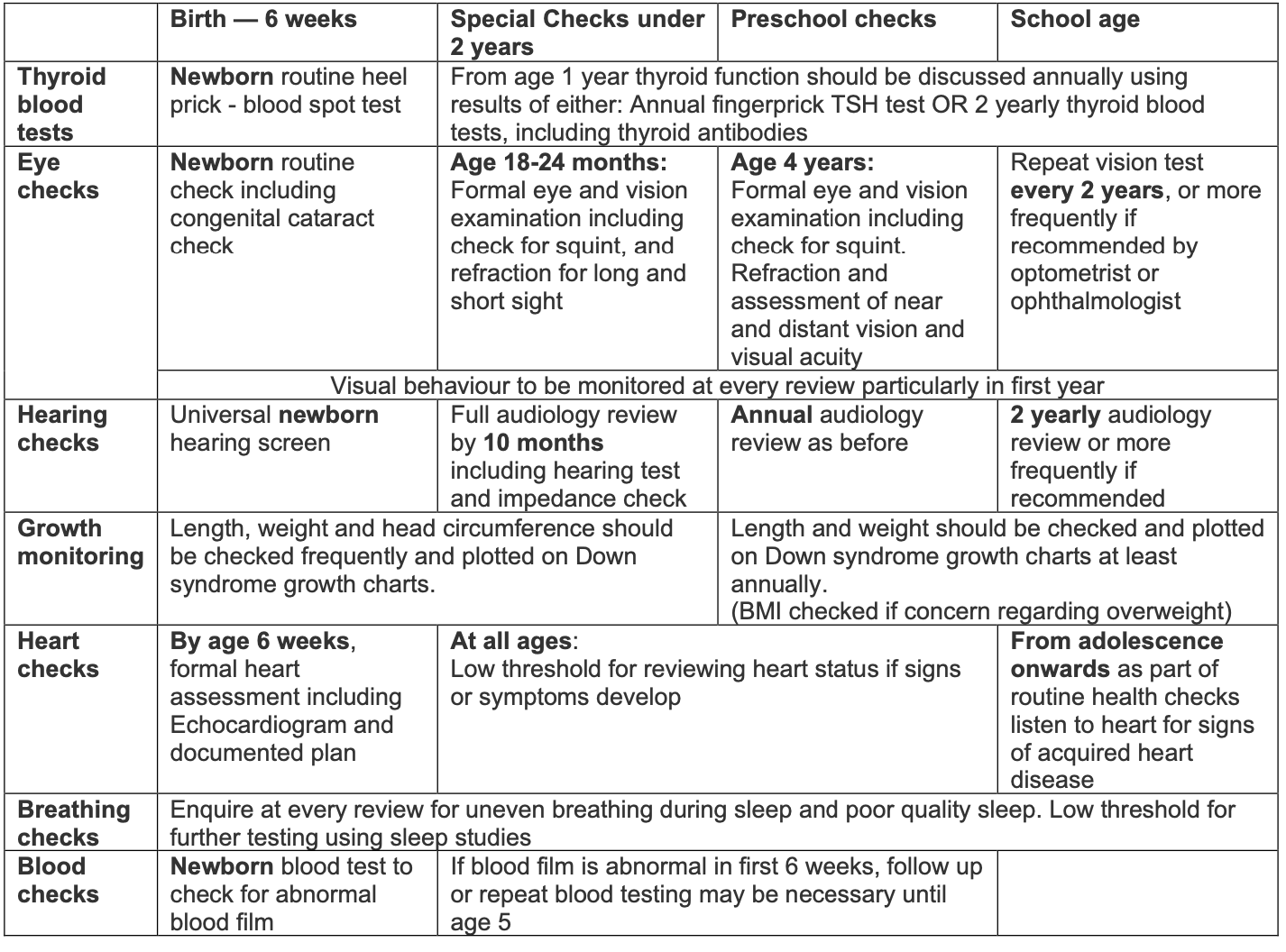
All newborns require clinical examination, 4 limb blood pressures, spot pre- and post-ductal saturations and an ECG. In addition, an Echocardiogram will be needed, timing indicated below.
-
If the ECG is abnormal (Superior QRS axis is highly predictive of AVSD (Atrioventricular Septal Defect)) or there are clinical concerns, the case should be discussed with the consultant on call, an echo may be done before discharge.
-
If there are no clinical concerns arrange an assessment with an echo in cardiac clinic within 6 weeks.
Approximately 40-60-% will have a congenital heart disease. 30-40% of these babies will have an AVSD. Surgical intervention for major shunt lesions must take place in early infancy to ensure optimum outcome. Cardiac status of every baby should be established and where appropriate an action plan should be in place by age 6 weeks.
The Down’s Heart Group provides parent support for any child with a heart problem. https://dhg.org.uk/information/
Thyroid function Check:
Neonatal blood spot screening card as usual on day 5, no separate routine neonatal testing is required. Hypothyroidism affects 4-20% of people with Trisomy 21, with only 1% being congenital. It can occur at any age and clinical diagnosis is difficult. Screening blood tests are essential from age 1, and thereafter every year for life. If untreated it can cause severe preventable disability.
Blood Checks:
FBC and blood film should be done on all babies with T21 as a newborn. If blood film is abnormal in first 6 weeks, follow up or repeat blood testing will be necessary until age 5. This will be led by paediatric haematology.
Newborns with Trisomy 21 have inefficient regulation of blood cell production. This leads to polycythaemia in 18-64%, thrombocytopenia, thrombocytosis, higher or lower leukocyte count and leukaemia. These abnormalities are usually time- limited, but must be followed up. The risk of developing leukaemia is 20 times higher for children with Trisomy 21 (1/100), peak incidence 4 years. 25% of all leukaemias are evident at birth; these include congenital leukaemias and Transient Myeloproliferative Disorder (TMD, incidence 4-10%). TMD has clinical and haematological features indistinguishable from those of common acute leukaemia (incidence 1%), except for its course leading to spontaneous and complete remission usually be 3 months. This makes therapeutic decisions very difficult. Those who have had TMD run an increased risk of later onset leukaemia (10-30%). 5 year survival for AML (Acute Myeloid Leukaemia) in the UK around 60% (same as other children) and for ALL around 75% (poorer).
Hearing Checks:
Neonatal screen before discharge followed by 6 months follow-up at King Edward VII audiology clinic (regardless of neonatal findings). Aim by 10 months to have established whether or not there is permanent hearing loss and a management plan will have been agreed and intervention instigated where necessary. Approximately 75-80% of persons with Trisomy 21 of any age have a more or less severe hearing deficiency, mostly a conductive one. Otitis media with effusion affects up to 35% of children with Trisomy 21 at birth.
Vision Checks:
Newborn and 6 weeks check for cataracts. Compared to the general population, children with Trisomy 21 have a 10 fold increased risk of cataracts (15%) and strabismus and refractory defects (50%). These can add to disability if left uncorrected. Refer to ophthalmology if there are any abnormalities, such as suspicion of cataracts.
Other congenital abnormalities:
Children with Trisomy 21 are at increased risk of duodenal stenosis (4-7% of those with T21), congenital megacolon (3% of those with T21), anal imperforation, Hirsprungs Disease (2.6% of those with T21) and hip dislocation (6% of those with T21).
As with all newborn babies, newborns with Trisomy 21 should pass meconium within 24-48 hours of life, and very careful routine examination of the external anal area should occur.
Referral for hip ultrasound is only indicated if there are risk factors as per NIPE guidance.
Immunisations and Red Book
Vaccinations:
Give all vaccines that are part of universal UK schedule and BCG (Bacillus Calmette Guerin) as indicated. There is a strong case for seasonal Influenza vaccine in addition. RSV immunisation is not specifically recommended unless there are additional relevant cardiac and prematurity factors.
Red book:
Ensure that the Down Syndrome Red Book Insert is provided by the health-visitor. It contains additional information for parents and professionals such as expected developmental progress, possible health problems, suggested schedule of health checks, advice about immunisation and feeding and Down specific growth charts.
Follow Up
Inform health visitor for support and referral to Community Paediatric team for all children. Please ensure a copy of the neonatal discharge summary goes to Community Child Health at Upton Hospital. Referral to Community Special Needs nursing team if specific problems identified such as feeding. Ensure community physiotherapy referral early on if concerns. If there is congenital heart disease or other ongoing medical problems, follow up also needs to be made with a general paediatric consultant They can then hand over care to the community team when appropriate.
Suggested Schedule of Health Checks