Heart Murmurs, Investigation and Management

Key Points

  • Earlier Review of the Child with a Heart Murmur in secondary care

  • ECG for suspicious murmurs to be reviewed by the PEC

  • Inclusion of Pre and Post Ductal Saturation Measurement

Version:2.0
Date Issued:03/12/2025
Review Date:01/12/2028
Key words:Congenital heart disease, heart murmur, midline defects, Newborn Infant Physical Examination, NIPE

This is a controlled document. If you are using a printed copy, check it against the guidelines site to ensure you are using the latest edition. Print copies must be destroyed after use.

Abbreviations

MRCPCHMembership Royal College of Paediatrics and Child Health
NIPENewborn Infant Physical Examination
PECPaediatrician with expertise in Paediatric Cardiology

1.0 Definitions

Congenital Heart DiseaseA range of defects that affect the normal way the hearts work that are present from birth.
Duct Dependent Congenital Heart DiseaseA range of defects which critically rely on the patency of the ductus arteriosus for systemic circulation to occur.
Young InfantA child under the corrected gestational age of 44 weeks of age (this is the age until which a patent ductus arteriosus may still be present)
Heart MurmurIs an audible regular occurring sound associated with the movement of blood in the cardiac cycle which is heard over the heart
Experienced Paediatric Doctor / Senior PaediatricianSomeone who has completed their MRCPCH and is appointed to the tier 2 (Registrar) paediatric rota or tier 3 (Consultant) paediatric rota within Frimley Health.
Paediatric CardiologistRegional Centre Specialist who has completed tier 1 training in Paediatrics (plus or minus Core Medical Training) and then complete a specialised 5-year training program in Paediatric Cardiology under the Joint Royal Colleges of Physicians Training Board.
Paediatrician with Expertise in Cardiology (PEC)A Paediatrician first and foremost, who usually helps run specialised clinics in their local hospital and works closely with the visiting Paediatric Cardiologist. PEC paediatricians usually have a minimum of 12 months of paediatric cardiology experience and/or have completed a RCPCH Specialist Interest Module in Paediatric Cardiology.
Paediatric Assessment Unit (PAU)Point of contact for same day emergency care for Paediatric Patients at Frimley Health

2.0 What is a heart murmur?

A heart murmur represents blood flow around the heart, it may be associated with congenital heart disease.

3.0 Assessment

Review antenatal scans (any concerns re the heart or size of the baby, or the lung volume).

Increased risk factors for congenital heart disease are

  • family history of congenital cardiac disease

  • maternal diabetes

  • midline defects

  • elevated triple test score

  • congenital syndromes with associated cardiac disease

  • consanguinity

4.0 Examination

Look for dysmorphic features or other congenital abnormalities.

  • Place your hand on the baby’s chest. Is there a heave or a thrill (this suggests obstructive cardiac disease)?

  • Is there any cyanosis?

  • Are there any signs of heart failure (tachypnoea, increased respiratory effort, hepatomegaly, shock)?

Measure heart rate, respiratory rate and pre and post ductal saturations

  • Are the femoral pulses present?

  • What is the volume of the peripheral pulses?

  • What are the Heart Sounds like?

Sats measuring <95% or >3% difference between pre- and post-ductal saturations should prompt further consideration.

Describe the murmur:

  • intensity (is the murmur loud or soft?)

  • character (systolic or diastolic, throughout = pan, gets louder = ejection)

  • location (loudest point is where?)

  • radiation (can the murmur be heard elsewhere, check back and abdomen?).

5.0 Table 1 Clinical Predictors of Murmurs

PathologicalFlow Murmur
Character of MurmurLoud > 3/6
systolic + diastolic component
1/6 or 2/6 (musical)
systolic only
RadiationHeard in more than 1 positionHeard only at left lower sternal edge
CyanosisPresentNot present
Peripheral PulsesNot palpablePalpable
Active PrecordiumPresentAbsent
TachycardiaPresentNormal pulse rate
Tachypnoea (without oxygen requirement)PresentNormal respiratory rate
Dysmorphic FeaturesPresentNo concerns
Midline DefectsPresentNo concerns

6.0 Investigation and Management

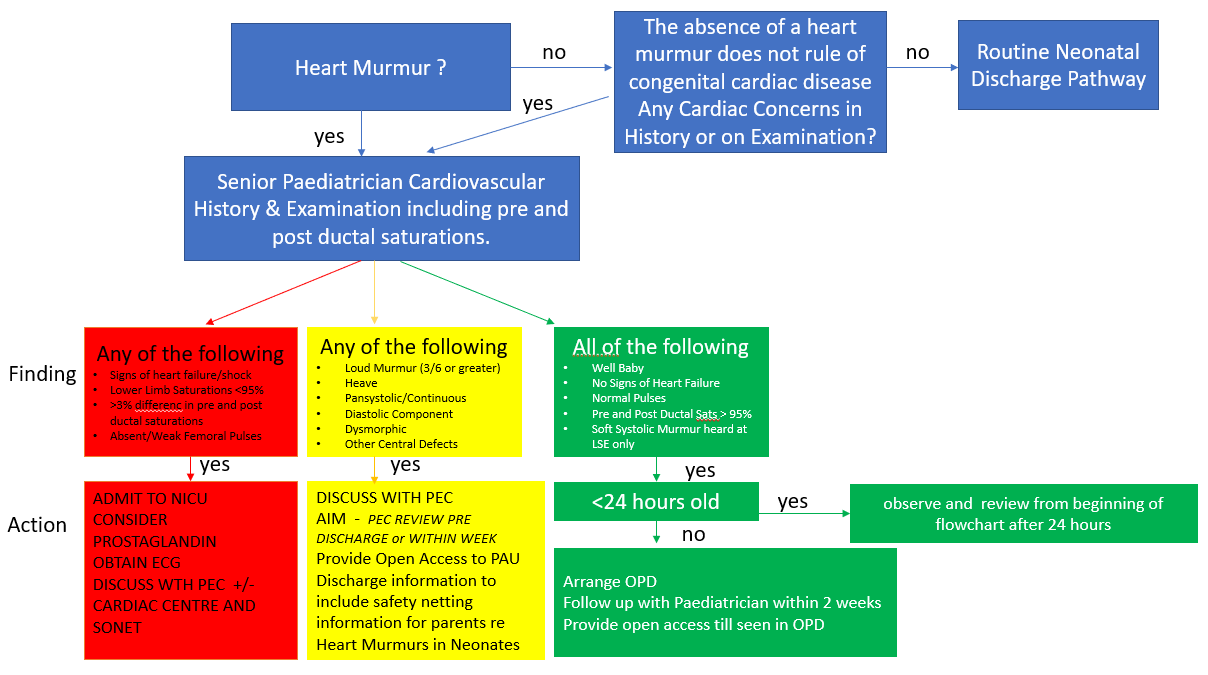
Babies with signs of a pathological murmur must be reviewed by a Consultant. The Consultant will liaise with the PEC about any patient on a yellow or red pathway at the earliest appropriate opportunity so a plan for review can be made. (Enlarged pathway appendix.)

A diagram of a patient's flowchart AI-generated content may be incorrect.

7.0 Electrocardiogram

ECG has been shown to be a sensitive and specific tool for diagnosing atrioventicular septal defect (more common in infants with Trisomy 21) but has not been shown to aid significantly in the diagnosis of other structural congenital heart disease.

Whilst an abnormal ECG should prompt further investigation, a normal ECG should not be considered reassuring if there are abnormal clinical findings or lower limb saturations <95%. This should be undertaken for any Red pathway patient, and may be requested on the amber pathway patients by the PEC.

Normal neonatal ECG shows right axis deviation because of the right ventricular dominance of the newborn heart.
Left axis deviation in a newborn is a significant abnormal finding and should prompt further investigation.

8.0 Chest Xray

There is no evidence to support the use of chest xray in the assessment of neonates with heart murmurs. However a collapsed infant or a child with suspected congenital cardiac disease on a red pathway would be expected to have a chest xray.

9.0 Four Limb Blood Pressure Measurements

There is no evidence to support the use of 4 limb blood pressure measurements in the assessment of neonates with heart murmurs. However it is anticipated that any child on the RED or AMBER pathway with suspected congenital cardiac disease will have upper and lower limb blood pressure readings.

10.0 Paediatric Consultant and PEC must determine discharge

Babies who are going home with a murmur who have not yet been assessed by the PEC

Should have a request raised for open access for their local Paediatric Assessment Unit.

Safetynetting information should be shared with the parents in their discharge summary

Explaining

  • what a heart murmur is

  • how to contact the paediatric assessment unit if they are concened about their baby

  • how to contact the paediatric secretaries if they do not hear about their follow up

  • appointment, and a time frame for this.

Babies on an amber pathway should have additional information about preparation for an

Echocardiogram assessment.

Standardised information is available within Epic for addition to discharge information in

Smartphrases.

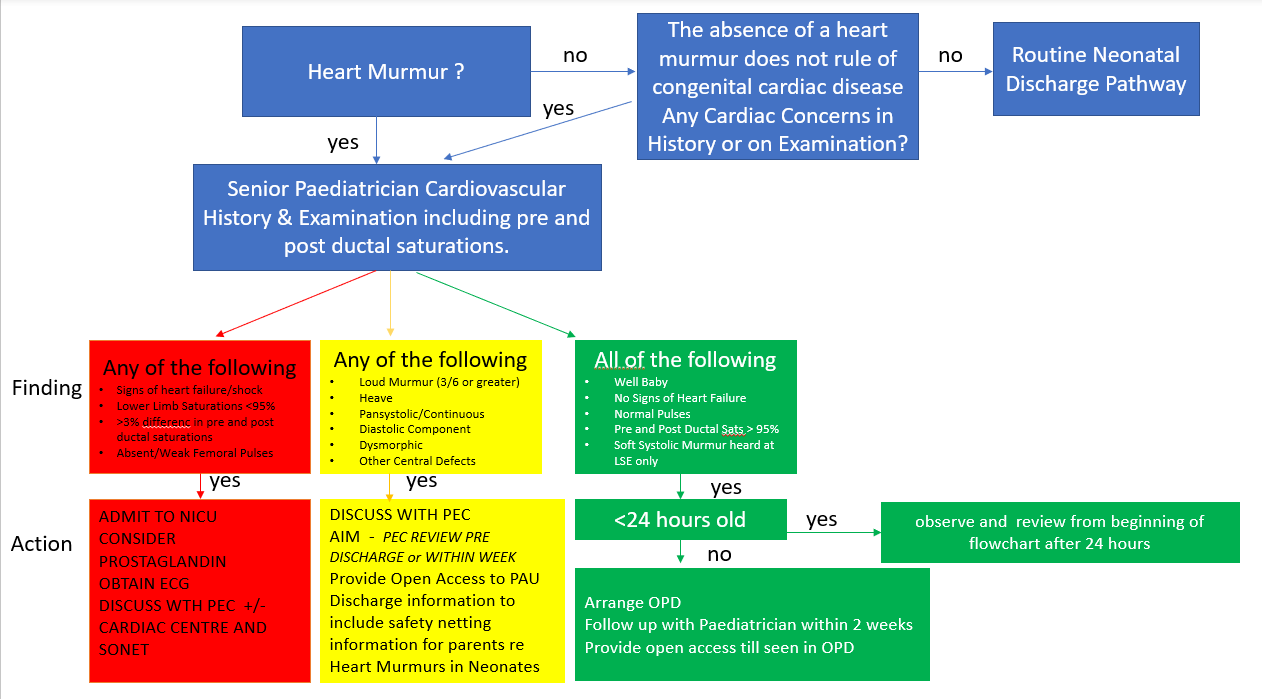
Appendix: Enlarged Pathway

A diagram of a flowchart AI-generated content may be incorrect.