Key Points
• Newborn infants are acutely vulnerable to the harmful effects of thermal stress
• Newborn admission temperature is a strong predictor of mortality and morbidity across all gestations
• Premature and low birth weight infants are at increased risk of hypothermia
• Skin to skin contact between Mother and infant is associated with improved thermoregulation of the newborn
This is a controlled document. If you are using a printed copy, check it against the guidelines site to ensure you are using the latest edition.
Print copies must be destroyed after use.
Abbreviations
Introduction
The purpose of this guideline is to give guidance on establishing and maintaining a neutral thermal environment for the infant at all times in order to minimise risk associated with hypothermia and hyperthermia.
A neutral thermal environment is defined as the maintenance of an infant’s temperature with a stable metabolic state along with minimal oxygen and energy expenditure. Thermoregulation is the ability to balance heat production and heat loss to maintain a core body temperature within a normal neonatal range of 36.5 and 37.5°C. Infants are prone to rapid heat loss and consequent hypothermia because of a high surface area to volume ratio.
Hypothermia (and hyperthermia) are major risk factors contributing to morbidity and mortality. Hypothermia is associated with adverse health effects such as hypoglycaemia, respiratory distress, hypoxia, metabolic acidosis, necrotising enterocolitis and poor weight gain (McCall et al, 2018) and has been strongly linked to preventable admissions of term infants to neonatal units (NHS Improvement 2017). Hyperthermia can cause hypotension, dehydration, seizures, apnoea and hypernatremia (Gardner and Cammack 2020)
Note, the KP sepsis calculator lists temperature instability of <97.5F/36.4C or ≥100.4 F/38C lasting more than 2 hours in equivocal scoring criteria for sepsis.
Severe hypothermia <32°C
Hypothermia <36.5°C
Normal 36.5-37.5°C
Hyperthermia >37.5°C
Clinical Symptoms of Temperature Instability
Signs of Hypothermia
-
Shallow breathing, apnoea
-
Decreased activity and apparent lethargy
-
Bradycardia or tachycardia
-
Hypotonia with diminished reflexes
-
Pale mottled skin – cool to touch, extremities
-
Weak suck, poor feeding, poor gastric emptying, abdominal distension
-
Respiratory distress, tachypnoea
-
Hypoglycaemia
Signs of hyperthermia
-
Tachycardia, tachypnoea, apnoea
-
Hypotension
-
Warm extremities (central temperature lower than peripheral), perspiration, flushing
-
Lethargy, hypotonia, poor feeding
Methods of heat loss in the infant
Understanding the mechanisms of heat loss in infants is important to be able to minimise the effect. Infants lose heat through their skin and respiratory tract to the environment through evaporation, convection, conduction and radiation.
-
Evaporation - Heat is lost when water evaporates from skin or respiratory tract
-
Convection - Heat is lost to cooler surrounding air
-
Conduction - Heat is lost to surfaces with which the infant is in direct contact
-
Radiation - Heat is lost to surrounding surfaces with which the infant is not in direct contact
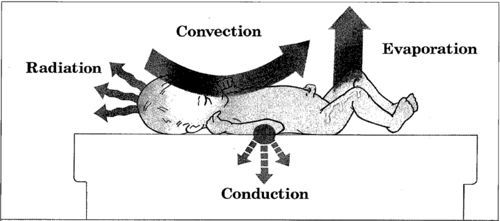
(Narvey, 2023)
It is important to note that preterm infants are at a higher risk of heat loss through these four modes mentioned above. Preterm infants possess a disproportionate body mass-to-surface area ratio, reduced thermal insulation in decreased brown adipose tissue, decreased glycogen stores, a thin epidermis that has increased permeability and poor vasomotor control (Brown & Landers 2011). Other babies at higher risk of heat loss include those with:
-
IUGR/SGA
-
Hypoglycaemia (insufficient brown adipose tissue oxidation)
-
Sepsis
-
Poor skin integrity
-
Prolonged resuscitation
-
PPHN and hypoxia
-
Gastroschisis or exomphalos
-
Receiving paralysing medication
Thermal Care in the Delivery Room/Theatre
Stable term infant and preterm infant ≥32 weeks gestation
-
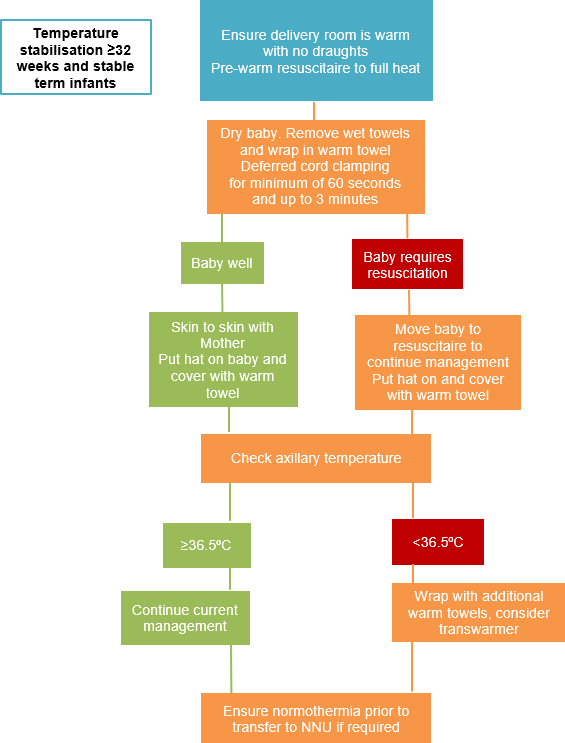
See Appendix 1
-
Ensure that the delivery room/theatre is warm at 23-25⁰C as per NLS guidance (Resuscitation Council UK 2021).
-
Windows and doors should be closed and fans switched off to limit draughts.
-
Resuscitaire turned on to appropriate level (NB new Drager resuscitaires need to be plugged in beforehand to allow the base plate to warm. They also need to have the heater reset every 15 minutes by pressing the temperature icon followed by confirm button, otherwise the heater will time-out).
-
Towels and hats should be warming on resuscitaire prior to the baby’s arrival.
-
Additional towels/blankets should be warming in the room ready for use if required.
-
Dry the infant with a prewarmed towel. Where immediate resuscitation or stabilisation is not required, allow for deferred cord clamping (DCC) for a minimum of 60 seconds and up to 3 minutes (see Optimal Cord Clamping Guideline).
-
Remove any wet towels and replace with dry.
-
Whilst being assessed and DCC continued, the infant should be on a warm surface; either the mother’s chest/abdomen or on another warmed towel.
-
If the infant remains with Mother then place skin to skin with pre-warmed towels over the infant. Kangaroo care (skin to skin contact) is widely regarding as one of the most effective ways of maintaining neonatal temperature in well babies provided maternal temperature is >36).
-
The head should be covered with a hat to prevent heat loss.
-
An axilla temperature should be taken in theatre/delivery room prior to transfer for all infants who require admission to NNU.
-
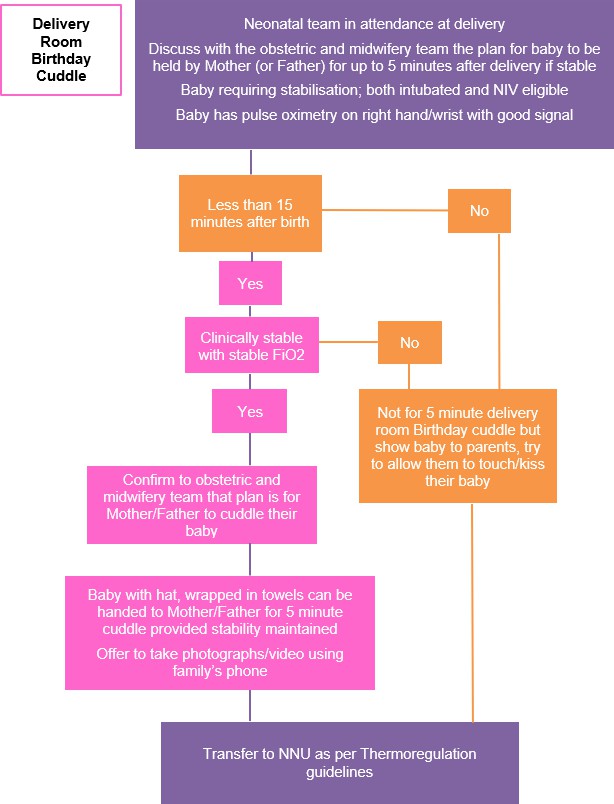
If infant is stable, consider a delivery room Birthday cuddle if appropriate (see Appendix 3).
-
Act to normalise temperature by using additional warm towels or transwarmer as required based on temperature prior to transfer to NNU.
-
If transferred to NNU, the infant should be wrapped in warm, dry towels and transferred to NNU in resuscitaire/shuttle or cot (if appropriate), with appropriate monitoring or respiratory support.
-
Plan transfer to NNU in advance with sufficient staff to open doors as far as possible, to minimize time spent in draughty corridors.
-
NB the resuscitaire radiant heater and temperature monitor will switch off during transfer
-
Document all actions taken to maintain normothermia with a timeline.
Thermal care for the preterm infant <32 weeks gestation, VLBW, IUGR
-
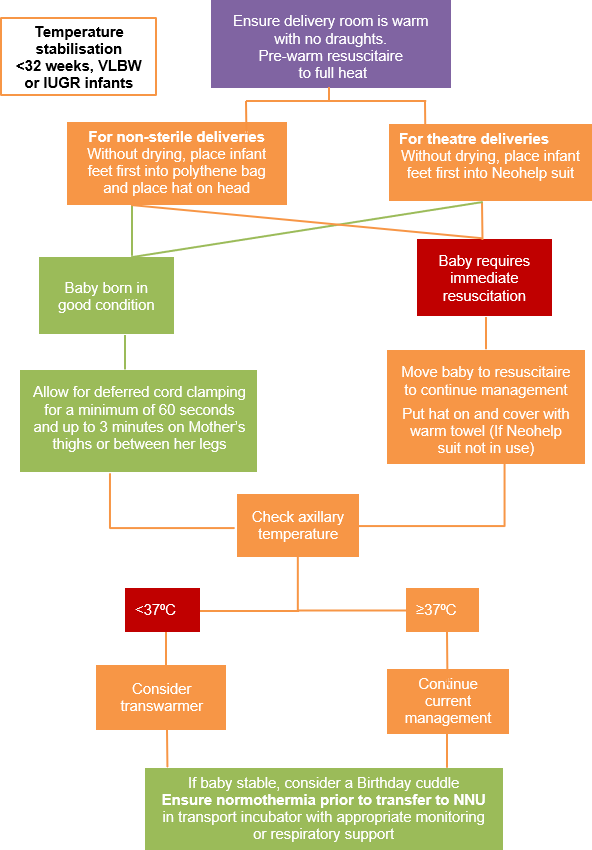
See Appendix 2.
-
Ensure that the delivery room/theatre is warm at 23-25⁰C (>25⁰C for infants <28 weeks gestation) as per NLS 2021 guidance.
-
Windows and doors should be closed and fans switched off to limit draughts.
-
Pre warm resuscitaire and position close to Mother’s/theatre bed to allow for DCC.
-
Polyethylene bag, towels and hats should be prewarmed on resuscitaire.
-
Where possible allocate responsibility for temperature maintenance to one member of the resuscitation team
-
Have your Neohelp suit prepared
-
Do not dry the infant and place baby feet first in a Neohelp suit
-
Ensure the head is covered and face free. If it’s not a typical Neohelp suit and the head is uncovered – dry and place a hat on.
-
Do not open the bag to examine the infant, the bag is clear and allows assessment, heart rate can be auscultated through the bag. Do not cut holes in the bag for arms to come out. When siting a saturation probe to the right wrist, ensure the arm is placed back into the bag as soon as possible.
-
Do not cover the suit in towels as this will prevent radiant heat reaching the infant
-
When immediate resuscitation or stabilization is not required allow for deferred cord clamping (DCC) for a minimum of 60 seconds and up to 3 minutes on Mother’s thighs or between her legs with a transwarmer underneath. Sterile drape can be used if in theatre to cover transwarmer.
-
Check axillary temperature after DCC.
-
Have a transwarmer ready for all extremely preterm infants and transfer baby on a transwarmer to the resuscitaire.
-
If using transwarmer and a resuscitaire heater, take care to ensure continuous temperature monitoring to avoid overheating/burning injuries in rare cases
-
Use skin temperature probe to monitor baby’s temperature continuously. Remember to change the resuscitaire to ‘Baby’ mode.
-
If the resuscitation is prolonged, the output from the radiant heater should be adjusted as necessary.
-
(NB new Drager resuscitaires need to have the heater reset every 15 minutes by pressing the temperature icon followed by confirm button, otherwise the heater will time-out).
-
If infant is stable, consider a delivery room Birthday cuddle if appropriate (see Appendix 3).
-
Act to normalise temperature by using a transwarmer as required. Check axillary temperature before transfer to NNU.
-
Transfer to NNU in transport incubator with appropriate monitoring or respiratory support (If available, use warmed, humidified respiratory gas).
-
There is no need to weigh infant prior to transfer – weigh on arrival to NNU.
-
Minimise time spent in transit to NNU by ensuring double doors are being opened ahead of the resuscitaire.
-
NB the resuscitaire radiant heater and temperature monitor will switch off during transfer
-
Document all actions taken to maintain normothermia with a timeline.
For every 1⁰C below 36.5⁰C the baseline risk of mortality increases by up to 28% in very low birth weight babies
(Abbot et al, 2007)
Thermal care on admission to the Neonatal Unit
-
Incubator should be pre-warmed to 35⁰C and humidity set at 80% as soon as admission is expected.
-
The preterm infant should be placed into the incubator in their polythene bag/Neohelp suit immediately without any delay.
-
If polythene bag/Neohelp suit is excessively wet with amniotic fluid, urine, blood, or meconium then remove (replace if incubator temperature not reached).
-
The infant should remain in the polythene bag/Neohelp suit until in a humidified thermally stable environment and is normothermic (this may include time for the insertion of peripheral/umbilical lines) and observations have taken place.
-
Allow infant to stabilise before taking the axillary temperature at 30-60 minutes post birth and at regular intervals thereafter to maintain normothermia.
-
Underlying conditions such as sepsis, drug withdrawal and intracranial haemorrhage can also affect ability to maintain normothermia, and should be managed specifically.
Environmental humidity
Babies born < 29+6 weeks gestation require weaning of their incubator humidity to help them transition. For babies born ≤27+6 weeks this remains at 80% humidity until the end of day 7, then weans 5% each day until 40% humidity. For babies born at 28-29+6 this remains at 80% humidity until the end of day 1, then wean humidity 5% each day until 40% humidity.
Maintaining normothermia on the postnatal ward
-
Wrap the infant in warm blankets/clothing + hat, or encourage skin-to-skin contact
-
Ensure an appropriate environment – away from drafts/ open windows/fans
-
Avoid placing the infant directly on cold surfaces
-
Measure the infant’s temperature at one hour of life. For PROM remember to follow those guidelines – check observations at 1 hour, 2 hours and then 2 hourly until 12 hours of age.
If a Term Infant is Hypothermic (36-36.5°C) on the Postnatal Ward
- Warm using one of the following:
- Kangaroo Care (skin to skin with parent, provided parental temperature is >36)
- Kanmed /Heated Mattress
-
Consider transferring infant to Transitional Care for closer monitoring.
-
RECHECK temperature in 30-60 minutes
-
If temperature recovers, then check temperature hourly until two consecutive normal temperatures
-
If temperature does not recover >36.5 after 2 hours of attempts to actively warm, then contact Neonatal SHO for medical review, as they may require further intervention.
-
Check blood sugar level – feed if low – refer to hypoglycaemia guidelines.
-
In a baby with no known cause for hypothermia, whose temperature is not recovering, consider need for septic screen.
If a Term Infant is Hypothermic (<36) on the Postnatal Ward
-
Inform Neonatal SHO
-
If baby has not yet had skin to skin, then place skin to skin until doctor arrives. Repeat temperature after 30 minutes.
-
If they have already had skin to skin, then place under radiant heater (resuscitaire in POC room) until doctor arrives. RECHECK temperature after 30 minutes.
-
If temperature has normalized, then check temperature every hour until 2 consecutive normal temperatures.
-
Check blood sugar level – feed if low – refer to hypoglycaemia guidelines.
-
Check KP score and risk factors for sepsis
-
If temperature does not normalise, then baby may require transfer to TCU/NNU for further monitoring, +/- septic screen +/- an incubator.
Hot Cots
Indicators for using a hot cot:
-
Well premature or low birth weight babies (≥1.8kg)
-
At least 32 weeks corrected gestational age
-
Current birth weight ≥ 1.4kg with adequate weight gain
-
Able to be dressed
-
Use of a hot cot should be discussed with the paediatric team
-
When using a hot cot use one layer of clothing, and avoid fully wrapping blankets/towels around baby, to enable heat to get through. As the hot cot temperature is reduced the layers of clothing can be increased.
-
When placing a baby on a hot cot, ensure 1 sheet on the mattress, no more than 3 sheets on the baby, and a single layer of clothes between baby and mattress.
-
Before placing a hot cot ensure baby has stable observations and there are no concerns about sepsis.
-
Ensure the hot cot temperature is adjusted according to the infant’s temperature.
-
If starting a hot cot, consider whether there could be underlying pathology (e.g. sepsis, drug withdrawal, intracranial haemorrhage) which could be affecting baby’s ability to maintain their body temperature. Consider KP sepsis calculator and check that baby’s other observations are stable.
-
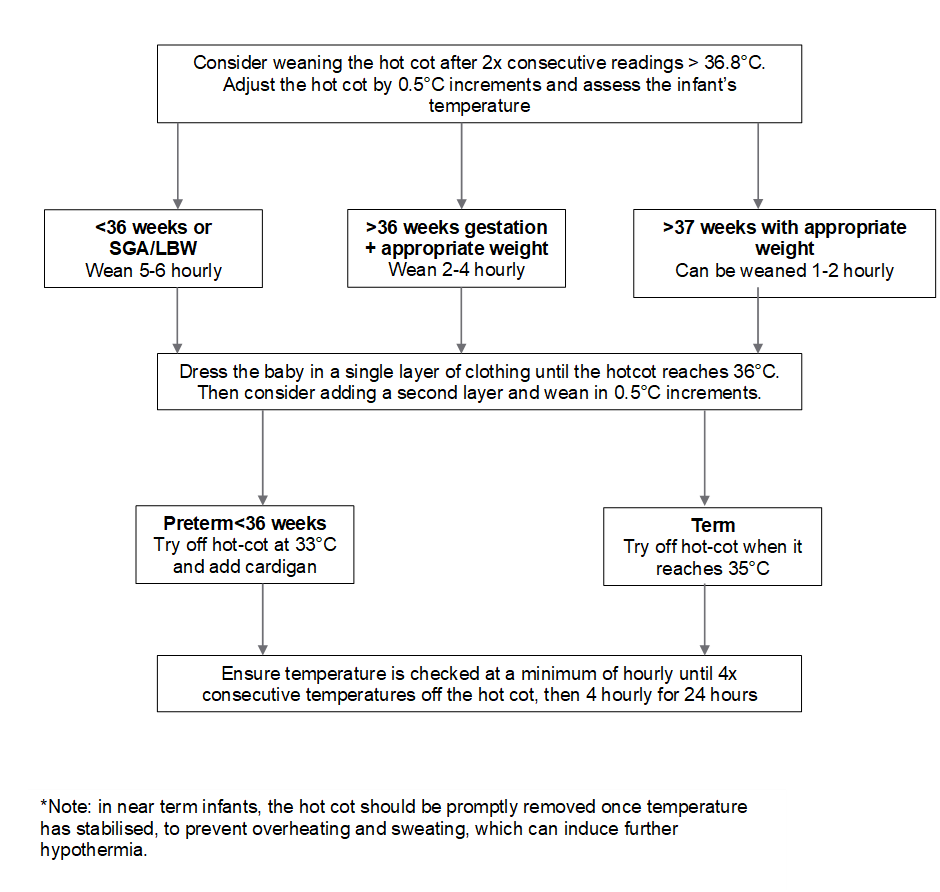
See appendix 4 for further guidance regarding weaning and stopping the hot cot.
Maintaining normothermia for babies receiving phototherapy
Babies receiving phototherapy for jaundice need careful temperature monitoring. They must have large amounts of skin exposed to receive maximum benefit from phototherapy, which can place them at increased risk of hypothermia, particularly if baby is nursed in a cot (e.g. on the postnatal ward) or is positioned near a window/door.
Conversely, many LED phototherapy lights produce radiant heat, which can sometimes lead to overheating.
Babies on phototherapy need regular observations (at least 4 hourly), including axillary temperature, to ensure they are maintaining normothermia.
Note that radiant heaters can increase insensible water losses for babies receiving prolonged phototherapy.
Therapeutic Hypothermia (Cooling)
Normothermia should be maintained during resuscitation. Infants with suspected Hypoxic Ischaemic Encephalopathy (HIE) who meet the criteria may be considered for treatment with active cooling. Adhere to Trust guidelines for therapeutic hypothermia. Use the smartphrase .hie to document criteria for cooling in babies at risk of HIE.
Appendix 1 Temperature Stabilisation ≥32 weeks gestation
Appendix 2. Temperature Stabilisation \<32 weeks gestation
Appendix 3. Delivery Room Cuddle
Appendix 4. Weaning and stopping a hot cot