Dexmedetomidine Sedation

Key Points

  • Dexmedetomidine is an alpha-receptor agonist.

  • Used for sedation and analgesia of mechanically ventilated patients either as an adjunct or primary agent in patients difficult to wean from sedation to extubation.

  • Treatment should be initiated by a consultant experienced in the management of critically ill patients.

Version:4
Date Issued:29/05/2025
Review Date:01/05/2028
Key words:Dexmedetomidine, sedation

This is a controlled document. If you are using a printed copy, check it against the guidelines site to ensure you are using the latest edition. Print copies must be destroyed after use.

Abbreviations

BPBlood Pressure
CAM- ICUConfusion Assessment Method for Intensive Care Unit
CYP450Cytochrome P450
ICUIntensive Care Unit
IVIntravenous
NIVNon Invasive Ventilation
RASSRichmond Agitation- Sedation Scale
MHRAMedicines and Healthcare products Regulatory Agency
CHMCommission on Human Medicines

Indications:

To be initiated following ICU consultant advice only

  • Patients difficult to wean from sedation to extubation (to bridge extubation)

  • Sedation in highly agitated patients or patients with delirium (failed first sedation hold, CAM-ICU +ve) to maintain RASS 0 to -2

  • Predicted to require ventilation for > 24 hours

  • To facilitate non-invasive ventilation in anxious/agitated patients at reduced dose 0.7mcg/kg/hr 6

*Not for Deep Sedation*

NOT to be used

• As the 1st line choice of sedative

• For patients who require prolonged or continuous deep sedation (RASS < -3)

Contraindications

  • Hypersensitivity to the active drug or any of the excipients

  • Patients with Second- or third-degree AV block without pacemaker

  • Uncontrolled hypotension

  • Acute cerebrovascular conditions e.g. traumatic brain injury, subarachnoid haemorrhage

Cautions

  • Not suitable for patients with severe cardiovascular instability

  • Spinal cord injury

  • Acute epilepsy/uncontrolled seizures

  • Severe liver dysfunction (Child Pugh Class C)

  • Pregnancy or breast feeding

Other considerations

  • Following the SPICE III trial a safety note was issued by MHRA/CHM with advice regarding increased risk of mortality in ICU patients aged 65 years or younger compared to alternative sedatives. (June 2022) These findings should be weighed against the expected clinical benefit of dexmedetomidine compared to alternative sedatives in younger patients. [https://www.ema.europa.eu/en/medicines/dhpc/dexdor]5

  • If no improvement within 48 hours - discontinue dexmedetomidine

  • There is no experience in the use of Dexmedetomidine for more than 14 days

  • Dexmedetomidine has been associated with withdrawals; symptoms observed include delirium, hypertension and agitation. Doses greater than 0.8 micrograms/kg/hour and cumulative daily doses greater than 12.9 micrograms/kg/day were associated with a higher incidence of withdrawal.

Pharmacology

  • Dexmedetomidine is an alpha 2 agonist with a similar pharmacology to clonidine, but with 8 times its potency.

  • Main side-effects are bradycardia and hypotension.

  • Avoid bolus dose due to hypertension. High doses can cause hypertension through peripheral alpha receptor stimulation (vasoconstriction) - reduce infusion rate.

Pharmacokinetics

  • On set 15 minutes, peak effect within 1 hour, Elimination t1/2 = 2 hours

  • Dexmedetomidine is eliminated to inactive metabolites by extensive metabolism in the liver thus caution is required in liver impairment.

  • Less than 1% of unchanged drug is found in the urine. There is no dose adjustment required in renal impairment.

  • No data for renal replacement therapy

Interactions

  • Co-administration with anaesthetics, sedatives, hypnotics and opioids is likely to lead to an enhancement of effects.

  • Enhanced hypotensive and bradycardic effects may be seen with other drugs that have these effects e.g. beta-blockers, although additional effects in an interaction study with esmolol were modest.

  • Dexmedetomidine has been shown to inhibit or induce some CYP450 enzymes in vitro thus an effect on drug substrates to these enzymes in vivo cannot be excluded. Clinical significance is unknown.

Compatibility

  • Should be infused via a dedicated central or peripheral line. Check Medusa for compatibility data.

Drug preparation and administration

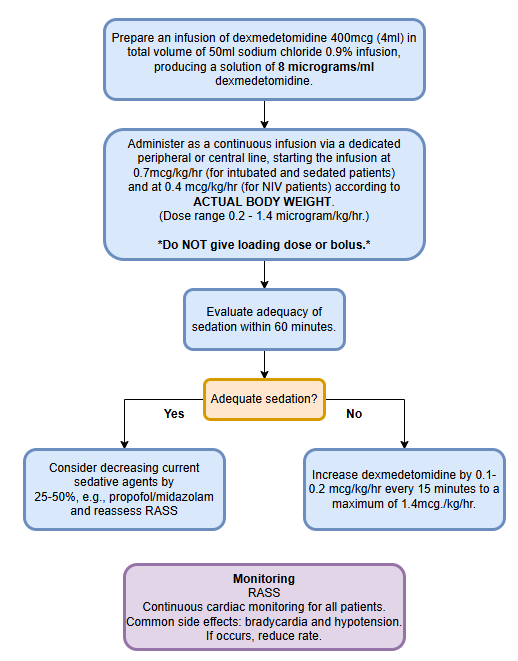
  • Must dilute prior to use, dexmedetomidine can be diluted in glucose 5% or sodium chloride 0.9% solution for injection to achieve the required concentration of 8 micrograms/ml prior to administration. (See flowchart 1)

  • Via controlled infusion pump device/syringe driver via a dedicated peripheral or central line.

  • After dilution dexmedetomidine is stable for 24 hours at 25°C

Flowchart 1. Starting and monitoring of Dexmedetomidine infusion.

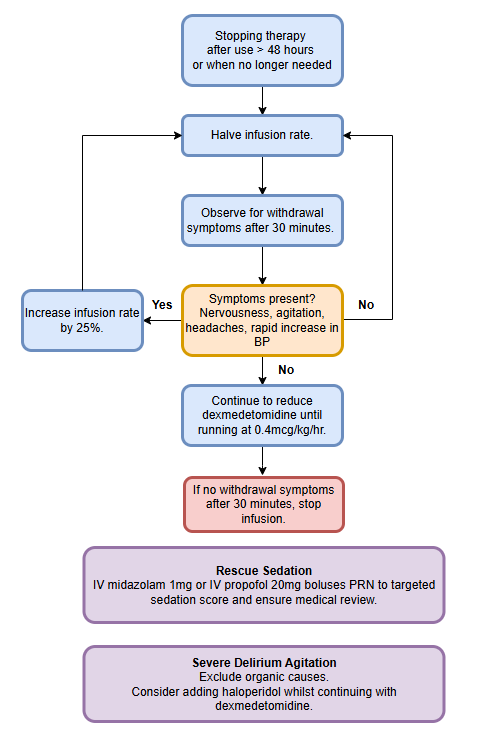
Flowchart 2: Stopping and monitoring of Dexmedetomidine infusion. If used for < 24 hours, dexmedetomidine can be stopped without down titration.

Table: Milliliters (mls) per hour for 8 micrograms/ml concentration solution according to patient’s weight and dose

   
Patient’s   actual body weight (kg)   
   
Dose in microgram   / kilogram / hr (mcg/kg/hr)   


0.2   
   
0.3   
   
0.4   
   
0.5   
   
0.6   
   
0.7   
   
0.8   
   
0.9   
   
1   
   
1.1   
   
1.2   
   
1.3   
   
1.4   
   
50   

1.3

1.9

2.5

3.1

3.8
   
4.4   

5.0

5.6

6.3

6.9

7.5

8.1

8.8
   
55   

1.4

2.1

2.8

3.4

4.1
   
4.8   

5.5

6.2

6.9

7.6

8.3

8.9

9.6
   
60   

1.5

2.3

3.0

3.8

4.5
   
5.3   

6.0

6.8

7.5

8.3

9.0

9.8

10.5
   
65   

1.6

2.4

3.3

4.1

4.9
   
5.7   

6.5

7.3

8.1

8.9

9.8

10.6

11.4
   
70   

1.8

2.6

3.5

4.4

5.3
   
6.1   

7.0

7.9

8.8

9.6

10.5

11.4

12.3
   
75   

1.9

2.8

3.8

4.7

5.6
   
6.6   

7.5

8.4

9.4

10.3

11.3

12.2

13.1
   
80   

2.0

3.0

4.0

5.0

6.0
   
7.0   

8.0

9.0

10.0

11.0

12.0

13.0

14.0
   
85   

2.1

3.2

4.3

5.3

6.4
   
7.4   

8.5

9.6

10.6

11.7

12.8

13.8

14.9
   
90   

2.3

3.4

4.5

5.6

6.8
   
7.9   

9.0

10.1

11.3

12.4

13.5

14.6

15.8
   
95   

2.4

3.6

4.8

5.9

7.1
   
8.3   

9.5

10.7

11.9

13.1

14.3

15.4

16.6
   
100   

2.5

3.8

5.0

6.3

7.5
   
8.8   

10.0

11.3

12.5

13.8

15.0

16.3

17.5
   
105   

2.6

3.9

5.3

6.6

7.9
   
9.2   

10.5

11.8

13.1

14.4

15.8

17.1

18.4
   
110   

2.8

4.1

5.5

6.9

8.3
   
9.6   

11.0

12.4

13.8

15.1

16.5

17.9

19.3
   
115   

2.9

4.3

5.8

7.2

8.6
   
10.1   

11.5

12.9

14.4

15.8

17.3

18.7

20.1
   
120   

3.0

4.5

6.0

7.5

9.0
   
10.5   

12.0

13.5

15.0

16.5

18.0

19.5

21.0