Key Points
-
This guideline is only for the use in adult patients who have been accepted for admission to ICU and with a critical care outreach nurse prior to transfer.
-
The decision to commence peripheral noradrenaline should be made by an ICU consultant.
-
4mg Noradrenaline made up to a total of 246mL with 0.9 % sodium chloride.
-
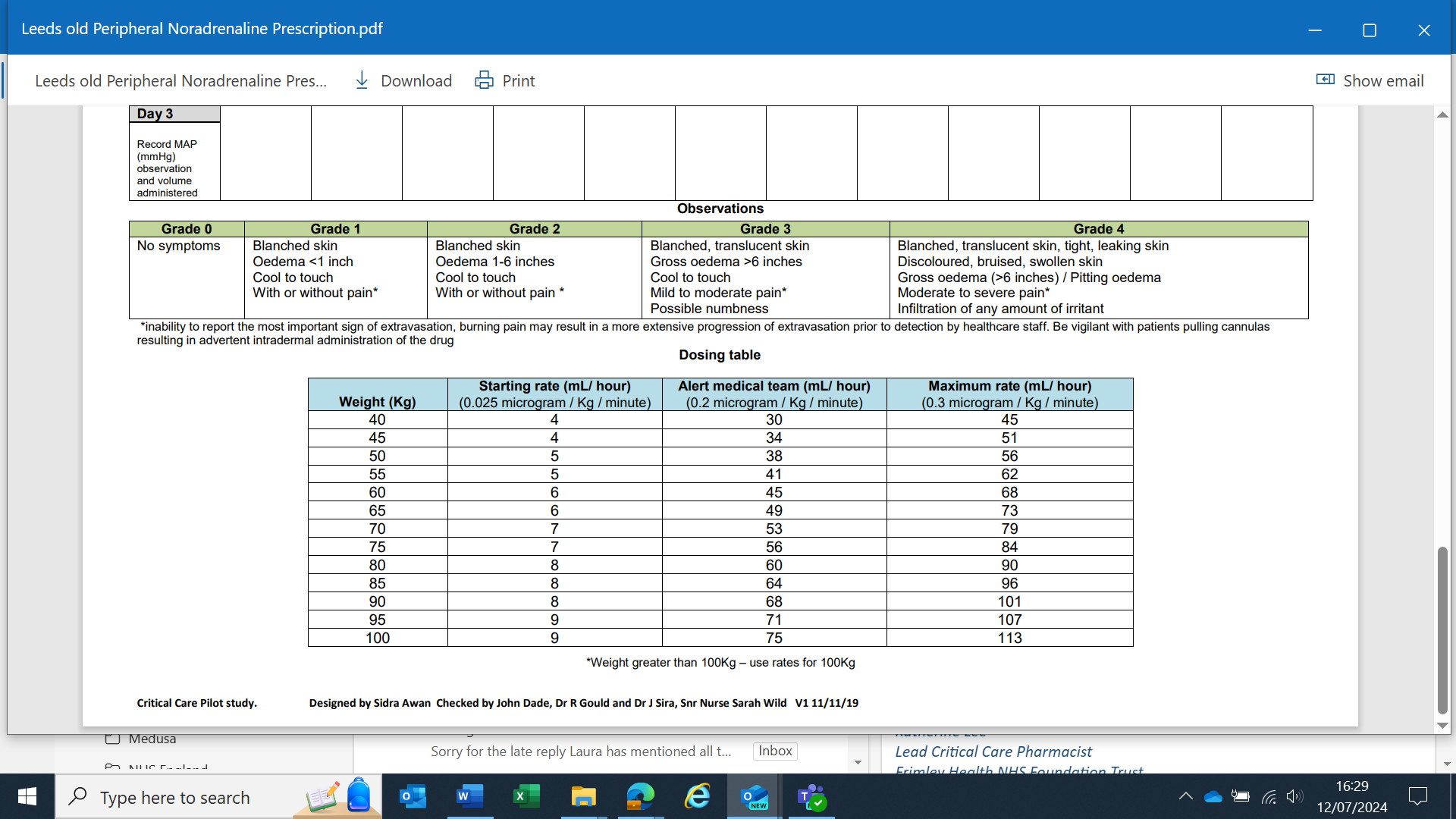
See Appendix for dosing guideline.
-
Maximum dose 0.3micrograms/kg/min.
-
Patient’s cannula sight must be closely monitored for extravasation.
This is a controlled document. If you are using a printed copy, check it against the guidelines site to ensure you are using the latest edition.
Print copies must be destroyed after use.
Abbreviations
Introduction
This document provides guidance to adult critical care professionals on the administration of noradrenaline via a peripheral venous cannula (PVC) to adult critical care patients who have been reviewed by the intensive care/critical care outreach team and been accepted for admission to ICU.
Peripheral Access requirements
-
Patients must have a 20G (pink) cannula, in the largest vein possible.
-
This must be placed in the upper limbs and be easily observable.
-
It must flush easily without pain or visible extravasation.
-
Clear cannula dressing should be in situ.
-
No Bionectar or octopus should be connected.
-
There should be no blood pressure cuff on the same limb as the cannula running the peripheral noradrenaline infusion.
-
Check and document infusion site every 2 hours for free flow and blanching. If patient is not responding then check line, pump and site.
-
If there is any concern regarding the patency of the cannula, then the infusion should be discontinued, and rescue measures instituted.
Vasopressor administration
-
4mg Noradrenaline made up to a total of 246mL with 0.9 % sodium chloride.
-
Maximum dose 0.3micrograms/kg/min.
-
If weight greater than 100kg, use rate for 100kg.
-
Medical team on unit to be contacted for review if dose > 0.2micrograms/kg/min.
-
To be used for less than 72hours.
-
Stop the infusion immediately if signs of extravasation are apparent (VIP score ≥ 1). Including if the patient complains of a burning sensation or pain.
-
Alert ICU doctor and record VIP score hourly.
-
Consider where Noradrenaline should be recommenced e.g. via second IV line/ central line.
-
Demarcate area of skin change.
-
The catheter should not be removed but should be left in place to attempt aspiration 3-5ml of fluid from the extravasated area.
-
DO NOT flush the cannula.
-
If phentolamine available, then follow the guidance below:
Guidance on the use of phentolamine
If available, dilute and inject the reversal agent phentolamine through the extravasated cannula.
-
Use 5–10 mg in 10-20ml in sodium chloride 0.9%, respectively and split into two equal volumes.
-
Inject one of the two volumes through the residual cannula (ensure not intravenous)
-
Using a new needle after each injection, inject the remaining subcutaneously in a circular pattern around the perimeter of the extravasation. Additional injections may be required if blanching returns.
-
Immediate administration is necessary if extravasation is suspected. The efficacy reduces (especially if more than 12 hours have elapsed since extravasation).
-
Continue with step 8.
-
Remove cannula.
-
Demarcate area of skin change.
-
Apply 2.5cm of GTN 0.4% (rectal) ointment, repeat after 8 hours if needed.
-
Elevate the affected limb.
-
Apply warm/hot compress for 20mins, four times a day (per Trust Extravasation guideline).
-
Refer to Tissue Viability and IVAS if skin damage develops.
-
Consider referring to Plastics if severe.
-
Complete an incident report (Inphase).
Stock located in ICU and emergency drug cupboard
Appendix: Dosing table for peripheral Noradrenaline 4mg in 246mL 0.9% Sodium Chloride
Full version control record
This guideline has been registered with the Trust. However, clinical guidelines are guidelines only. The interpretation and application of clinical guidelines will remain the responsibility of the individual clinician. If in doubt, contact a senior colleague or expert. Caution is advised when using guidelines after the review date.
This guideline is for use in Frimley Health NHS Foundation Trust hospitals only. Any use outside this location will not be supported by the Trust and will be at the risk of the individual using it.
Version History
Related Documents