Key Points
• The viral haemorrhagic fevers are severe and life-threatening viral diseases that have been reported in parts of Africa, South America, the Middle East and Eastern Europe.
• The purpose of this document is to provide guidelines on the assessment and management of patients with suspected or confirmed viral haemorrhagic fevers, such as Ebola virus disease.
• VHFs are categorised as High Consequence Infectious Diseases (HCID).
This is a controlled document. If you are using a printed copy, check it against the guidelines site to ensure you are using the latest edition. Print copies must be destroyed after use.
Abbreviations
1.0 Scope of Guideline
The purpose of this document is to provide guidelines on the assessment and management of patients with suspected or confirmed viral haemorrhagic fevers (VHF), and to promote effective and evidence-based patient care.
This guideline applies to all staff employed by Frimley Health NHS Foundation Trust, and also to all visiting staff and contractors.
2.0 Background
VHF are severe and life-threatening viral diseases that have been reported in parts of Africa, South America, the Middle East and Eastern Europe. VHFs;
• can spread within a hospital setting;
• have a high case-fatality rate;
• are difficult to recognise and detect rapidly;
• have no effective, definitive treatment (ACDP 2015).
Viral haemorrhagic fevers (VHF) are viral infections caused by a number of groups of viruses:
2.1 Arenaviridae
• Lassa virus: the cause of Lassa fever, endemic in parts of west Africa
• Lujo virus: a novel virus that caused a small outbreak in South Africa following transmission in Zambia in 2008
• Junin virus: the cause of Argentinian haemorrhagic fever
• Guanarito virus: the cause of Venezuelan haemorrhagic fever
• Machupo virus: the cause of Bolivian haemorrhagic fever
• Chapare virus: the cause of Bolivian haemorrhagic fever
• Sabia virus: the cause of Brazilian haemorrhagic fever
2.2 Bunyaviridae
• Crimean-Congo haemorrhagic fever virus (CCHF)
• Hantaviruses, which cause haemorrhagic fever with renal syndrome, and Hantavirus pulmonary syndrome
• Rift Valley fever virus
2.3 Flaviviridae
• Alkhurma virus (Saudi Arabia)
• Kyasanur Forest virus (India, Karnataka State)
• Omsk virus (Siberia)
2.4 Filoviridae
Ebola and Marburg viruses which cause the most severe forms of haemorrhagic fever.
All recorded cases of VHF in the UK have been acquired abroad, with one exception of one laboratory worked who sustained a needle-stick injury (ACDP 2015). However, with increasing international travel and personnel deployed to endemic regions due to operational commitments, these diseases may be imported more frequently.
An evolving outbreak of Ebola virus disease in West Africa was first reported in March 2014, affected primarily Sierra Leone, Liberia and Guinea.
3.0 Mode of Transmission
• Direct or indirect contact with infected rats (Lassa fever), monkeys (Ebola, Marburg), and tick bite (Crimean-Congo fever).
• Direct contact (through broken skin or mucous membrane) with blood or body fluids, and indirect contact with environments contaminated with splashes or droplets of blood or body fluids.
4.0 Signs and Symptoms
The incubation periods of these infections are usually 7-10 days (range of 3-21 days).
The period of infectivity can be up to 64 days post-onset.
Virus can survive on surfaces for approximately two weeks, and longer on fabrics/ soft furnishings.
5.0 PATIENT ASSESSMENT & MANAGEMENT
VHF viruses are classified as biosafety level four (BSL-4, the highest level) pathogens. Risk Assessment is a legal obligation under the Control of Substances Hazardous to Health (CoSHH) Regulations.
It is the responsibility of clinical teams and divisional managers to ensure their departments have systems in place to recognise and document the potential risk of VHF, ideally before the patient even arrives at the Trust during the referral process.
Patients should routinely be questioned about recent travel history and pyrexia prior to and on arrival to Emergency Departments, and any assessment and admission units, using the Epic Communicable Disease screening tool.
VHF infection is possible in any patient presenting with:
A) a pyrexia of unknown origin (>37.5°C), or a history of pyrexia within previous 24 hours AND has returned from (or is currently residing in) a VHF endemic country where there is a current VHF outbreak within 21 days of symptoms developing. (For a current list of VHF-endemic countries, refer to: www.gov.uk/guidance/viral-haemorrhagic-fevers-origins-reservoirs-transmission-and-guidelines). OR
B) a pyrexia of unknown origin (>37.5°C), or a history of pyrexia within previous 24 hours AND has cared for/come into contact with body fluids of /handled clinical specimens (blood, urine, faeces, tissues, laboratory cultures) from an individual or laboratory animal known or strongly suspected to have VHF.
The UKHSA Imported Fever Service (IFS) provides 24-hour, 7-days a week telephone access (Tel: 0844 778 8990) to expert clinical and microbiological advice. Hospital doctors across the UK can contact the IFS after discussion with the local microbiology, virology or infectious disease consultant.
5.1 Assessment of VHF risk in the Acute Care Setting
Refer to the UK Health Security Agency (UKHSA) Viral Haemorrhagic Risk Assessment, for clinical history and additional questions. Accessible at:
https://assets.publishing.service.gov.uk/government/uploads/system/uploads/attachment_data/file/478115/VHF_Algo.pdf
The UKHSA Imported Fever Service (IFS) provides 24-hour, 7-days a week telephone access (Tel: 0844 778 8990) to expert clinical and microbiological advice. Hospital doctors across the UK can contact the IFS after discussion with the local microbiology, virology or infectious disease consultant.
RISK ASSESSMENT OF SUSPECTED CASES MUST BE CARRIED OUT BY A SENIOR CLINICIAN WITH ADVICE FROM THE ON-CALL CONSULTANT MICROBIOLOGIST/ VIROLOGIST FOLLOWED BY IFS, and categorised as one of the following:
• Low Possibility of VHF
• High Possibility of VHF
• Confirmed VHF

Refer to the flowcharts in Appendix A for the pathway and placement of suspected VHF cases.
5.2 Assessment of VHF risk in the Community Care Setting
If a patient under the care of FHFT Community Care Teams is noted to have returned from a viral haemorrhagic fever-endemic country in the past 21 days, and has a fever (>37.5°C) or history of a fever, the patient must be informed to call NHS 111 for advice.
Inform the Trust on-call Microbiologist via switchboard, providing patient details, symptoms and travel history.
5.3 Management of ward/ department areas used for initial placement of patients with Suspected VHF
5.3.1 Ward G1 (Frimley Park Hospital)
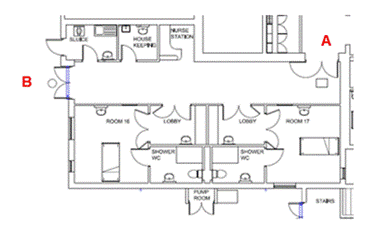
Doors (A) between Infectious Diseases Unit and the rest of G1 to be closed and locked.
Patient to be transferred to unit through external access fire doors (B). Staff requiring access must also use these doors. Rooms 6a and 6b are circled on the diagram.
An intercom system is available for both negative-pressure isolation rooms.
5.3.2 Emergency Department, Blue (Wexham Park Hospital)
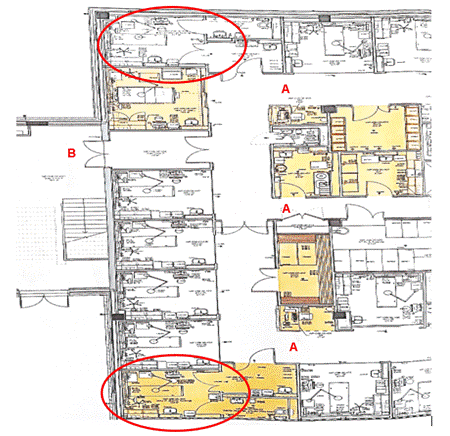
Screens and signage to be placed at points (A).
Patient to be transferred to department through external access fire doors (B). Staff requiring access must also use these doors. Rooms 19 and 25 are circled on the diagram. The remaining five cubicles in this zone will be closed from use whilst a suspected case remains in isolation.
5.4 VHF Precautions Summary for the Hospital Setting
Links Included in the table
6.0 Public Health Management
The Consultant Microbiologist/ Virologist will notify the CCDC who may then convene and chair an Incident Management team (IMT) and the Trust Outbreak plan should be referred to. All contacts, including healthcare workers, will be followed up and monitored by the UKHSA team for a period of 21 days from their final contact with the patient and their environment.
7.0 Monitoring:
In the event of VHF case admission, this guideline would be monitored as part of the Emergency Preparedness Resilience and Response review process.
References
Advisory Committee on Dangerous Pathogens (Department of Health & Health and Safety Executive) 2015 Management of Hazard Group 4 viral haemorrhagic fevers and similar human infectious diseases of high consequence The Stationery Office, London. Available at:
https://assets.publishing.service.gov.uk/government/uploads/system/uploads/attachment_data/file/534002/Management_of_VHF_A.pdf
UK Health Security Agency 2024 Viral haemorrhagic fever: ACDP algorithm and guidance on management of patients. Webpages.
Available at:
https://www.gov.uk/government/publications/viral-haemorrhagic-fever-algorithm-and-guidance-on-management-of-patients
NHS England 2024a National Infection Prevention and Control Manual for England.
Available at:
https://www.england.nhs.uk/national-infection-prevention-and-control-manual-nipcm-for-england/
NHS England 2024b National Infection Prevention and Control Manual for England. Addendum on high consequence infectious disease (HCID) personal protective equipment (PPE).
Available at:
https://www.england.nhs.uk/national-infection-prevention-and-control-manual-nipcm-for-england/addendum-on-hcid-ppe/#app-2
World Health Organization 2016 Clinical management of patients with viral haemorrhagic fever: A pocket guide for frontline health workers (interim emergency guidance for country adaptation) WHO, Geneva.
https://iris.who.int/bitstream/handle/10665/205570/9789241549608_eng.pdf
World Health Organization 2024 Haemorrhagic fevers, Viral. Webpages.
Available at:
https://www.emro.who.int/health-topics/haemorrhagic-fevers-viral/index.html
APPENDIX A: Initial Screen
APPENDIX B: Frequently Asked Questions
How are Viral Haemorrhagic Fevers, such as ebola virus spread?
Infection occurs from direct contact through broken skin or mucous membranes with the blood, or other bodily fluids or secretions (stool, urine, saliva, semen) of infected people. Infection can also occur if broken skin or mucous membranes of a healthy person come into contact with environments that have become contaminated with a patient’s infectious fluids such as soiled clothing, bed linen, or used needles.
What are typical signs and symptoms of infection?
Sudden onset of fever, intense weakness, muscle pain, headache and sore throat are typical signs and symptoms. This is followed by vomiting, diarrhoea, rash, impaired kidney and liver function, and in some cases, both internal and external bleeding.
Laboratory findings include low white blood cell and platelet counts, and elevated liver enzymes.
The incubation period, or the time interval from infection to onset of symptoms, is from 2 to 21 days. The patients become contagious once they begin to show symptoms. They are not contagious during the incubation period.
VHF infections/ causes can only be confirmed through laboratory testing.
What is the treatment?
Severely ill patients require intensive supportive care. They are frequently dehydrated and need intravenous fluids or oral rehydration with solutions that contain electrolytes. There is currently no specific treatment to cure the disease.
Some patients will recover with the appropriate medical care.
Are visitors allowed in areas where patients suspected or confirmed VHF disease are admitted?
Stopping visitor access to patients infected with VHF is preferred. If this is not possible, access should be given only to those individuals who are necessary for the patient’s well-being and care, such as a child’s parent. Please contact the on-call Medical Microbiologist for advice prior to allowing family members to visit.
Is hand hygiene important?
Hand hygiene is essential and must be performed in line with the World Health Organization’s ‘5 Moments for Hand Hygiene’.
It is important to note that neglecting to perform hand hygiene after removing PPE will reduce or negate any benefits of the PPE.
Either an alcohol-based hand sanitiser or soap and running water can be used for hand hygiene, applying the correct technique recommended by WHO. It is important to always perform hand hygiene with soap and running water when hands are visibly soiled. Alcohol-based hand sanitiser should be made available at every point of care (at the entrance and within the isolation rooms and areas); running water, soap, and single use towels should also be always available.
What other precautions are necessary in the health-care setting?
Other key precautions are safe injection and phlebotomy procedures, including safe management of sharps, regular and rigorous environmental cleaning, decontamination of surfaces and equipment, and management of soiled linen and of waste.
In addition, it is important to ensure safe processing of laboratory samples from suspected or confirmed patients.
Will I put my family/other people at risk when I finish my shift?
The World Health Organization says “If the individual has not developed symptoms, they cannot transmit EVD to those around them. If the individual does have symptoms, they should seek immediate medical attention at the first sign they are feeling unwell”.
Can I take breaks? Use the staff toilet etc?
Yes, you can. The World Health Organization says “If the individual has not developed symptoms, they cannot transmit EVD to those around them. If the individual does have symptoms, they should seek immediate medical attention at the first sign they are feeling unwell”.
APPENDIX C Staff Contact List – Viral Haemorrhagic Fever
Full version control record
This guideline has been registered with the Trust. However, clinical guidelines are guidelines only. The interpretation and application of clinical guidelines will remain the responsibility of the individual clinician. If in doubt, contact a senior colleague or expert. Caution is advised when using guidelines after the review date.
This guideline is for use in Frimley Health NHS Foundation Trust hospitals only. Any use outside this location will not be supported by the Trust and will be at the risk of the individual using it.
Version Control Sheet
Related Documents