Hypertension Management

Key Points

  • Differentiate between hypertensive emergency and urgency.
  • Assess for target organ damage (heart, brain, kidneys).
  • Initiate immediate antihypertensive medications in hypertensive emergencies.
  • Do not treat hypertensive urgency with immediate medications; refer to primary care.
  • Investigate for secondary causes if the patient is young or has resistant hypertension.

This is a controlled document. If you are using a printed copy, check it against the guidelines site to ensure you are using the latest edition.

Print copies must be destroyed after use.

Abbreviations

ABPMAmbulatory blood pressure monitoring
ACEAngiotensin converting enzyme
AECUAmbulator Emergency Care Unit
ARBAngiotensin receptor blocker
BPBlood pressure
CCBCalcium-channel blocker
HBPMHome blood pressure monitoring
ICUIntensive Care Unit
NSAIDNon-steroidal anti-inflammatory drugs
SBPSystolic blood pressure

Hypertension Diagnosis and Management Algorithm
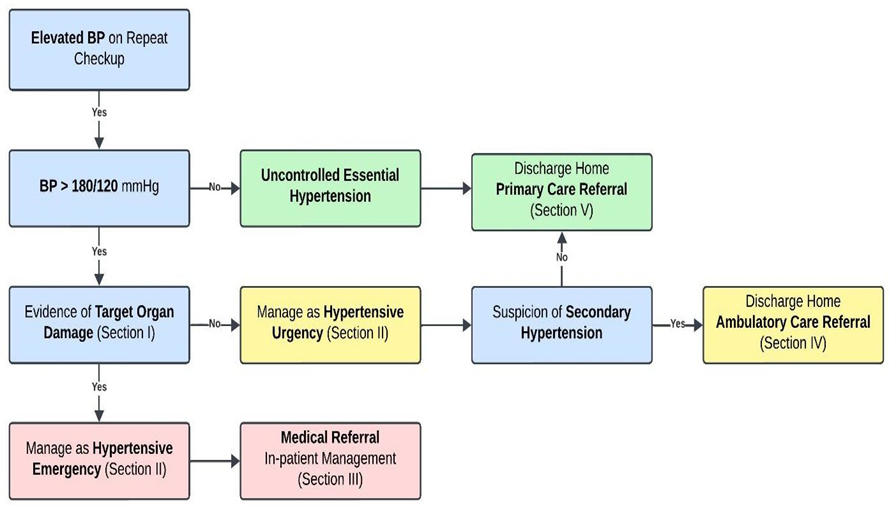
I – Initial Assessment

1. Categorizing Blood Pressure

  • Hypertensive emergency: Severely elevated BP (usually >180/120 mmHg) associated with new or progressive target organ dysfunction.

  • Hypertensive urgency: BP is above 180/120 mmHg but the patient is stable and there is no organ dysfunction.

  • Uncontrolled essential hypertension: Asymptomatic elevated BP less than 180/120 mmHg.

2. Assessing for Target Organ Damage

a) History

  • Cardiac symptoms: chest pain, shortness of breath, syncope

  • Neurological symptoms: headache, visual changes, focal weakness or numbness, altered mental status, seizures

  • Renal symptoms: Decrease urine output

b) Examination

  • Cardiac signs: differential blood pressure, radio-radial/femoral delay, pulmonary edema

  • Neurological signs: any acute neurological deficit, including retinopathy

  • Renal signs: oliguria, anuria, proteinuria

c) Investigation

  • Baseline

    • FBC

    • Blood chemistry (renal function, electrolytes)

    • Urinalysis

    • ECG

  • Others

    • If features of coronary ischemia: Troponin

    • If features of heart failure: Chest X-ray and/or BNP

    • If neurological issues: Brain imaging and/or fundoscopy

    • If suspected aortic dissection: CT Aortogram

II - Immediate Management

Hypertensive Urgency

  1. Monitor BP and symptoms.

  2. No medications needed immediately.

  3. Regular medications for known hypertension cases.

  4. Ambulatory emergency care unit (AECU) referral if suspicion of secondary cause of hypertension (Refer to section IV – Secondary).

  5. Primary care referral once target organ damage assessment complete (Refer to section V - Primary).

Hypertensive Emergency

  1. Continuous (arterial line) or frequent BP monitoring.

    • Initial Phase: Measure BP every 5-15 minutes in the initial hours

    • Stabilisation Phase: Measure BP every 30 minutes to an hour, then every 2-4 hours

  2. Antihypertensive medications given intravenously (IV).

  3. First-line IV medication choice from BMJ Best Practice (Refer to section VI - IV Antihypertensive Medications Choice) & section VII – IV Antihypertensive Medications Dose), that are available in FHFT:

  • Labetalol

    • Accelerated (malignant) hypertension

    • Hypertensive encephalopathy

    • Intracranial haemorrhage

    • Acute ischaemic stroke

    • Aortic dissection

    • Pre-eclampsia and eclampsia

  • Glyceryl trinitrate

    • Myocardial ischaemia/infarction

    • Left ventricular failure and/or pulmonary oedema

  • Esmolol

    • Myocardial ischaemia/infarction

    • Aortic dissection

  • Benzodiazepine

    • Hyperadrenergic state - Sympathomimetic drug use
  • Phentolamine

    • Phaeochromocytoma
  • Hydralazine

    • Pre-eclampsia and eclampsia
  1. BP reduction target:
  • Reduce mean arterial BP by no more than 25% within 1st hour.

  • Then reduce to160/100-110mmHg in next 2-6 hours.

  • Aim for normal BP over next 24-48 hours.

  • Exceptions:

    • Ischaemic stroke

      • If BP >220/120 mmHg – lower the BP by 15% during the first 24 hours.

      • If BP <220/120 mmHg – close observation without direct intervention to reduce BP.

      • For thrombolysis candidates, reduce BP to <185/110 mmHg.

    • Severe pre-eclampsia, eclampsia, or phaeochromocytoma crisis

      • Reduce SBP to <140 mmHg in the 1st hour.
    • Aortic dissection

      • Reduce SBP to <120 mmHg in the first 20 minutes.
    • Spontaneous intracerebral haemorrhage

      • Acute lowering of SBP to a target of 140 mmHg
  1. Medical referral for in-patient management
  • Special care or ICU admission for severe cases with significant organ damage.

III – In-Patient Management

  1. Regular BP monitoring.

  2. Regular assessment and monitoring of target organ damage.

  3. Adjust antihypertensive therapy based on BP readings and patient condition.

  4. Switch from IV to oral antihypertensive medication as the condition stabilizes as per the recommendations (Refer to section VIII – Oral Antihypertensive Medications Recommendations).

  5. First-line oral medication choice from NICE Guideline (Refer to section IX Oral Antihypertensive Medications Steps):

    a. ACE inhibitor or ARB

    * All with type 2 diabetes
    
    * All aged under 55 without type 2 diabetes
    
    * Prefer ARB if:
    
      - ACE inhibitor not tolerated
    
      - Black African or African–Caribbean family origin with type 2 diabetes
    

    b. Calcium-channel blocker (CCB)

    * All aged over 55 without type 2 diabetes
    
    * All Black African or African–Caribbean family origin without type 2 diabetes
    

    c. Thiazide-like diuretic

    * If CCB not tolerated
    
    * If evidence of heart failure
    
  6. Assessment regarding secondary cause of hypertension, where suspected (Refer to section IV – Secondary Hypertension Assessment).

  7. Primary care referral once target organ damage improves and the condition stabilizes (Refer to section V – Primary Care Referral).

IV – Secondary Hypertension Assessment

Assess for underlying secondary causes if:

  1. Age under 40 with hypertension

  2. BP is unusually high and/or resistant to treatment

Secondary Causes:

  1. Renal Disease: Renal artery stenosis, acute glomerulonephritis, and collagen vascular diseases.

  2. Endocrine Disorders: Hyperaldosteronism, pheochromocytoma, thyroid disorders, Cushing's syndrome, and acromegaly.

  3. Neurological Conditions: Head trauma, spinal cord injuries, and autonomic dysfunction.

  4. Respiratory Issues: Obstructive Sleep Apnoea.

  5. Immunologic Factors: Scleroderma and vasculitis.

  6. Pregnancy-Related Causes: Preeclampsia and Eclampsia.

  7. Vascular Conditions: Coarctation of the aorta.

  8. Medication-Induced: NSAIDs, corticosteroids, oral contraceptives, and decongestants.

  9. Substance Use: Chronic alcohol consumption, cocaine, and amphetamines.

Additional workup for secondary causes:

  1. Renin & aldosterone levels, aldosterone:renin ratio

  2. Serum and urine metadrenalines

  3. Urine drug screen

V – Primary Care Referral

  1. Primary care review within 1 week for confirmation of diagnosis and long-term management.

    a. Advice home blood pressure monitoring (HBPM) or ambulatory blood pressure monitoring (ABPM)

    b. Target BP 130/80mmHg (following hypertensive crisis).

    c. Monthly checks until the target BP is achieved.

    d. Then monitored every 3 to 6 months.

  2. Communicate details of hospital treatment and BP readings to the primary care provider.

  3. Educate and counsel on lifestyle modification

    a. Diet - Reduction of salt, caffeine and alcohol

    b. Exercise

    c. Smoking cessation

  4. Emphasize the importance of medication adherence.

VI – Intravenous Antihypertensive Medications Choice

ConditionsDrug Choices
Accelerated (malignant) hypertension or hypertensive encephalopathy or intracranial haemorrhageIncreased intracranial pressure or renal disease
1st: Labetalol
2nd: Nicardipine
3rd: Fenoldopam
Normal intracranial pressure and renal function
1st: Labetalol
2nd: Nitroprusside
or Nicardipine
3rd: Fenoldopam
Acute ischaemic strokeSBP ≤220 mmHg and DBP ≤120 mmHg
1st: close observation ± blood pressure reduction
SBP >220 mmHg or DBP 121-140 mmHg
1st: Labetalol
1st: Nicardipine or Clevidipine DBP >140 mmHg
1st: Nitroprusside
Myocardial ischaemia/infarction1st: Esmolol and Glyceryl trinitrate
2nd: Labetalol and Glyceryl trinitrate
3rd: Nitroprusside
Left ventricular failure and/or pulmonary oedema1st: Glyceryl trinitrate + Furosemide
1st: Clevidipine + Furosemide
2nd: Nitroprusside + Furosemide
Aortic dissection1st: Labetalol or Esmolol
Adjunct: Nitroprusside or Nicardipine
Acute kidney injury1st: Fenoldopam
1st: Nicardipine or Clevidipine
Hyperadrenergic stateSympathomimetic drug use
1st: Benzodiazepine
2nd: Phentolamine
2nd: Nicardipine or Clevidipine
No sympathomimetic drug use
1st: Phentolamine
Adjunct: Labetalol
1st: Nicardipine or Clevidipine
Severe hypertension in pregnancy (pre-eclampsia and eclampsia)1st: Hydralazine, Labetalol, or Nifedipine
Adjunct: Magnesium Sulfate

Fenoldopam, nifedipine, nitropruside, clevidipine, nicardipine are non-formulary, contact pharmacy for advice.

VII – Intravenous Antihypertensive Medications Dose

MedicationsDoses
Labetalol20 mg intravenously every 10 minutes according to response, maximum 300 mg total dose; or 0.5 to 2 mg/minute intravenous infusion
Glyceryl Trinitrate5-100 micrograms/minute intravenously
Esmolol50-100 micrograms/kg/minute intravenously
Fenoldopam0.1 to 0.3 micrograms/kg/minute intravenously initially, increase by 0.05 to 0.1 micrograms/kg/minute increments
every 15 minutes according to response, maximum 1.6 micrograms/kg/minute
Phentolamine5-15 mg intravenous bolus
Hydralazine5 mg intravenously initially, followed by 5-10 mg every 20-40
minutes according to response, maximum 20 mg/ total dose; or
0.5 to 10 mg/hour intravenous infusion

VIII – Oral Antihypertensive Medications Recommendations

RecommendationCriteria
Offer drugAny age with persistent stage 2 hypertension (clinic BP: 160/100 - 180/120 AND ABPM/HBPM: 150/95 or higher)
Consider drugAdults aged under 60 with stage 1 hypertension (clinic BP: 160/100 - 180/120 AND ABPM/HBPM: 150/95 or higher) and an estimated 10‑year risk below 10%.
Aged over 80 with stage 1 hypertension if their clinic blood pressure is over 150/90 mmhg.
Discuss starting drugAdults aged under 80 with persistent stage 1 hypertension who have 1 or more of the following:
Target organ damage
Established cardiovascular disease
Renal disease
Diabetes
An estimated 10‑year risk of cardiovascular disease of 10% or more.

IX – Oral Antihypertensive Medications Steps

   
STEPS   
   
MEDICATIONS   
   
CRITERIA   


Step 1   


ACE inhibitor or ARB

- have type 2 diabetes and are of any age or family origin or

- are aged under 55 but not of Black African or African–Caribbean family origin.

- Prefer ARB:

        - If an ACE inhibitor is not tolerated, for example because of cough

        - Black African or African–Caribbean family origin

        - Do not combine an ACE inhibitor with an ARB


Calcium-channel blocker (CCB)

- aged 55 or over and do not have type 2 diabetes or

- are of Black African or African–Caribbean family origin and do not have type 2
    diabetes (of any age).


Thiazide-like diuretic

- If a CCB is not tolerated, for example because of oedema

- If there is evidence of heart failure

- indapamide in preference to a conventional thiazide diuretic such
   as bendroflumethiazide or hydrochlorothiazide.


Step 2   


Adults taking step 1 treatment of an ACE
inhibitor or ARB

offer the choice of 1 of the following drugs in addition

- a CCB or

- a thiazide-like diuretic.


Adults taking step 1 treatment of a CCB

offer the choice of 1 of the following drugs in addition

- an ACE inhibitor or

- an ARB or

- a thiazide-like diuretic.


Step 3   


If hypertension is not controlled in adults
taking step 2 treatment

offer a combination of:

- an ACE inhibitor or ARB and

- a CCB and

- a thiazide-like diuretic

References

Sanders, M.L. and Suneja, M. (2024) 'Hypertensive emergencies', in BMJ Best Practice. London: BMJ Best Practice. Available at: https://bestpractice.bmj.com/topics/en-gb/27 (Accessed: 06 January 2025).

National Institute for Health and Care Excellence [NICE] (2023) Hypertension in adults: diagnosis and management. NG136. Available at: https://www.nice.org.uk/guidance/ng136 (Accessed: 06 January 2025).

Full version control record

Version:1.0
Guidelines Lead(s):Dr Yohan Samarasinghe, Consultant in Acute Medicine, Diabetes and Clinical Pharmacology
Contributor(s):Main Contributor: Dr Moeed Ahmed, Chief Registrar & Speciality Doctor in Emergency Medicine
QIP Lead: Dr Kyi Kyi Nwe, Consultant in Emergency Medicine
QIP Team: Peter Samwel, Opeyemi Aiyegbo, Anil Rai, Joanna Gao, Rebecca Jurdon, Inesh Thureraja
Lead Director / Chief of Service:Dr Chris Orchard, CoS for General Medicine
Dr Ed Behn, CoS for Emergency Medicine
Library check completed:06 January 2025
Ratified at:ED Clinical Governance (FPH), 19 June 2024
General Medicine Clinical Governance (FPH), 15th May 2024
ED Clinical Governance (WPH), approved by e-governance, September 2024
General Medicine Clinical Governance (WPH), 15th May 2024
Date Issued:26 February 2025
Review Date:01 September 2027
Pharmaceutical dosing advice and formulary compliance checked by:Shelan Karim, 18 March 2024
Key words:Hypertension, blood pressure, antihypertensives, organ damage, hypertensive emergency, hypertensive urgency

This guideline has been registered with the Trust. However, clinical guidelines are guidelines only. The interpretation and application of clinical guidelines will remain the responsibility of the individual clinician. If in doubt, contact a senior colleague or expert. Caution is advised when using guidelines after the review date.

This guideline is for use in Frimley Health NHS Foundation Trust hospitals only. Any use outside this location will not be supported by the Trust and will be at the risk of the individual using it.

Version History

VersionDateGuideline Lead(s)StatusComment
1.0Sept 2024Dr Y SamarasingheFinalDeveloped from a Quality Improvement Project led by Dr Kyi Kyi Nwe

Related Documents

None