Limping Child Without History of Trauma
Limping / Non-Weight Bearing

Key Points

  • Guideline for the assessment and management of children who present with hip pain or limp/non-weight bearing who have no history of trauma.
Version:2.0
Date Issued:05/11/2025
Review Date:01/11/2028
Key words:Limp, limping child, non-weight bearing, acute hip pain, irritable hip, transient synovitis, septic arthritis, Perthes, SUFE

This is a controlled document. If you are using a printed copy, check it against the guidelines site to ensure you are using the latest edition. Print copies must be destroyed after use.

Abbreviations

HSPHenoch-Schonlein purpura
NIANon-Accidental Injury
SUFESlipped upper-femoral epiphysis

Background

This guideline aims to address the management of children and young people presenting acutely with unilateral hip pain. Children > 1 year of age typically present with a history of limp or refusal to weight bear. Children < 1 year can have very subtle presentations but septic arthritis, whilst rare, must always be considered.

Assessment and management of the limping/non-weight bearing child

A number of pathologies can present acutely with a unilateral painful hip. The history and examination should be aimed at drawing out the differences between these presentations, excluding life or limb threatening diagnoses and managing the risk for those patients in whom the diagnosis is unclear initially. See below for common diagnoses grouped by age.

Age-based differential diagnosis

Toddlers (1-3 years)Children (4-10 years)Adolescents (11-16 years)
Transient synovitis of the hip (irritable hip)

Toddler’s fracture

Non-accidental injury

Developmental dysplasia of the hip

Juvenile idiopathic arthritis

Neuromuscular disease

Haemophilia

Henoch-Schonlein purpura (HSP)
Transient synovitis of the hip (irritable hip)

Perthes disease

Juvenile idiopathic arthritis

Haemophilia

Henoch-Schonlein purpura (HSP)
Slipper upper femoral epiphysis (SUFE)

Overuse syndromes or stress fractures

Osteochondritis dissecans

Osteosarcoma
Presenting across all ages
Infection, e.g., septic arthritis, osteomyelitis, viral myositis, cellulitis

Trauma

Non-accidental injury

Sickle cell disease

Malignancy

Referred pain from intra-abdominal pathology e.g. appendicitis
Inguino-scrotal pathology, e.g., testicular torsion

Rheumatological disorders

The ‘not to miss’ diagnoses are infection, malignancy and non-accidental injury.

History

Important aspects of the history to elicit and document include:

  • Onset and duration of symptoms

  • Any history of trauma

  • Any preceding illness (minor viral illness commonly anticipates transient synovitis or reactive arthritis)

  • History of fever, rash or systemic upset

  • Presence and site of pain

  • Complete inability or refusal to weight bear

  • Family history of illness

  • Consideration of non-accidental injury

Examination

General features

  • General appearance of child

  • Presence or absence of fever

  • Any excessive or unusual bruising

  • Any unusual marks/scars

Rheumatological

  • Gait – running/play may exaggerate any abnormality

  • Joint inspection – warmth/swelling/erythema (although these findings are often absent)

  • Range of hip movement – this ought to be symmetrical. Hip pathology typically limits internal and external rotation

  • Always examine the knee and spine- remember that knee pain can be referred pain from the hip and thigh pain can be referred from the lumbar spine

Neuromuscular

  • Look for ataxia

  • Note any muscle weakness or wasting

  • Note abnormal tendon reflexes

  • Lower limb neuro examination must be completed and documented

Abdomen and genitalia

  • Abdominal examination and, in boys, genital examination

Notes on common / important presentations

Transient synovitis (Irritable hip)

This is common and usually affects the hip, although it can affect the knee. It is typically sudden in onset and more frequently affects boys than girls. It is post-viral in origin and will generally self-resolve within 14 days. Treatment is with analgesia and advice only. There is usually only a mild reduction in hip movement and a joint effusion is present, restricting the full range of movement. If investigated, children with transient synovitis may have mildly raised inflammatory markers associated with preceding viral infection.

Septic arthritis

Presentation of septic arthritis can be subtle and varied, particularly in very young children, and as such can be difficult to diagnose. Generally, the hip is the more commonly affected site in infants, whilst in older children it more frequently affects the knee. If the hip is affected there is unlikely to be any visible redness or swelling. If the knee is affected there will be an effusion. In children the route of infection is usually haematogenous spread. Onset may be sudden. Children hold the affected joint in a fixed, often flexed position and movement usually causes significant pain. Systemic features such as fever, tachycardia and malaise may be present and will develop with observation. Joint warmth or erythema are often not obvious. Septic arthritis can rapidly destroy a joint and therefore must be actively excluded as a diagnosis.

Perthes disease

This is avascular necrosis of the femoral head. It affects boys more commonly than girls (ratio 4:1) typically between the ages of 4-10 years. 15% are bilateral. It commonly presents with pain and a limp. X-ray of the pelvis usually demonstrates a flattened femoral head with a widened joint space although these changes might well be absent in early disease. Systemic features should be absent in Perthes.

Slipped upper-femoral epiphysis (SUFE)

SUFE generally affects peri-pubescent children and is more common in those who are overweight or obese. It more frequently occurs in boys than girls (ratio 2:1). Children may present with hip, groin, thigh or knee pain and may walk with externally rotated feet. 25% will have bilateral disease. Diagnosis is radiological with a frog-lateral view, as AP-only views will miss a significant number of presentations. Unstable slips can lead to avascular necrosis of the femoral head.

Investigations

Children presenting with acute hip pain require a thorough history and examination including a neurological examination. All children with limp should be given analgesia (if it has not been given prior to arrival at hospital). The majority of children with a limp of short duration (i.e. < 72 hours) should NOT require any investigations. Historically children have been over-investigated. This guideline aims to provide advice as to when and what investigations are appropriate in the acute setting.

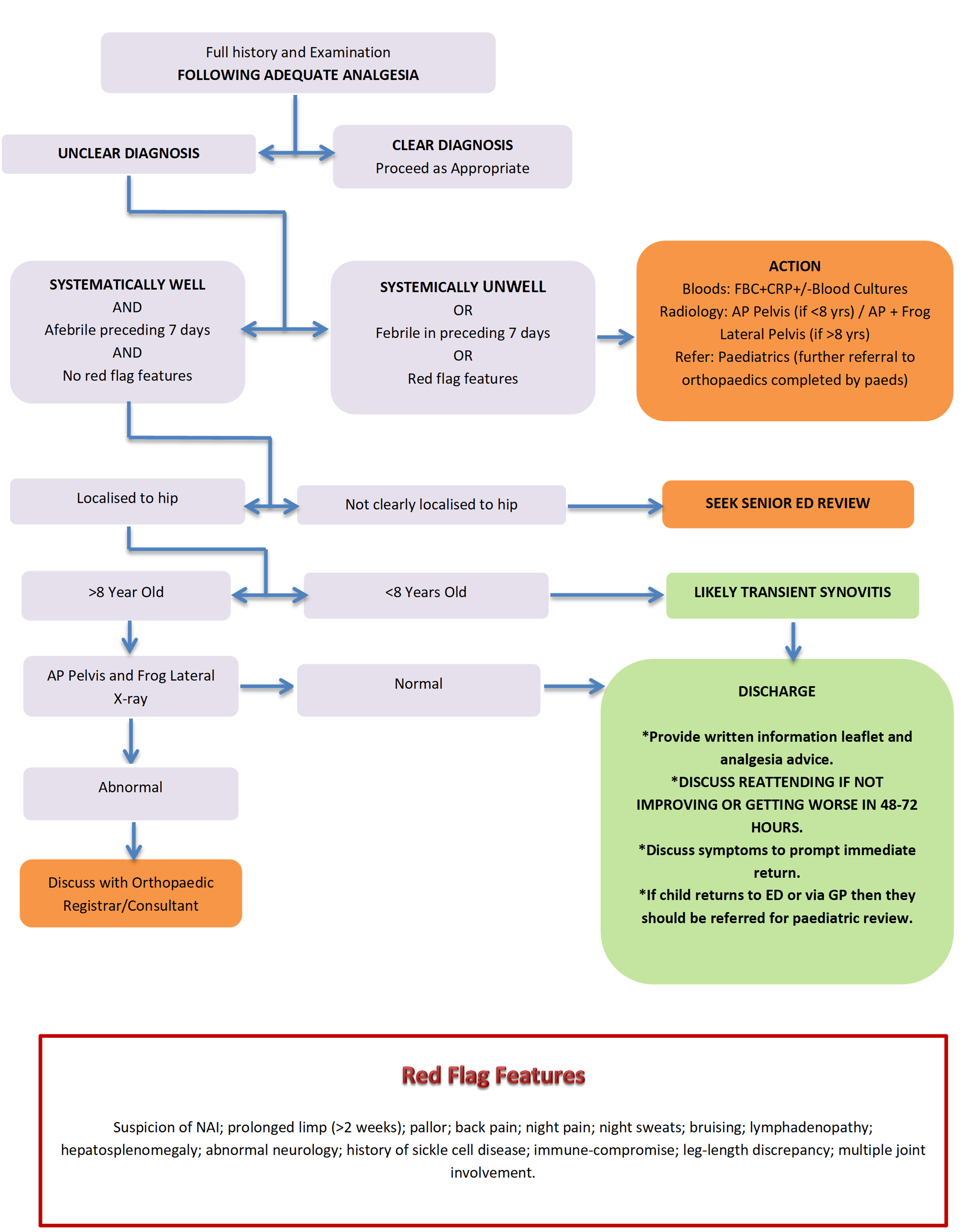
Initial Evaluation of the limping / non-weight bearing child >1 year old

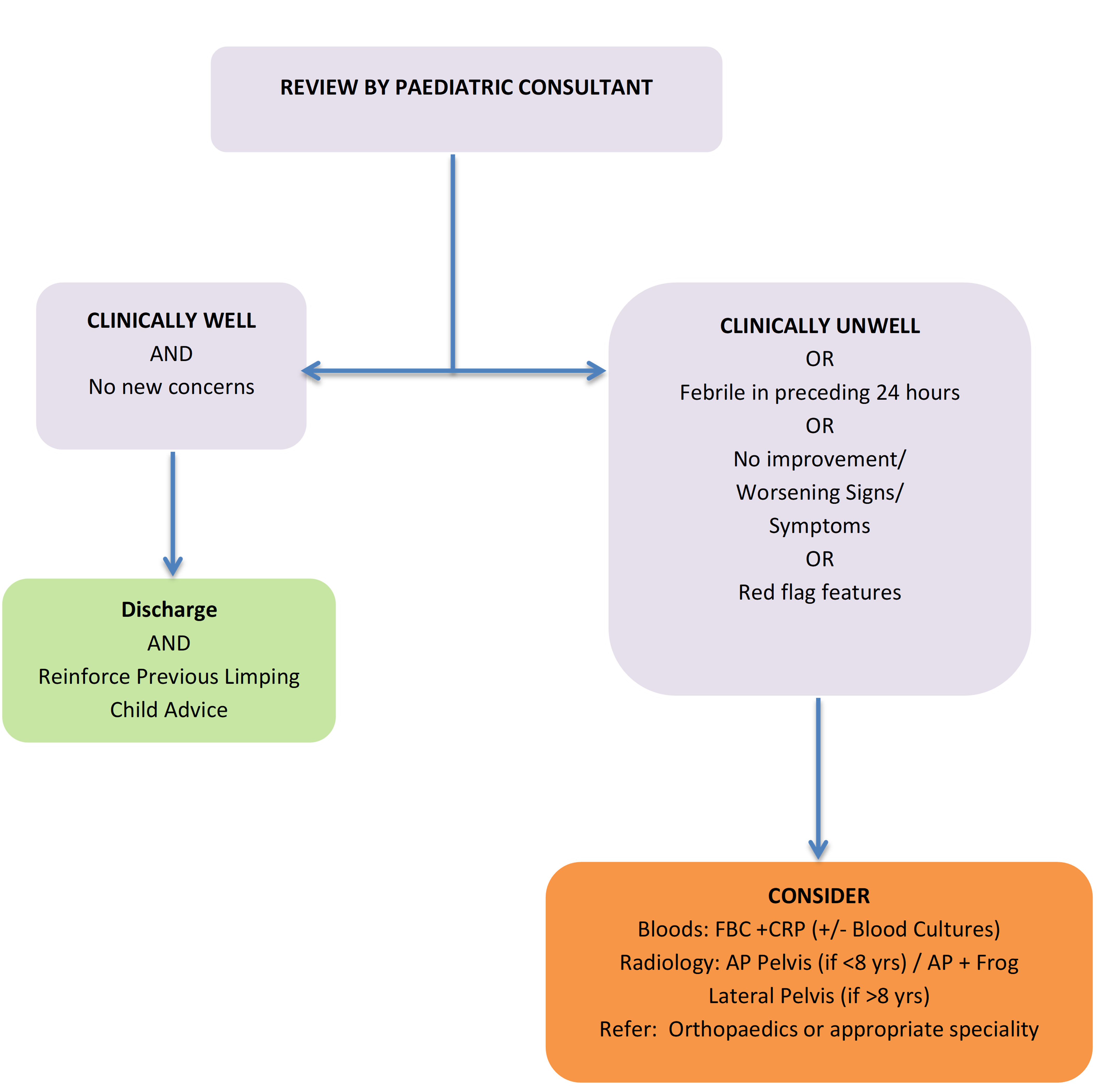
Review of the limping / non-weight bearing child > 1 year old at 48-72 hours