LAT Gel

Key Points

  • LAT gel contains: Lignocaine 4%, adrenaline 0.1% and tetracaine 0.5%.

  • Can be used as topical anaesthesia +/- local infiltration for suturing of wounds in children under 16 years of age.

  • Can be used as topical anaesthesia for debridement of wounds in children under 16 years of age.

  • LAT gel can be used on extremity wounds (including fingers). Current evidence suggests it is less effective and local infiltration may still be required.

Version:2.0
Date Issued:14/03/2025
Review Date:01/02/2028
Key words:LAT gel, wound care

This is a controlled document. If you are using a printed copy, check it against the guidelines site to ensure you are using the latest edition. Printed copies must be destroyed after use.

Abbreviations

EDEmergency Department
LATLignocaine, Adrenaline & Tetracaine

LAT gel treatment summary

1. Aim of Guideline

  • This guideline is to help the clinician treating a child with a wound that requires suturing and cleaning

  • To standardise/improve patient care.

2. Scope

  • Children under 16 years of age with wounds requiring suturing or local debridement.

2.1 Background

  • Skin lacerations requiring cleaning and suturing are commonly seen in children presenting to the ED. Neither of the standard topical anaesthetic agents [Emla® (lidocaine, prilocaine) or Ametop® (tetracaine)] can be applied to open wounds as they do not contain a vasoconstricting agent and so rapid absorption may result in systemic toxicity.

  • The alternative of injection of local anaesthesia (e.g., lidocaine) has the major disadvantage of fear associated with injection among children who may require sedation before a procedure can take place. Injection of local anaesthetic can also lead to tissue distortion, impeding cosmetic closure.

  • LAT gel is a topical anaesthetic gel that can be applied to open wounds reducing the need to inject local anaesthetic/administer sedation when cleaning and suturing open wounds in paediatric patients.

2.2 Rationale

  • Injection of local anaesthesia subcutaneously is often painful and a distressing experience for children who require sutures for wound closure.

  • Lignocaine, Adrenaline and Tetracaine (LAT) gel is a topical anaesthetic gel that has been successfully used in the USA to anaesthetise open wounds. This can either be for wound cleaning or wound suturing. The gel is painless to apply and thus children are more compliant and less frightened and distressed by the experience, reducing the need for a general anaesthetic.

  • The rationale for using this combination of ingredients is that the lignocaine and tetracaine provide excellent anaesthesia whilst the adrenaline acts as a vasoconstrictor thus limiting bleeding and limiting systemic absorption of the anaesthetic. As the gel is topical, not injected, there is no distortion of the wound edges from swelling after an injection.

3. Inclusion Criteria

  • Children under 16 years of age with a wound that requires closure with sutures.

  • Children under 16 years of age with a ‘dirty’ wound that requires cleaning.

  • Wounds not greater than 5cm in length.

  • May be used on wounds on the limbs, torso, scalp and face.

4. Exclusion Criteria

  • Wounds in close proximity to eyes, nostrils and mouth where there may be accidental application to mucous membranes.

  • Known cardiac condition.

  • Deep wounds.

  • Known hypersensitivity to any components of LAT gel.

  • Wounds involving mucous membranes.

  • Burns

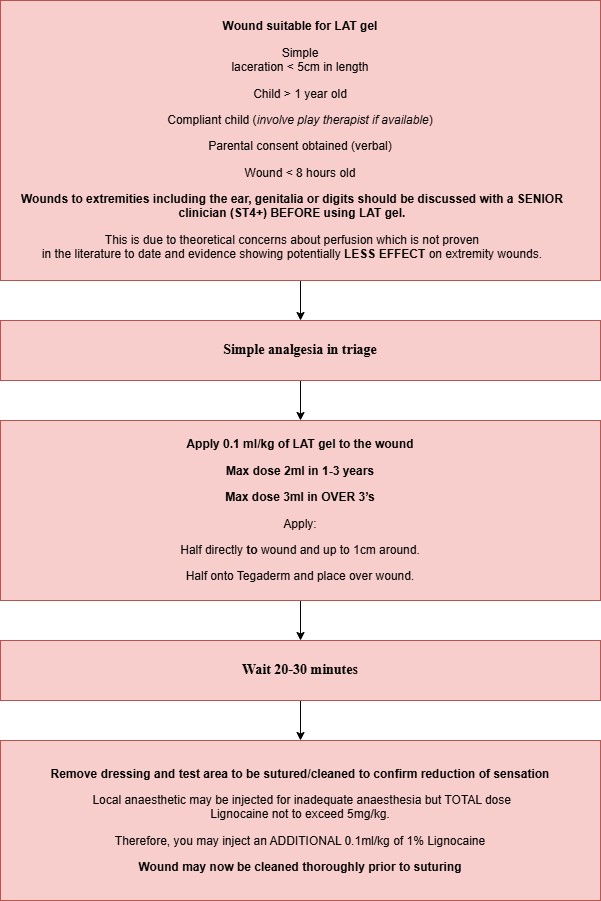
Wounds to extremities including the ear, genitalia or digits should be discussed with a SENIOR clinician (ST4+) BEFORE using LAT gel.

This is due to theoretical concerns about perfusion which is not proven in the literature to date and some evidence showing less effect on extremity wounds.

5. Contraindications

  • Allergy to amide anaesthetics

  • Gross contamination of wound

5.1 Adverse Events

  • Local irritation may occur in some patients.

5.2 Cautions for use

  • Previous adverse effect

  • Allergy to any of the product ingredients

6. Dosage and Application Procedure

  • LAT should be applied according to standard ED topical anaesthetic gel procedure.

  • Application should be performed 20-30 minutes before the planned procedure – this may be at triage or later than this.

  • Time of application should be documented on electronic drug record.

Dosage is 0.5ml to 1.0ml per cm of wound length up to a maximum of:

  • 2ml for those aged 1-3 years

  • 3ml for those over 3 years

  • Maximal dose 5mg/kg of lignocaine as LAT gel (1ml = 40mg)

  • Maximum wound length: 5 cm

  • **NOTE – In wounds >4cm evidence suggests further analgesia (local infiltration) may be required

  • Each bottle is for use on one patient only and should be discarded within 24 hours of opening.

7. Procedure

  • Suitability of wound for LAT gel assessed by assessment nurse.

  • LAT gel should be prescribed on the appropriate drug section on Epic before application.

  • Provide an explanation and reassurance to child and carer.

  • Remove heavy soiling from wound to allow LAT gel to infiltrate wound.

  • The person applying the gel must wear gloves to reduce the risk of accidental exposure to the gel.

  • Draw up the dose of LAT gel as prescribed (to a maximum dose of 5mg/kg), in 5ml syringe and drip approximately 1.0ml into the wound.

  • Squirt the remaining gel onto Opsite/Tegaderm and apply so that gel is directly on the wound/laceration. Date and time the dressing. It may be necessary to use bandage to secure in place.

  • Document application time in notes. Leave LAT gel in place for 30 minutes.

  • After 30 minutes remove dressing and clean area. Wound edges should blanch to show the uptake of gel.

  • Sensation should be checked before suturing and if anaesthesia is inadequate, infiltration of lidocaine 1% through the wound edges may be necessary.

  • A repeat dose of LAT gel MUST NOT be used.

  • Clean and suture the wound as per Trust policy. If suturing is still insufficient or not possible, reassess the treatment plan.

  • Nursing staff should inform doctor if child becomes unwell during time of gel application.

  • Complete documentation and give advice to child and carer.

References

  1. Cambridge University Hospital NHS Foundation Trust (2006) Use of LAT gel. Available at: https://www.jiscmail.ac.uk/cgi-bin/webadmin?A3=ind0702&L=ACAD-AE-MED&E=base64&P=141284&B=------_%3D_NextPart_000_01C74E9D.91C61BA0&T=application%2Foctet-stream;%20name=%22LAT_Gel_Guideline_1.pdf%22&N=LAT_Gel_Guideline_1.pdf&attachment=q&XSS=3. (Accessed: 09 January 2025).

  2. Association of Paediatric Anaesthetists of Great Britain and Ireland (2012) Good practice in Postoperative and Procedural Pain Management. Available at: Good Practice in Postoperative and Procedural Pain Management, 2nd Edition (Accessed: 09 January 2025).

  3. Loryman, B. et al. (2006) ‘Consigning “brutacaine” to history: a survey of pharmacological techniques to facilitate painful procedures in children in emergency departments in the UK’, Emergency Medicine Journal, 23(11), pp. 838-840. Available at: https://doi.org/10.1136/emj.2006.034140 (Accessed: 09 January 2025).

  4. Eidelman, A. et al. (2005) ‘Comparative efficacy and costs of various topical anesthetics for repair of dermal lacerations: a systematic review of randomized, controlled trials’, Journal of Clinical Anesthesia, 17(2), pp. 106-116. Available at: https://doi.org/10.1016/j.jclinane.2004.05.006 (Accessed: 09 January 2025).

  5. Ernst, A. A. et al. (1997) ‘Topical lidocaine adrenaline tetracaine (LAT gel) versus injectable buffered lidocaine for local anesthesia in laceration repair’, Western Journal of Medicine, 167(2), pp. 79-81. Available at: Topical lidocaine adrenaline tetracaine (LAT gel) versus injectable buffered lidocaine for local anesthesia in laceration repair - PMC (Accessed: 09 January 2025).

  6. Leicester Children’s Emergency Department (2022) Use of Topical Wound Anaesthetic- LAT gel In the Paediatric Emergency Department. Available at: Microsoft PowerPoint - LAT gel2016.ppt [Compatibility Mode] (Accessed: 09 January 2025).

  7. VandaVandamme, E. et al. (2017) ‘LAT gel for laceration repair in the emergency department: not only for children?’, European Journal of Emergency Medicine, 24(1), pp. 55-59. Available at: https://doi.org/10.1097/mej.0000000000000298 (Accessed: 09 January 2025).

  8. White, N. J. et al. (2004) ‘The anesthetic effectiveness of lidocaine-adrenaline-tetracaine gel on finger lacerations’, Pediatric Emergency Care, 20(12), pp. 812-815. Available at: https://doi.org/10.1097/01.pec.0000148029.61222.9f (Accessed: 09 January 2025).

Full Version Control

Version2.0
Guidelines Lead(s):Patrick Aldridge, Paediatrician (FPH ED)
Contributor(s):Natasha Gandhi, Lead Pharmacist, Emergency Department
Lead Director / Chief of Service:Ed Behn, Chief of Service for Emergency Medicine
Library check completed:9 January 2025
Ratified at:Emergency Medicine Clinical Governance Committee, Frimley Park, 12 February 2025
Wexham Park, 21 February 2025
Date Issued:14/03/2025
Review Date:01/02/2028
Pharmaceutical dosing advice and formulary compliance checked by:Natasha Gandhi, Lead Pharmacist, Emergency Department
Key words:LAT gel, wound care

This guideline has been registered with the trust. However, clinical guidelines are guidelines only. The interpretation and application of clinical guidelines will remain the responsibility of the individual clinician. If in doubt, contact a senior colleague or expert. Caution is advised when using guidelines after the review date. This guideline is for use in Frimley Health Trust hospitals only. Any use outside this location will not be supported by the Trust and will be at the risk of the individual using it.

Version History

VersionDateGuideline Lead(s)StatusComment
1January 2022Patrick Aldridge
Lauren Whitty
Heather Castle
FinalFirst cross site guideline for LAT gel.
1.1Sept 2023Patrick AldridgeInterimUpdate from Symphony to Epic in section 7, 2nd bullet point.
2.0March 2025Patrick AldridgeFinalScheduled review.