Key Points
This is a controlled document. If you are using a printed copy, check it against the guidelines site to ensure you are using the latest edition. Print copies must be destroyed after use.
Abbreviations
Introduction
This guideline is designed to support safe nurse led discharge of children presenting to the ED with history leading to diagnosis of pulled elbow. It supports the treatment and discharge with appropriate safety netting advice.
‘Pulled elbow’/’Radial Head Subluxation’/’Nursemaids elbow’ is a common presentation in children between 1-5 yrs. The child usually presents with a history of a pull to the elbow and often a “click” will be reported. The child will often play with the affected arm hanging to the side with pain and restriction when trying to use or complain of wrist pain. In 50% of cases there is no history of a “pull”.
Mechanism of injury - often results from axial traction on a pronated forearm with the elbow in extension. With sudden pulling on the distal radius, a portion of the annular ligament slips over the head of the radius and slides into the radiohumeral joint, where it becomes trapped.
Examination
Include assessment of whole limb – Clavicle, shoulder, elbow and wrist.
-
Note any bruising, swelling, deformity to limb – if present do not manipulate
-
Temperature of limb, radial pulse
-
How the child is holding, using moving the arm.
-
How the child appears in relation to pain
-
Note any pain on palpation of limb (often there will be no palpable pain at elbow)
-
Note pain on movement of limb (pain likely to be worse on pronation / supination of wrist or flexion / extension of elbow)
Manipulation
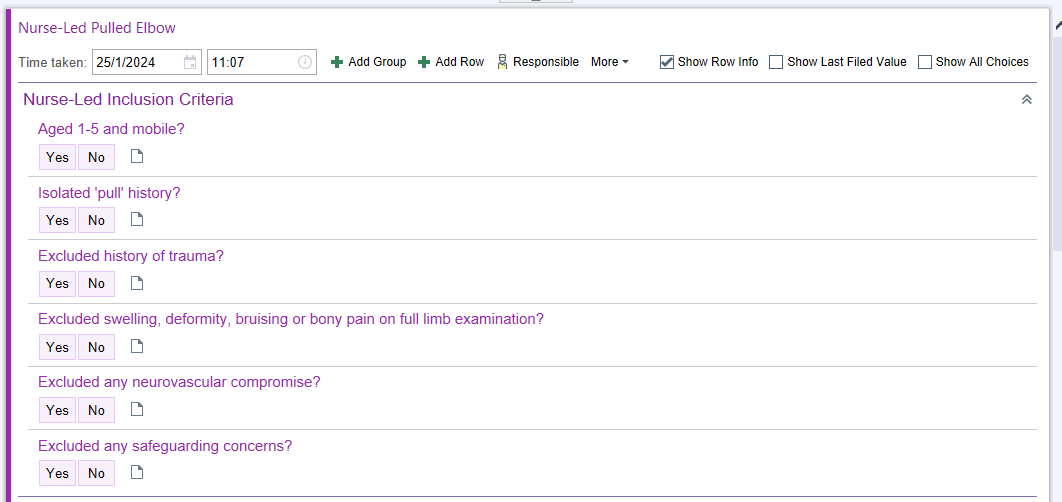
Manipulation should only be attempted by those trained & competent to do so in patients with all the following 3 criteria:
-
Mobile child over 1 yr and under 6yrs of age.
-
No concerns with safeguarding
-
The history and examination must be consistent with a diagnosis of pulled elbow.
If unhappy or unsure, refer for clinical review
-
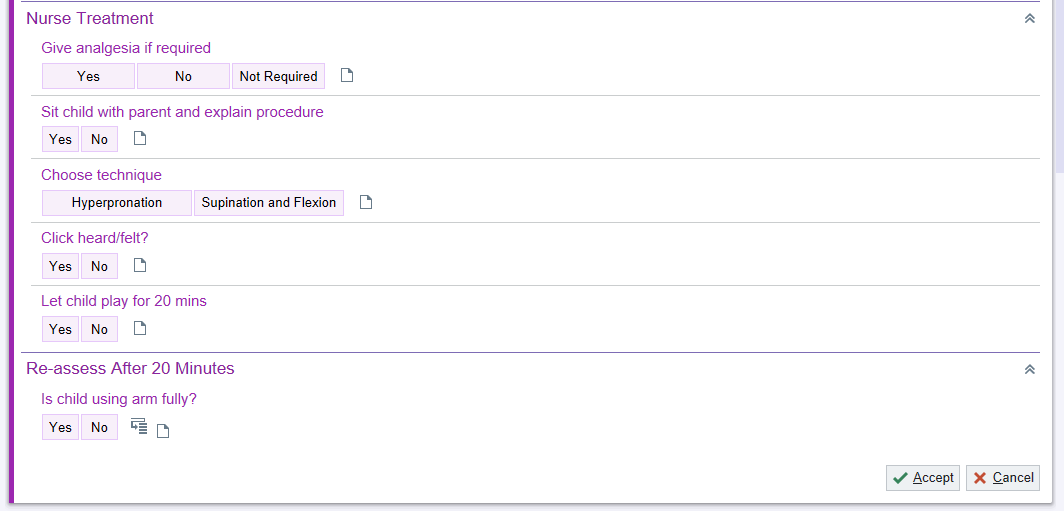
Explain to parent/ carer diagnosis and plan for manipulation and that the child will experience pain on manipulation and ensure consent (must be documented)
-
Consider analgesia if appropriate or required pre manipulation
-
Perform manipulation manoeuvre as trained
-
Consider analgesia post manipulation
-
Review after 20 mins or earlier if full ROM seen
-
2nd attempt can be considered by a senior nurse/Dr after discussion with Nurse in charge and confirmation of history.
-
If reduction fails, refer for clinical review by Dr / ANP and consider imaging
Manipulation Procedure
The procedure is best performed with the child seated comfortably in the parent's arms and the examiner seated and facing the child.
Although the evidence is small, reduction by the hyperpronation method rather than the supination/flexion method has slightly increased evidence of success the supination/flexion method is still widely taught and is a reasonable alternative if the clinician prefers.
Hyperpronation: The examiner supports the child's arm at the elbow and places moderate pressure with a finger on the radial head. The examiner grips the child's distal forearm with the other hand and hyperpronates the forearm. A click may be felt by the finger over the radial head when the displacement is reduced.
Supination/Flexion: The examiner supports the child's arm at the elbow and exerts moderate pressure on the radial head with one finger. With the other hand, the examiner holds the child's distal forearm and then pulls with gentle traction. While maintaining traction, the examiner fully supinates the child's forearm and then fully flexes the elbow in one smooth motion. A click may be felt by the finger over the radial head or a pop may be heard by the examiner when the displacement is reduced.
Discharge
- Ensure good verbal and written advice leaflet sent via Frimley Healthier together
Pulled Elbow :: Frimley HealthierTogether (frimley-healthiertogether.nhs.uk
Appendices
Questions for EPIC for Nurse Led Pulled elbow
Full version control record
This guideline has been registered with the Trust. However, clinical guidelines are guidelines only. The interpretation and application of clinical guidelines will remain the responsibility of the individual clinician. If in doubt, contact a senior colleague or expert. Caution is advised when using guidelines after the review date.
This guideline is for use in Frimley Health NHS Foundation Trust hospitals only. Any use outside this location will not be supported by the Trust and will be at the risk of the individual using it.
Version History
Related Documents
None.