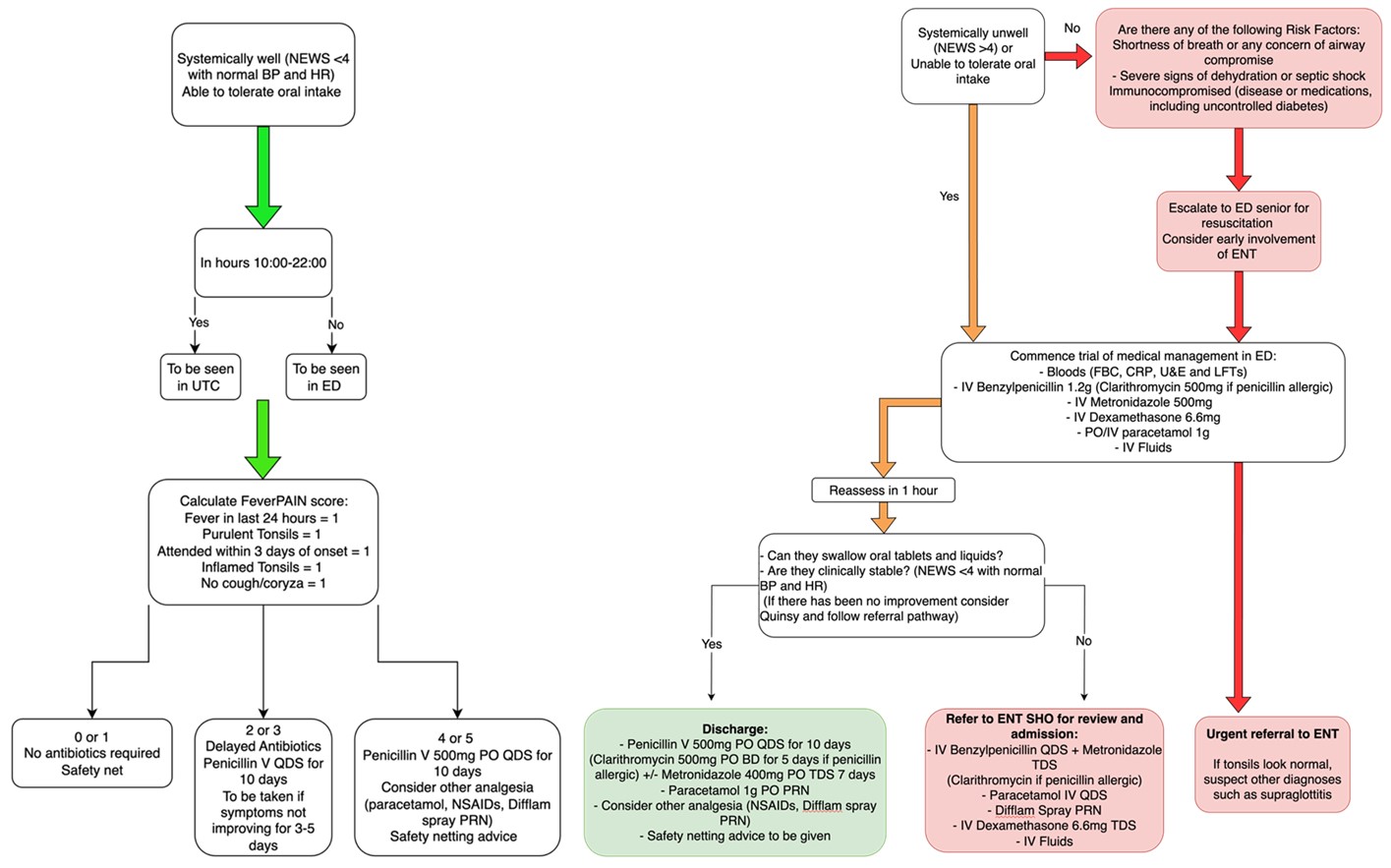
INTEGRATE (The UK ENT Trainee Research Network) (2021) 'Admission avoidance in tonsillitis and peritonsillar abscess: A prospective national audit during the initial peak of the COVID-19 pandemic', Clinical Otolaryngology, 46(2), pp. 363-372. Available at: https://doi.org/10.1111/coa.13680 (Accessed: 09 July 2025).
Hoade, L. M. S. and Rees, E. N. (2023) 'Developing a novel tonsillitis pathway to reduce pressures on front-door services: A multi-phase quality improvement project in a large UK teaching hospital', Surgery in Practice and Science, 14, article number 100214. Available at: https://doi.org/10.1016/j.sipas.2023.100214 (Accessed: 09 July 2025).
Balai, E. et al. (2021) 'Implementation of an acute tonsillitis management protocol within a clinical decisions unit', Annals of the Royal College of Surgeons of England, 103(9). Available at: https://doi.org/10.1308/rcsann.2021.0060 (Accessed: 09 July 2025).
South and West Devon Formulary and Referral (no date) Recurrent Tonsillitis/Tonsillectomy. Available at: https://southwest.devonformularyguidance.nhs.uk/referral-guidance/western-locality/ent/recurrent-tonsillitis-tonsillectomy (Accessed: 09 July 2025).
Royal Berkshire NHS Foundation Trust (2023) Tonsillitis and quinsy: treatment. Available at: https://www.royalberkshire.nhs.uk/media/qabb111z/tonsillitis-and-quinsy-treatment_aug23.pdf (Accessed: 09 July 2025).
National Institute for Health and Care Excellence [NICE] (2018) Sore throat (acute): antimicrobial prescribing. Available at: https://www.nice.org.uk/guidance/ng84 (Accessed: 09 July 2025).
ENT UK (no date) Adult Acute Severe Sore Throat Management Guidelines for Emergency Department Doctors. Available at: https://www.entuk.org/_userfiles/pages/files/resources/adult_sore_throat_clinical_guideline.pdf (Accessed: 09 July 2025).
Little, P. et al. (2014) ‘Antibiotic prescription strategies for acute sore throat: a prospective observational cohort study’, Lancet Infectious Diseases, 14(3), pp. 213-219. Available at: https://doi.org/10.1016/s1473-3099(13)70294-9 (Accessed: 02 September 2025).
Little, P. et al. (2014) ‘PRImary care Streptococcal Management (PRISM) study: in vitro study, diagnostic cohorts and a pragmatic adaptive randomised controlled trial with nested qualitative study and cost-effectiveness study’, Health Technology Assessment, 18(6), pp. 1-102. Available at: https://doi.org/10.3310/hta18060 (Accessed: 02 September 2025).
Little, P. et al. (2014) ‘PRImary care Streptococcal Management (PRISM) study: identifying clinical variables associated with Lancefield group A beta-haemolytic streptococci and Lancefield non-Group A streptococcal throat infections from two cohorts of patients presenting with an acute sore throat’ BMJ Open, 3(10), e003943. Available at: https://doi.org/10.1136/bmjopen-2013-003943 (accessed: 02 September 2025).