Key Points
-
HHS is a medical emergency requiring immediate treatment.
-
The initial management can be accessed via Epic orders, available as HHS panel order
-
Regular review of clinical status is crucial, calculate osmolality (2Na + glucose + urea) to monitor treatment response.
-
Use IV 0.9% sodium chloride solution as the principal fluid to restore circulating volume and reverse dehydration. IV insulin infusion (0.05 units/kg/hr) should only be commenced once the blood glucose is no longer falling with IV fluids alone OR immediately if there is significant ketonemia (>1mmol/L).
-
All patients should receive prophylactic low molecular weight heparin (LMWH) unless contraindicated as they will be at high thrombotic risk. Please refer to Trust guidelines for VTE prophylaxis.
-
HHS diagnosed >24 hours after admission is an SI and should have incident form completed on InPhase Risk Management reporting platform
This is a controlled document. If you are using a printed copy, check it against the guidelines site to ensure you are using the latest edition. Print copies must be destroyed after use.
Abbreviations
Overview:
The hyperglycaemic hyperosmolar state (HHS) is a medical emergency.
This document sets out the FHFT guidelines for the management of Hyperosmolar Hyperglycaemic State (HHS) in adults (previously known as Hyperosmolar Non-Ketotic Diabetic state (HONK)).
It is based on the Joint British Diabetes Societies (JBDS) guideline ‘The Management of the hyperosmolar hyperglycaemic state (HHS) in adults with Diabetes’ published in August 2012 and updated in 2022.
HHS is associated with a significantly higher morbidity and higher mortality risk than DKA and must be diagnosed promptly and managed appropriately (mortality 15-20%).
Patients with HHS are complex and often have multiple co-morbidities and require intensive monitoring.
Treatment pathway for HHS in adults
The HHS Order Set is available on Epic, accessible via the Orders tab. This should make it easier to order initial investigations, fluids and insulin (if required). This guideline should be consulted alongside this order set to ensure complete clinical care.
Definition:
A precise definition of HHS does not exist but there are characteristic features that differentiate it from other hyperglycaemic states such as DKA.
The characteristic features of a person with HHS are:
-
Marked hypovolaemia
-
Measured or calculated serum osmolality usually ≥320 mOsm/kg
-
Marked hyperglycaemia (≥30 mmol/L)
-
No significant hyperketonaemia (ketones ≤3.0 mmol/L)
-
No significant acidosis (pH ≥7.3 and blood or serum bicarbonate ≥15.0 mmol/L)
NB: A mixed picture of HHS and DKA may occur, although relatively rare.
Assessment of severity
Care for people with HHS can be complex because they often have multiple co-morbidities and may require intensive monitoring.
The presence of one or more of the following should prompt discussion with MADU /Level 2 environment if appropriate.
-
Measured or calculated Osmolality >350 mOsm/kg
-
Sodium >160 mmol/L
-
Venous/arterial pH < 7.1 on admission
-
Hypokalaemia (<3.5mmol/l) or hyperkalaemia (>6mmol/l) on admission
-
GCS<12 or abnormal AVPU (Alert, Voice, Pain, Unresponsive) scale.
-
Oxygen saturation < 92% on air (assuming normal respiratory functions e.g. no known COPD)
-
Systolic blood pressure persistently < 90mmHg
-
Pulse persistently >100 or < 60 bpm
-
Serum Creatinine > 200 µmol/L and/or acute kidney injury
-
Oliguria Urine output < 0.5ml/kg/hour
-
Hypothermia
-
Macrovascular event such as myocardial infarction or stroke (HASU or CCU admission)
Goals of treatment
Whilst also preventing:
Immediate management: time 0 to 60 minutes
- IV fluids
- If Systolic BP below 90 mmHg;
Likely due to low circulating volume, but consider heart failure, sepsis, etc.
Give 500 ml 0.9% sodium chloride solution over 15 minutes.
If SBP remains < 90 mmHg repeat above and request senior input.
Involve ITU/Critical care team if SBP remains < 90mmHg after 2 IV fluid boluses.
Caution in the elderly and patients on fluid restriction (i.e. dialysis, pre-existing heart failure)
- If Systolic BP is above90 mmHg;
Give 1 L 0.9% sodium chloride over 60 minutes.
- IV insulin infusion
ONLY commence intravenous insulin infusion quickly in the following circumstances:
• If there is HHS and ketonaemia (blood ketones >1.0 - ≤3.0 mmol/L) and not acidotic (venous pH >7.3 and bicarbonate >15.0 mmol/L) then use 0.05 units/kg/hr
OR
• If there is significant ketonaemia (blood ketones >3.0 mmol/L) or with a pH < 7.3 and bicarbonate of < 15 mmol/L (Mixed HHS and DKA) then use the DKA guidelines at 0.1 units/kg/hr
- Clinical assessment:
-
Does the history suggest sepsis / vascular event or a recent change in medication?
-
Assess the degree of dehydration.
-
Observations: respiratory rate; temperature; blood pressure; pulse; oxygen saturation, Glasgow Coma Scale
-
Full clinical examination
-
Examine for a source of sepsis or evidence of vascular event (stroke, MI, gangrene)
-
Assess for cognition, frailty score and delirium.
-
Assess for contraindications of low molecular weight heparin (LMWH)
-
Assess foot risk score (assume high risk if the person is obtunded or uncooperative)
- Ensure heels are off-loaded
- Heel protectors and an appropriate mattress should be provided for those with immobility, neuropathy, peripheral vascular disease, or lower limb deformity
- Ensure daily foot checks Documented on the flow sheets
- Further investigations
-
Blood cultures, urine culture, ECG, CXR, pregnancy test in women of childbearing age
-
Urea and electrolytes, FBC, CRP (if indicated)
-
Capillary blood glucose, venous plasma blood glucose
-
Measured or calculated serum osmolality [(2xNa+) + glucose + urea]. Until the urea is available, calculate using (2xNa+ + glucose). Recalculate osmolality once urea is available, and then use (2xNa+ + glucose + urea).
-
VBG for pH, bicarbonate, lactate and electrolytes
-
Capillary blood ketones: check hourly until HHS resolution
- Establish monitoring regimen.
Establish monitoring regime appropriate to the individual.
-
1 hourly blood glucose, Na+, K+, urea and calculated osmolality [(2xNa+) + glucose + urea] for the first 6 hours
- Then: 2 hourly osmolality if the response is satisfactory (i.e. a fall of 3.0-8.0 mOsm/kg/hr).
-
Chart measured or calculated osmolality / glucose / sodium.
-
Continuous pulse oximetry
-
Consider continuous cardiac monitoring.
-
Measure arterial blood gases if oxygen saturation < 92%
-
Regular observations and Early Warning Score (NEWS2)
-
Accurate fluid balance chart, minimum urine output 0.5 ml/kg/hr minutes (consider urinary catheter if anuric >1 hour)
-
Consider NG tube with airway protection, if obtunded or vomiting.
Management 60 minutes-6 hours
-
Treat underlying cause if known
-
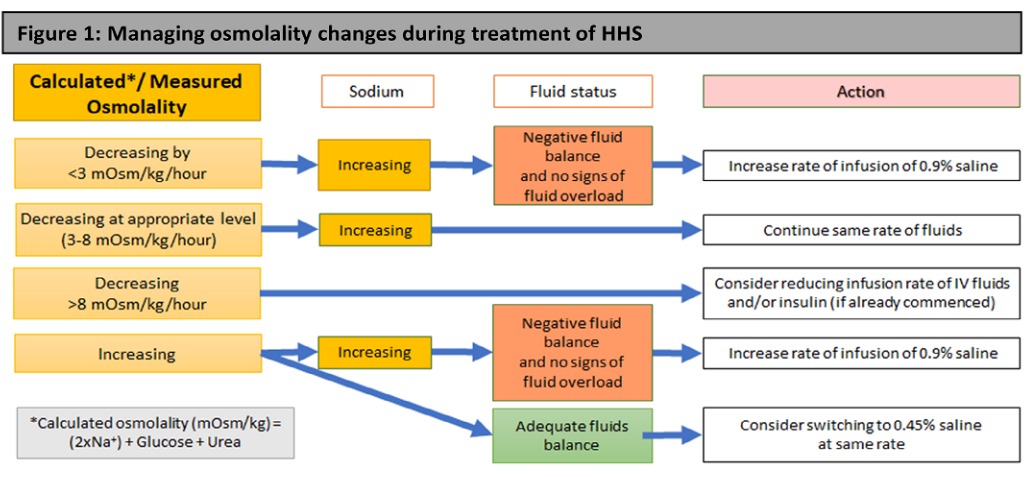
Managing osmolality
-
Aim gradual decline in osmolality (i.e. 3.0-8.0 mOsm/kg/hr)
-
Rate of IV fluids: Use 0.9% sodium chloride to give a further 0.5-1 litre/hr depending on clinical assessment of dehydration vs. risks of precipitating heart failure.
-
Fluid replacement should be adjusted for those who are < 50Kg in body weight or with pre-existing heart and renal disease. More cautious fluid replacement is necessary e.g. 0.25 ml/kg/hr as recommended by NICE.
-
Target positive fluid balance of 2-3 litres by 6hrs.
-
If the serum sodium is increasing but the osmolality declining at an appropriate rate, continue 0.9% sodium chloride solution.
-
If serum sodium is increasing AND the osmolality is increasing (or declining at < 3.0 mOsm/kg/hr), then check the fluid balance. If it is inadequate, then increase the infusion rate of 0.9% sodium chloride solution
-
If the osmolality is increasing and the fluid balance is adequate, consider switching to 0.45% sodium chloride solution given at the same rate
-
If osmolality is falling at a rate exceeding 8.0 mOsm/kg/hr (or > 3 mOsm/kg/hr in those at high risk of developing cerebral oedema), then consider reducing the infusion rate of IV fluids and/or insulin (if already commenced) Review chart 1 (JBDS, 2022)
Chart 1
- Correction of hyperglycaemia.
-
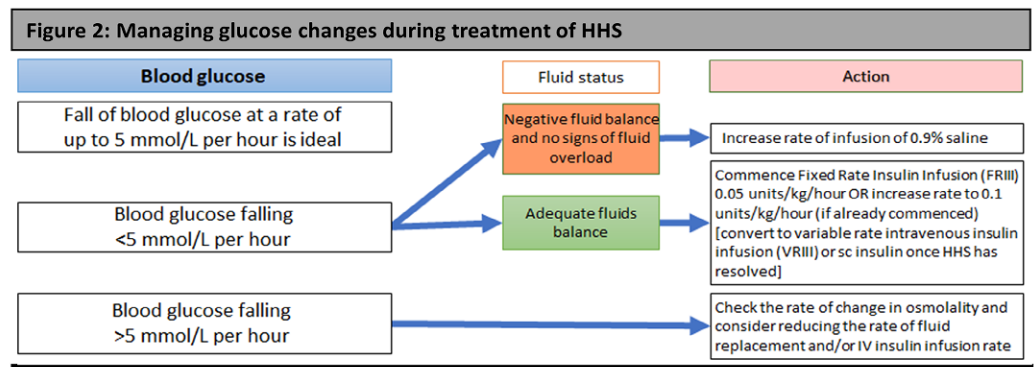
Allow gradual fall in glucose concentration at a rate between 4-6 mmol/L per hour.
-
If the blood glucose is falling at < 5.0 mmol/L per hour, then check fluid balance.
-
Only start IV insulin once fluid replacement is adequate and glucose concentrations have plateaued. Starting an IV insulin infusion too early could result in circulatory collapse.
-
If the fluid balance is inadequate, then increase the rate of infusion of 0.9% sodium chloride solution.
-
If the fluid balance is adequate, then commence an FRIII at 0.05 units/kg/hr, or if already running, increase the rate to 0.1 units/kg/hr if glucose concentrations are not falling
-
If the blood glucose is falling at over 5.0 mmol/L/hr, then check the rate of change in osmolality and consider reducing the rate of fluid replacement and / or intravenous insulin infusion rate. (review Chart2, JBDS, 2022)
Chart 2
- Avoidance of hypoglycaemia
- Potassium correction
- Maintain potassium in the normal range. Potassium abnormalities are less common in HHS than DKA but monitoring and replacement are essential.
Management 6 to 12 hours
-
Ensure that clinical and biochemical parameters are improving.
-
Continue monitoring CBG hourly and sodium and calculated osmolality 2 hourly.
-
Continue IV fluid replacement to achieve positive balance of 3-6 litres by 12 hours.
- Maintain an accurate fluid balance chart.
-
Assess for complications of treatment e.g. fluid overload, cerebral oedema, cerebral pontine myelinolysis (e.g. deteriorating conscious level)
-
Continue treatment of any underlying precipitant(s)
-
Avoid hypoglycaemia: Aim to keep CBG 10-15 mmol/L in first 24 hours
-
If BG falls below 14 mmol/L commence 5% or 10% glucose at 125 ml/hr AND CONTINUE 0.9% sodium chloride solution (see above)
-
Ensure referral has been made to the inpatient diabetes team.
Management 12 to 24 hours
-
Ensure continuing improvement of clinical and biochemical parameters
-
Continue monitoring CBG hourly and sodium and calculated osmolality 4 hourly if improvement maintained (if not, continue 2 hourly)
-
Do not expect biochemistry to have normalised by 24 hrs (sodium and osmolality are likely to be raised)
-
Continue IV fluid replacement to achieve remaining replacement of estimated fluid losses, within the next 12 hours. This will be dependent on factors such as initial degree of dehydration, body weight etc, and most importantly response to treatment thus far.
- Continue maintaining accurate fluid balance chart, plotting osmolality and make appropriate adjustments to fluid replacement rates.
-
Continue IV insulin with or without 5 or 10% glucose solution to maintain BG 10-15 mmol/L
- Adjust insulin infusion rate hourly by 1 unit/hr increments or decrements to achieve desired CBG
-
Assess for complications of treatment e.g. fluid overload, cerebral oedema, cerebral pontine myelinolysis (e.g. deteriorating conscious level)
-
Continue treatment of any underlying precipitant(s)
Management 24hours to 72hours
-
The individual should be steadily recovering, beginning to eat and drink.
-
Ensure that clinical and biochemical parameters are improving or have normalised.
-
Continue IV fluids until eating and drinking normally.
-
Switch to VRIII if not eating and drinking.
-
Convert to appropriate subcutaneous insulin regime when biochemically stable.
-
Encourage early mobilisation.
-
Daily urea and electrolytes
-
Remove urinary catheter when clinically appropriate.
-
Assess for signs of fluid overload or cerebral oedema.
-
Assess for evidence of continuing sepsis.
-
Daily foot checks
-
Continue LMWH until day of discharge (consider extended treatment in those deemed very high risk. This may require specialist advice)
-
Ensure that the person has been reviewed by diabetes team.
After care
-
Most people should go home on subcutaneous insulin (regimen depend on circumstances)
-
For those with previously undiagnosed diabetes or well controlled on oral agents, switching from insulin to the appropriate oral hypoglycaemic agent should be considered after a period of stability (diabetes team to decide this at follow up)
Goals of treatment of HHS are to treat the underlying cause and to gradually and safely:
HHS is associated with a significant morbidity and higher mortality than DKA therefore must be diagnosed promptly and managed intensively.
Other goals include prevention of:
-
Arterial or venous thrombosis
-
Other potential complications, e.g., cerebral oedema/central pontine myelinolysis/osmotic demyelination syndrome.
-
Foot ulceration
Full guidelines.
JBDS 06 The management of the hyperosmolar hyperglycaemic state (HHS) in adults with diabetes | The Association of British Clinical Diabetologists (abcd.care)
References
Joint British Diabetes Societies for inpatient care [JBDS-IP] (2022) Hyperosmolar Hyperglycaemic State (HHS) care pathway in adults.
Joint British Diabetes Societies for inpatient care [JBDS-IP] (2022) JBDS 06 The management of the hyperosmolar hyperglycaemic state (HHS) in adults with diabetes.
Joint British Diabetes Societies for inpatient care [JBDS-IP] (2023) JBDS 02 The management of diabetic ketoacidosis in adults.
Appendix: When and How to Start Fixed-Rate Intravenous Insulin Infusions (FRIII) in HHS
Scenario 1 - HHS and blood ketones 7.3 and bicarbonate >15.0 mmol/L)
Do not start FRIII immediately
Continue to monitor hourly capillary glucose during IV fluid replacement (use laboratory venous glucose if capillary reading ‘>28 mmol/L’ or ‘Hi’)
Once glucose plateaus with fluid replacement alone, commence FRIII at rate of 0.05 units/kg/hr, aiming for a target glucose of 10.0 – 15.0 mmol/L
Scenario 2 – HHS and blood ketones >1.0 mmol/L (urine ketones >2+) and not acidotic (venous pH >7.3 and bicarbonate >15.0 mmol/L)
Start FRIII immediately at rate of 0.05 units/kg/hr (correct to nearest whole unit)
Continue to monitor hourly capillary glucose during IV fluid replacement (use laboratory venous glucose if capillary reading ‘>28 mmol/L’ or ‘Hi’)
Continue to monitor capillary ketones hourly
If glucose is dropping too quickly (i.e. by >5.0 mmol/L/hr), then reduce the FRIII rate by 50%
Repeat the glucose and blood ketones hourly and, if necessary, adjust the insulin infusion rate to ensure the ketones are clearing and the glucose is falling in a controlled manner.
Aim for a target glucose of 10.0 – 15.0 mmol/L
Scenario 3 – Significant hypovolaemia, hyperosmolality and pH3.0 mmol/L
This suggests a mixed picture of HHS/DKA
In this circumstance the DKA pathway should be followed
• Commence IV fluids and FRIII of 0.1 units/kg/hr
Full version control record
This guideline has been registered with the Trust. However, clinical guidelines are guidelines only. The interpretation and application of clinical guidelines will remain the responsibility of the individual clinician. If in doubt, contact a senior colleague or expert. Caution is advised when using guidelines after the review date.
This guideline is for use in Frimley Health NHS Foundation Trust hospitals only. Any use outside this location will not be supported by the Trust and will be at the risk of the individual using it.
Version History
Related Documents
None