Key Points
-
Arrange pre-op assessment as soon as possible after the decision is taken to proceed with surgery to allow optimisation of care.
-
Aim for a HbA1c of < 69mmol/mol if possible and it is safe to do so.
-
Patients with a planned short starvation period (no more than one missed meal in total) should be managed by modification of their usual diabetes medication, avoiding a VRIII wherever possible.
-
Minimise starvation time by prioritising on the list.
-
Measure the capillary blood glucose hourly in an anaesthetised patient, i.e. during the operation.
-
Aim to stop the VRIII as soon as the patient is able to eat and drink.
-
Post-op surgical ward round – look at the glucose and check the feet.
-
SGLT-2 inhibitors (flozins) – omit the day before and the day of a surgical procedure. Only restart when eating and drinking normally. Continue to withhold in any inpatient who is acutely unwell or not eating. Risk of euglycaemic DKA. If unwell check ketone status + VBG.
-
GLP1/ dual GLP1-GIP agents – no need to routinely hold pre surgery. The anaesthetist should provide an individualised assessment for pulmonary aspiration risk and consider the need for any additional measures to mitigate the risk.
This is a controlled document. If you are using a printed copy, check it against the guidelines site to ensure you are using the latest edition. Print copies must be destroyed after use.
Overview
It is expected that 25% of patients with Diabetes will require surgery at some point in their lives. The mortality risk for those with diabetes is estimated to be up to five times that in non-diabetic individuals. Up to two thirds will experience post-operative complications making for longer hospital stays and higher costs.
Poor diabetes control is known to impair immune function, increase cardiovascular risk and increase the risk of thrombosis. Effective pre-operative assessment provides an opportunity to reduce these risks and reduce last minute operation cancellations.

Abbreviations
Pre-Operative management
Refer for pre-op assessment clinic ASAP.
This will give you enough time to sort out any problems with diabetes control and optimise comorbidities. Please note that if the HbA1c is >69mmol/mol then the risk of proceeding with moderate or major surgery should be balanced against the urgency of the procedure.
Pre-op checklist for all patients with Diabetes
a. Do blood tests (U&Es, random blood glucose, HbA1C) and 12 lead-ECG
b. In those patients with a HbA1c>69mmol/mol you have 2 choices
Frimley Park Hospital
-
Alert the patients GP if not known to FPH Diabetes team.
-
Alert the DISN (Diabetes Inpatient Specialist Nurse) if patient is already under the care of the FPH Diabetes team OR if the patient has poor control (random glucose >15 or HbA1c >75mmol/mol)
Wexham Park Hospital
Alert the patient’s GP, who can refer to the Diabetes centre if necessary.
3. Look for and optimise comorbidities
a. Documented IHD – do they need any further cardiac investigation/input?
b. Documented neuropathy – if your patient has a history of previous foot ulceration/amputation/documented neuropathy or attend dialysis then they have ‘AT RISK FEET’. Please make sure that this risk is made clearly visible to the theatre and ward staff at the time of their admission.
c. Find out if your patient has PVD – i.e. check there are no contraindications to use of anti-embolic stockings.
4. Highlight any patients with red flags to the anaesthetic department
a. Evidence of IHD (MI/Ischaemic ECG)
b. End organ complications (e.g. CKD)
c. Autonomic neuropathy (postural hypotension/ resting tachycardia/sensory loss)
d. Obesity
e. Smoker
f. Pre-operative glucose >15mmol/L
g. Use of GLP-1 or dual GIP/GLP-1 receptor agonists* (e.g. semaglutide, dulaglutide, liraglutide, exenatide, lixisenatide, tirzepatide)
*Due to their effect on gastric emptying, GLP-1 and dual GIP/GLP-1 receptor agonists may increase the risk of pulmonary aspiration during general anaesthesia or deep sedation, despite appropriate pre-operative fasting.
Anaesthetists should consider the potential risk of aspiration within their risk assessment of patients being treated with GLP-1 or dual GIP/GLP-1 receptor agonists for all indications and manage the aspiration risk, in line with usual anaesthetic practice. All patients should have an individualised assessment of their aspiration risk accounting for drug, patient and procedural factors. Regional anaesthesia should be considered as the primary anaesthetic technique, if appropriate. Point of care gastric ultrasound should be considered before induction of anaesthesia to facilitate risk stratification, if appropriate.
In general, treatment can be continued but this should be supported through risk assessment and stratification, shared decision making and the use of peri-operative techniques to mitigate risk of pulmonary aspiration.
5. Give the patient written instructions with changes they need to make to their diabetic medication explicitly highlighted (see Appendix 1 & 2)
a. If on morning (am) list- fast from midnight
See appendix 1 and 2 for advice on what to do with diabetic therapy.
b. If on afternoon (pm) list – breakfast before 7am
See appendix 1 and 2 for advice on what to do with diabetic therapy
c. If the patient is on a Continuous Subcutaneous Insulin Infusion (CSII) the ‘pump team’ should be routinely notified at the time of pre assessment (via Epic referral in Frimley and patient’s usual diabetes team in Wexham) so that specific peri-operative advice can be given.
6. Highlight the need for the patient to be prioritised on the theatre list.
a. Aim first on list if possible (minimises starvation period)
b. Please note that prioritisation is not needed for patients who have diet controlled diabetes.
How to manage on day of surgery
On arrival to ward
- Measure blood glucose 2 hourly in the lead up to the operation
Target blood glucose 6-10mmol/L (acceptable range 6-12 mmol/L)
- Check feet prior to surgery
Use heel protectors if ‘high risk foot’ + highlight concern to theatre staff.
- Determine the need for a VRIII according to anticipated starvation period.
Measure the capillary blood glucose hourly in an anaesthetised patient, i.e. during the operation for all patients with diabetes (independent of whether they are on a VRIII)
Anticipated short starvation period (only one missed meal)
Can generally avoid using a VRIII
Anticipated long starvation period (more than one missed meal)
If expect >1 missed meal start VRIII at induction and continue post-operatively until able to eat and drink. Please note that patients managed on diet alone or on once daily metformin should only start a VRIII if their capillary blood glucose levels are >12 mmol/L on 2 consecutive occasions.
VRIII
Suggested Insulin Infusion Rates
Please adhere to Trust Clinical Guidelines on how to manage a patient on a VRIII
Key points
If the patient is on a long-acting insulin this must be continued alongside the VRIII at 80% of their usual dose
CBGs must be checked hourly
For advice on concurrent fluid administration – refer to guidance on the Trust Clinical Guideline platform.
How to stop a VRIII – refer to guidance on the Trust Clinical Guideline platform.
Please note U&Es must be checked at least once daily (look at Na + K trend)
Hypoglycaemia whilst on VRIII – refer to guidance on platform for full details.
*Treat Hypoglycaemia and restart IV insulin within 20 minutes. The half-life of intravenous insulin is very short (seven to eight minutes) and restarting the VRIII minimises the risk of ketoacidosis. When restarting the VRIII you will need to step down to the next scale for example if using the ‘standard scale’ you would step down to the ‘reduced scale’ on the table above.
Trouble shooting on the day of surgery
Blood glucose 12-20 mmol/L pre-operatively (assuming patient is otherwise well)
Please check blood for ketone status.
If significant ketonaemia >1.5 mmol/L, the patient will require an urgent VBG – need to exclude DKA/impending DKA. If the pH or HCO3 are abnormal on the VBG, please do an ABG and seek urgent medical advice on how to manage. If no significant ketonaemia start a VRIII. Aim to stop the VRIII as soon as patient is able to eat + drink after surgery.
Please refer to the Trust Clinical Guideline platform for guidance on use of a VRIII for advice on how to do this safely.
Blood glucose >20mmol/L pre operatively
Postpone surgery and manage the diabetes (refer to diabetes SpR/Consultant/DISN).
Please check the blood for ketone status. If significant ketonaemia >1.5 mmol/L, the patient will require an urgent VBG – need to exclude DKA/impending DKA.
If the PH or HCO3 are abnormal on the VBG, please do an ABG and seek urgent medical advice how to manage.
Blood glucose <4 pre-operatively
Non-carbonated glucose drinks can be given until 2 hours pre-op.
If < 2hours pre op, then treat according to the hypo box protocol on the ward with iv glucose
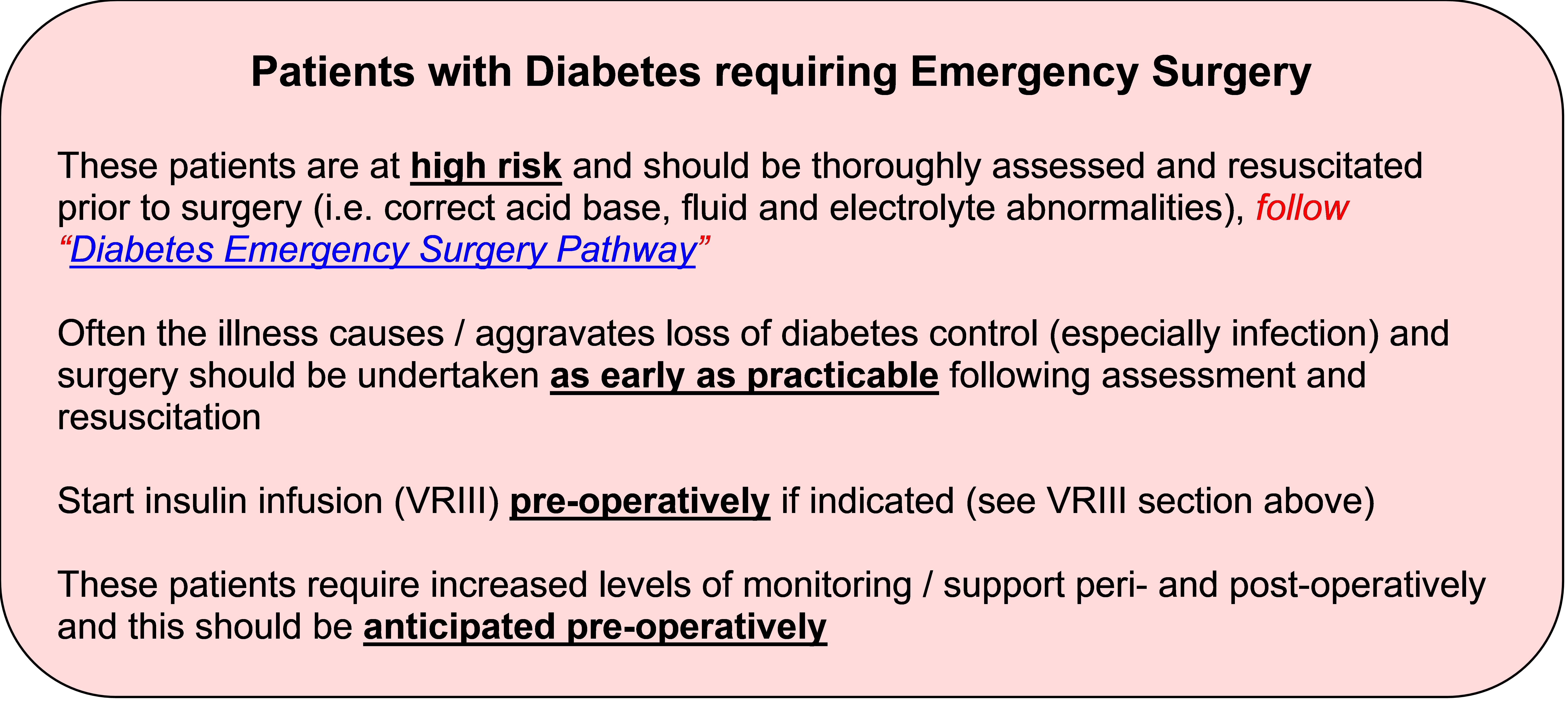
Post –operative management
Aim CBGs 6-10 mmol/L (6-12 mmol/L acceptable)
For patients on a VRIII
-
Continue to check the CBG levels hourly in the immediate postoperative period
-
Ensure that the patient has a daily U&E check (note the Na and K trend)
-
Aim to stop the VRIII at the next most appropriate mealtime when the patient is able to eat + drink without nausea or vomiting.
Follow guidance on use of a VRIII for advice on how to do this safely.
a. If restarting oral hypoglycaemic medication:
i. Please be prepared to withhold or reduce the sulphonylurea if the food intake is likely to be reduced.
ii. Continue to withhold SGLT-2 inhibitors (flozins) in any patient who is acutely unwell or not eating (risk of euglycaemic DKA). If unwell check ketone status + VBG – please note the glucose does not need to be raised to do this. Can restart the SGLT2i when patient is eating and drinking normally.
b. If restarting subcutaneous insulin, it is fine to restart the normal pre surgical regimen but do be prepared to adjust doses because the insulin requirement may change as a result of post-operative stress, infection or altered food intake.
c. In the case of a person who uses a CSII, i.e. ‘an insulin pump’, the subcutaneous insulin can be recommenced at their normal basal rate. The VRIII should be continued until the next meal bolus has been given. Do not recommence a CSII at bedtime. Please refer to Trust Clinical Guidelines for specific CSII guidance. For all patients using a CSII, please involve the technology team/DISN.
For all patients: do daily foot checks whilst in hospital.
For patients that have undergone a major surgical procedure
a. Do a follow up ECG in the immediate post-operative period and on day 1 post operation to make sure there have been no acute/ ‘silent’ changes.
Trouble shooting in the post-operative phase
Recurrent CBGs >15
Contact Diabetes Specialist Team. Remember to check the ketone status and if ketonaemia >1.5mmol/L is present do a VBG – need to exclude DKA/ impending DKA. If the PH or HCO3 are abnormal on the VBG, please do an ABG and seek urgent medical advice for how to manage.
Hypos (CBG<4)
Follow hypo box guidance and additional guidance on the intranet. Increase monitoring to at least 4x daily but ideally 4 hourly as further risk of hypoglycaemia is high within next 24 hours. Take steps to prevent further hypos. If recurrent hypos – contact the Diabetes team.
Discharge
Should not be delayed solely because of poor glucose control if the patient is otherwise well. The patient or carer’s ability to manage the diabetes should be taken into consideration. Discuss with the Diabetes specialist team if necessary.
Contacts for Diabetes Specialist advice
Suggest that you contact the Diabetes Specialist Nurse as first point of contact for most queries. If your patient is unwell with impending DKA contact the Diabetes SpR or Medical SpR on call for advice. If your patient needs urgent Specialist review in the pre op period because of poor glycaemic control or other diabetes related comorbidities and is known to the Specialist team at FPH or WPH – please contact the relevant Consultant and they can advise as to the most appropriate course of action.
For advice on FPH site
Diabetes specialist nurse (bleep 5250) or extension 134701
Diabetes SpR 07917 643736
For advice on WPH site
Please contact the Diabetes specialist nurse via mobile 07776 225313
Please contact the Endocrinologist/Diabetologist on call via switchboard.
References
Elective peri-operative management of adults taking glucagon-like peptide receptor agonists, glucose dependent insulinotropic peptide agonists and sodium-glucose contrasnporter-2 inhibitors: a multidisciplinary consensus statement. El -Boghdadly et al. Anaesthesia 2025 doi.10/1111/anae. 16451
Centre for Perioperative Care and Academy of Medical Royal Colleges (updated October 2023) Guideline for Perioperative Care for People with Diabetes Mellitus Undergoing Elective and Emergency Surgery. Available at: https://www.cpoc.org.uk/sites/cpoc/files/documents/2024-05/CPOC-DiabetesGuideline2023.pdf (Accessed: 11 February 2025).
Joint British Diabetes Societies for Inpatient Care (2015) Management of adults with diabetes undergoing surgery and elective procedures: Improving standards. Available at: http://www.diabetologists-abcd.org.uk/JBDS/JBDS_IP_Surgical_Guideline_2015_Full.pdf (Accessed: 12 June 2024)
National Institute for Health and Care Excellence [NICE] (2020) Perioperative care in adults. NG180. Available at: https://www.nice.org.uk/guidance/ng180 (Accessed: 11 February 2025).
Perioperative use of glucagon-like peptide-1 receptor agonists and sodium-glucose cotransporter 2 inhibitors for diabetes mellitus, Dhatariya, Ketan et al. British Journal of Anaesthesia, Volume 132, Issue 4, 639 - 643
Medicines and Healthcare products Regulatory Agency. GLP-1 and dual GIP/GLP-1 receptor agonists: potential risk of pulmonary aspiration during general anaesthesia or deep sedation. January 2025
Appendix 1: Peri-operative adjustment of insulin medication
Appendix 2 – Peri-operative adjustment of non-insulin medication