Key Points
Suspected adrenal crisis should be treated with IV hydrocortisone and fluids without delay.
-
There is no risk of overdose from hydrocortisone in emergency situations. Omission can result in death.
-
Patients who have been taking 5mg or more prednisolone (or equivalent) on a long-term basis should be regarded as potentially having adrenal insufficiency.
Ensure patient education and long-term management planning before discharge.
This is a controlled document. If you are using a printed copy, check it against the guidelines site to ensure you are using the latest edition. Print copies must be destroyed after use.
Abbreviations
Acute cortisol insufficiency
Also known as adrenal crisis, is a life-threatening condition characterized by a sudden and severe deficiency of cortisol. This can occur in patients with known primary or secondary adrenal insufficiency, as well as those with undiagnosed adrenal disorders.
Diagnostic measures should never delay treatment, and if an adrenal crisis is suspected, treatment should be initiated WITHOUT DELAY.
Short-term administration of high doses of glucocorticoids is never harmful, but failure to treat adrenal crisis can result in death.
Common Causes of Adrenal Crisis:
-
Primary adrenal insufficiency (Addison’s disease, congenital adrenal hyperplasia, bilateral adrenal haemorrhage or infarction, bilateral adrenal metastasis, bilateral adrenalectomy)
-
Secondary adrenal insufficiency (due to pituitary, hypothalamic disorders, patients on long term glucocorticoid therapy or abrupt cessation of glucocorticoid therapy)
-
Acute stress (infection, trauma, surgery) in patients with any adrenal insufficiency
Emergency Management:
Initial Treatment:
- Hydrocortisone IV: Administer 100 mg of hydrocortisone via IV or IM injection immediately, followed by 200 mg over 24 hours, either as a continuous infusion or in divided doses (IV or IM Hydrocortisone 50mg QDS).
There is no risk of overdose from hydrocortisone in an emergency.
-
Fluid Resuscitation: Rapid IV infusion of isotonic saline (0.9% NaCl) to correct hypovolemia and hypotension (500-1000 mL given over 30 minutes and repeated as needed).
-
Hypoglycaemia: If hypoglycaemia is present, administer IV glucose (200mL of 10% dextrose solution) and monitor blood glucose levels closely. See Hypoglycaemia guideline.
Followed by:
- Hydrocortisone 200 mg over 24 hours, either as a continuous infusion or in divided doses (IV or IM Hydrocortisone 50mg QDS).
Continue until the person is haemodynamically stable and they are able to take and absorb oral glucocorticoids.
-
Continue to give 0.9% sodium chloride intravenous infusion, determined by haemodynamic parameters and electrolyte status, until the person is haemodynamically stable.
-
Identify and treat any underlying cause of adrenal crisis.
-
Refer to the specialist endocrine team (Inpatient Consult on Epic) for ongoing clinical advice and support throughout admission and during the hospital stay.
Monitoring:
-
Regularly monitor vital signs (blood pressure, heart rate, oxygen saturation) and fluid balance.
-
Monitor serum electrolytes and renal function every 6-8 hours initially.
-
Regularly monitor glucose status, as indicated.
-
Assess clinical improvement (blood pressure, mental status, resolution of symptoms).
Transition to Oral Therapy:
-
Once the patient stabilises (hemodynamically stable, able to tolerate and absorb oral medications), switch to oral hydrocortisone 20mg every 6 hourly and taper over 1-2 days until the patient’s maintenance dose is reached (typically 15-25 mg/day in 2-4 divided doses).
-
If they weren’t on steroids previously, offer at least 40mg oral hydrocortisone in 3-4 divided doses, or at least 10mg oral prednisolone in 1-2 divided doses until any underlying cause has resolved and the person is clinically stable. This can be gradually reduced to a baseline dose of hydrocortisone 15-25mg daily in 2-4 divided doses or prednisolone 3-5mg daily.
Long-Term Management and Prevention:
*Steroid cards – further information:
There are two types of steroid card. Their purpose and distribution are highlighted in the table below.
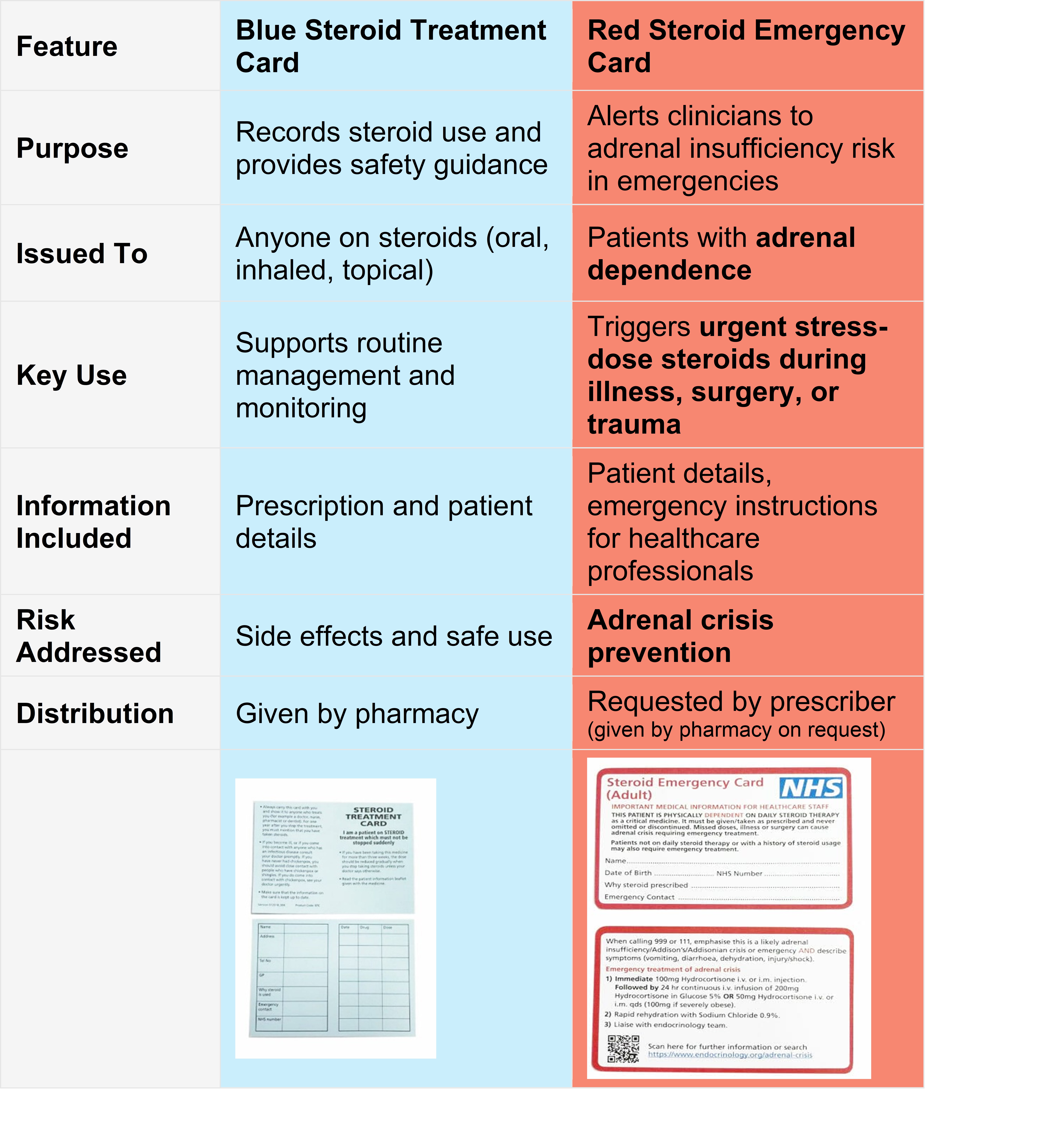
Importantly, please note that red steroid cards will only be issued by pharmacy, on request from the prescriber. This can be requested directly from the ward pharmacist, or alternatively by adding instructions in the “Note to pharmacy” field. This should be done only after the patient is counselled on its use and purpose.
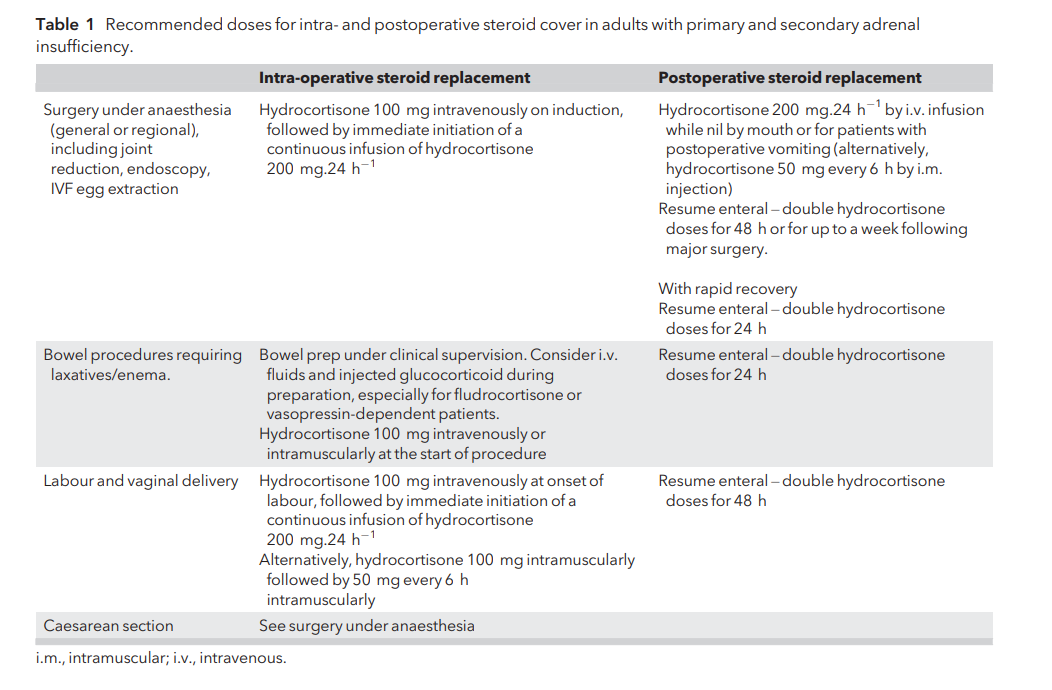
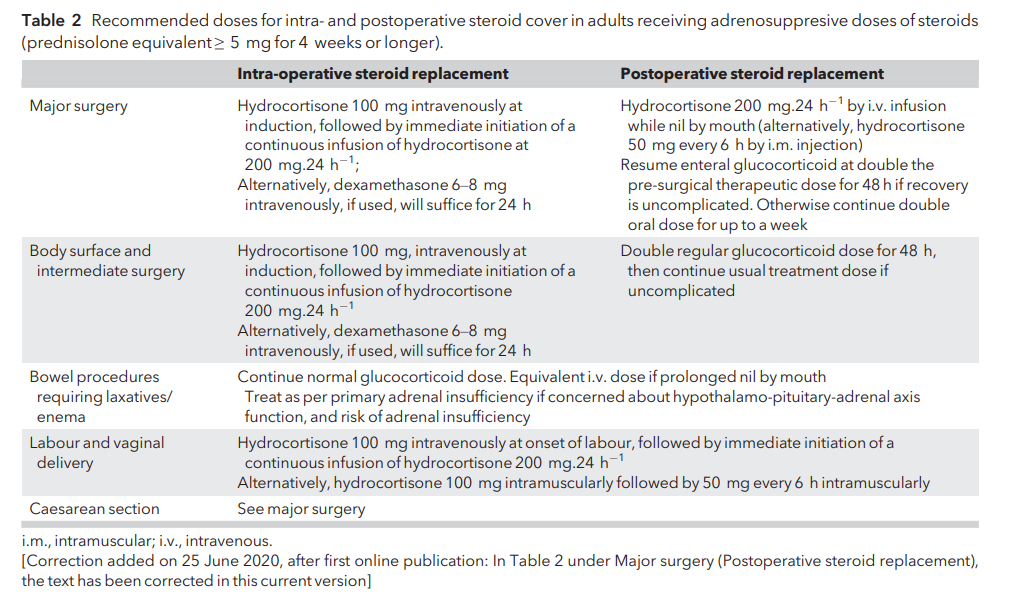
Appendix 1: Recommended doses for Intra- and Post-Operative Steroid Cover in Adults with Primary or Secondary Adrenal Insufficiency
Key facts
-
Patients with adrenal insufficiency should, where possible be first on the list (similar to those with type 1 DM)
-
Patients who have been taking 5mg or more prednisolone (or equivalent) on a long-term basis should be assumed to have adrenal insufficiency and managed with perioperative supplemental steroid cover, on a precautionary basis.
-
In severe obesity, if 50mg hydrocortisone is recommended, consider using 100mg instead.
-
Steroids must NOT be omitted for patient nil by mouth (this needs to be given as IV replacement in bowel obstruction or orally with a sip of water for other procedures)
Appendix 2: Managing glucocorticoid withdrawal to prevent adrenal insufficiency
Do patients require assessment of adrenal function before commencing prednisolone withdrawal?
-
Most patients on oral prednisolone do not need assessment of adrenal function.
-
If following guidelines are followed carefully, the hypothalamic pituitary axis should recover in almost all the individuals and they do not require formal assessment.
-
Decisions to taper dosages of glucocorticoid should be made by the clinical team who initiated the treatment (this is not up to the endocrinologist)
-
While reducing glucocorticoid dosing, patients should be considered steroid dependent. Therefore, they require education around sick day rules.
For people who have been taking glucocorticoids to treat an underlying condition for more than 4 weeks and no longer need them:
- Reduce the glucocorticoids to a daily physiological equivalent dose (this is a total daily dose of hydrocortisone 15 mg to 25 mg or prednisolone 3 mg to 5 mg, or dexamethasone 0.5 mg)
and
Decisions to taper dosages of glucocorticoids should be made by the clinical team who initiated the treatment.
For people who have been taking Prednisolone for more than 12 weeks and no longer need them:
Gradually reduce glucocorticoids to a daily physiological equivalent dose ( this is a total daily dose of hydrocortisone 15 mg to 25 mg or prednisolone 3 mg to 5 mg, or dexamethasone 0.5mg).
Then: consider stopping treatment using a slower dose-tapering regimen following the Imperial Centre for Endocrinology prednisolone withdrawal regimen (Table 1).
Consider changing from dexamethasone to prednisolone to manage dose tapering below a physiological equivalent dose.
Monitor people on glucocorticoid dose tapering below physiological equivalent dose regimens for signs and symptoms of adrenal insufficiency.
Table 1
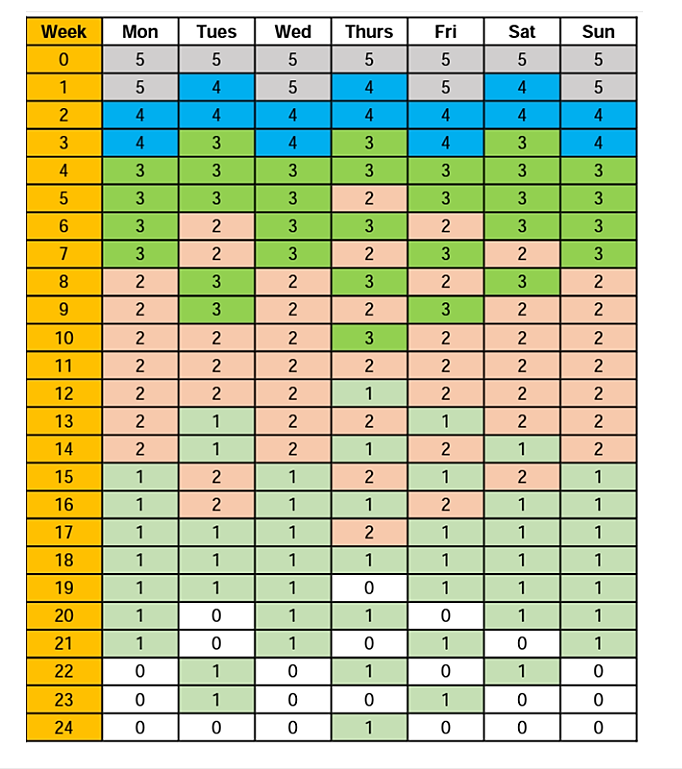
Imperial Centre for Endocrinology prednisolone withdrawal regimen
Indications to assess adrenal functions during Glucocorticoid weaning.
Key points
-
We advise against routine assessment of plasma cortisol or short synacthen test in all the patients undergoing slow taper of oral prednisolone therapy.
-
Patients who have only been taking prednisolone for less than 12 weeks and weaned appropriately are unlikely to develop adrenal insufficiency.
-
Patients will require regular clinical assessment for both flare up of underlying disease and/or development of adrenal insufficiency symptoms during a slow glucocorticoid tapering regimen. Symptoms of adrenal insufficiency are often non-specific (fatigue/myalgia/weight loss/hypoglycaemia) and can mimic the underlying initial disease.
Consider assessment of adrenal function only in selected patients during the slow weaning process. Examples of these patients include:
- Person has developed signs and symptoms of suspected adrenal insufficiency during slow weaning.
These include weight loss, decreased appetite, nausea, fatigue that is significantly affecting the person's ability to conduct activities of daily living, muscle weakness, light-headedness.
- Those who are about to undergo an acute stress (e.g. elective surgery)
In order to accurately assess adrenal function, patients should omit prednisolone for 24 hours, hydrocortisone for 12 hours or dexamethasone for 72 hours prior to the test. They can restart their steroids immediately after the test. As an example, for a patient on prednisolone with a 9am serum cortisol test on a Monday morning, should take their last dose on Sunday morning, and only restart after the test on the Monday.
Adrenal function can be assessed by measuring the following:
- Early morning cortisol (checked between 0800-1000hr) after omitting Prednisone for 24hours.
Table 2
Follow table 2 to interpret the results and aid decision making.