Key Point
The diagnosis of Brugada Syndrome should be considered in any person who has experienced
- syncope
- nocturnal agonal respiration
- documented ventricular fibrillation
- self-terminating polymorphic ventricular tachycardia
Or where there is a family history of sudden cardiac death
This is a controlled document. If you are using a printed copy, check it against the guidelines site to ensure you are using the latest edition. Print copies must be destroyed after use.
Abbreviations
1.0 Introduction
This guideline will outline the use of ajmaline in helping to diagnose patients with suspected Brugada Syndrome.
Brugada Syndrome is a syndrome that causes sudden unexpected cardiac death in apparently healthy individuals. The sudden death is a result of severe disturbances of the rhythm of the heart and is seen as a distinct ECG pattern consisting of atypical right bundle branch block and right precordial ST-elevation.
Brugada Syndrome is inherited as an autosomal dominant condition with variable penetrance and is caused by three different mutations on the cardiac sodium channel gene SCN5A which results in sodium channel dysfunction that leads to the myocardial tissue being more excitable and therefore vulnerable to tachyarrhythmias. Episodes of arrhythmia often occur during sleep, rest and when febrile or dehydrated.
The diagnosis of Brugada Syndrome should be considered in any person who has experienced syncope, nocturnal agonal respiration, documented ventricular fibrillation, self-terminating polymorphic ventricular tachycardia, or where there is a family history of sudden cardiac death.
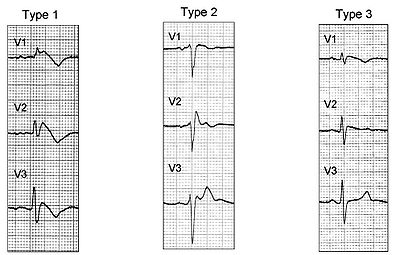
The diagnosis of Brugada Syndrome is made on both clinical and ECG criteria. The administration of Class I antiarrhythmics such as ajmaline, a sodium channel blocker, may convert the subtle saddleback ST-T elevation (types 2 and 3) to the more typical coved-type elevation (type 1) which may help to confirm the diagnosis. Ajmaline is favoured over other sodium channel blockers because of its short half-life and electrophysiological effects.
The aim of the guideline is to ensure that treatment is given within a safe environment by adequately trained staff.
TREATMENT
Antiarrhythmic drugs can be used as preventative therapy for Brugada syndrome such as quinidine and hydroquinidine. However, the only treatment able to reduce the risk of SCD in Brugada syndrome is an implantable cardiac defibrillator (ICD). Therefore, ICD implantation is recommended in patients with Brugada syndrome who are survivors of a cardiac arrest or who have documented spontaneous sustained VT. An ICD should also be considered in thought who display a spontaneous type 1 ECG pattern and have a history of syncope. (2015 VA Guidelines- ESC) The following lifestyle changes are recommended in all patients with a diagnosis of Brugada syndrome:
1) Avoidance of drugs that may induce ST-segment elevation in right precordial leads (http://www.brugadadrugs.org)
2) Avoidance of excessive alcohol intake and large meals
3) Prompt treatment of any fever with antipyretic drugs
2.0 AJMALINE
Ajmaline is a class Ia antiarrhythmic agent which blocks the fast inward sodium current to the myocardial cells, thus inhibiting depolarisation in the fast-conducting structures of the heart (atrial and ventricular muscle, His-Purkinje system, accessory pathways).
Half-life is 5-6 minutes.
Plasma elimination half-life is 95 minutes.
3.0 Preparations Available
Ajmaline 5mg/ml (10ml vials)
4.0 Licensed Indications
Unlicensed in UK
In Germany, licensed for the following indications:
-
Acute therapy of ventricular and supraventricular tachyarrhythmias, ventricular and supraventricular extrasystoles
-
Termination of paroxysmal tachycardias, also in connection with WPW (Wolff-Parkinson-White) and Lown-Ganong-Levine syndromes
-
Differential diagnosis of the WPW syndrome
-
Ajmaline test to assess AV conduction disturbances in the infra-His bundle (contraindicated in patients with cardiac decompensation)
5.0 Prescriber Restrictions
Recommended by Consultant Electrophysiologist but Cardiology Consultants and Cardiac Arrhythmia Nurse Specialist able to prescribe.
6.0 Drug Interactions
Ajmaline is known to have drug interactions with some drugs especially those known to prolong QT interval and hence concurrent administration is not recommended. These drugs include:
-
Other Class Ia antiarrhythmics such as disopyramide, procainamide, quinidine
-
Class Ic antiarrhythmics such as flecainide
-
Class III antiarrhythmics such as amiodarone and sotalol, bretylium, and dofetilide
-
Cardiac glycosides
-
Tricyclic antidepressants and Antipsychotics
-
Other drugs including levofloxacin, sulfamethoxazole, erythromycin. This list is not exhausitive. Please check for interactions if patient taking medication
8.0 RISK FACTORS
-
Significant widening of the QRS complex or significant prolongation of the QT interval
-
Pre-existing ventricular conduction disorders
-
Left ventricular hypertrophy
NB a higher risk ajmaline test may need to be reconsidered or conducted in a tertiary centre
9.0 Administration of Ajmaline
Pre procedure
-
Concomitant antiarrhythmic drugs or drugs known to provoke Brugada ECG to be discontinued for at least five half-lives prior to challenge
-
Patient should be fasted (6 hours for food, 2 hours clear fluid)
-
Defibrillator and Resuscitation equipment to be present throughout procedure
Ward responsibilities
-
Receive and admit patient on arrival
-
Complete admission ajmaline safety checklist – observations, weight, cannula, bloods ensuring potassium >4mmol/L
-
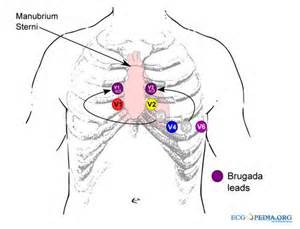
Connect ECG machine to patient, perform baseline 12 lead ECG and high precordial lead ECG
- Prepare and draw ajmaline (DOSE: 1mg/kg body weight to a maximum dose of 100mg) given intravenously
Total dose is given over 5 minutes, so calculate amount of ajmaline required every minute for total dose to be given in 5 minutes
- Isoprenaline on hand and easy to draw up - separate labelled emergency medication container
Clinician’s responsibilities
-
Review medical notes, history, medication and any investigation reports
-
If typical type 1 Brugada pattern, then do not proceed with test
-
If AV block present, discuss with consultant as to whether to proceed without temporary pacemaker
-
If other pathology suggested, discuss with consultant as to whether to proceed
-
Explain procedure to patient including benefits, risks, and side effects before obtaining verbal consent.
During Ajmaline Test
-
Resuscitation trolley by bedside
-
Continuous ECG monitoring co-ordinating start time with colleague giving the ajmaline.
-
Perform ECG every minute during injection including high precordial leads V1-3
Administer ajmaline slowly every minute when instructed by colleague.
Total dose of ajmaline is given over 5 minutes
Expected ECG changes that can occur and does not require test termination:
-
A degree of QRS prolongation
-
A degree of PR and QTc prolongation
-
T-wave variation in amplitude or shape from beat to beat
Ajmaline administration should be stopped if:
-
Target dose is reached
-
QRS widens to ≥130% (30% more than baseline)
-
Prolongation of the PR interval duration > 150% (50% more than baseline) or the occurrence of higher degree AV-block
-
A type 1 Brugada ECG is detected, i.e., coved ST elevation of greater than 2mm height above the isoelectric line in 2 adjacent RV and/or high RV leads
-
Premature ventricular beats or other ventricular arrhythmias occur
-
Sinus arrest
-
Unacceptable adverse effect
Positive test:
- ≥ 2mm ST segment elevation in one or more right ventricular leads (V1-V3) – a type 1 change
Reassure patient when experiencing expected side effects of the medication
In the event of life-threatening arrhythmia initiate defibrillation and intermediate life support.
In extreme overdose, respiratory depression, hypotension, shock, anuria, coma may be seen. Antidote is Isoprenaline given intravenously.
Management of Ventricular Arrhythmias - Isoprenaline
Vials supplied as: 200micrograms/1mL
Dilution: Take 0.1ml and dilute up to 10ml with sodium chloride, giving a concentration of: 20 micrograms in 10ml which is equal to 2 micrograms in 1 ml
Note: If the strength of isoprenaline is different, do NOT follow the above dilution and contact pharmacy or a colleague for advice
After Ajmaline test
Continue to record ECG every minute for 15 minutes after administration of ajmaline.
If QRS has not returned to baseline, then continue to monitor until ECG has returned or is close to baseline.
Perform full set of observations.
If negative test patient can eat and drink.
Remove cannula.
If positive, discuss with consultant re. plan of care.