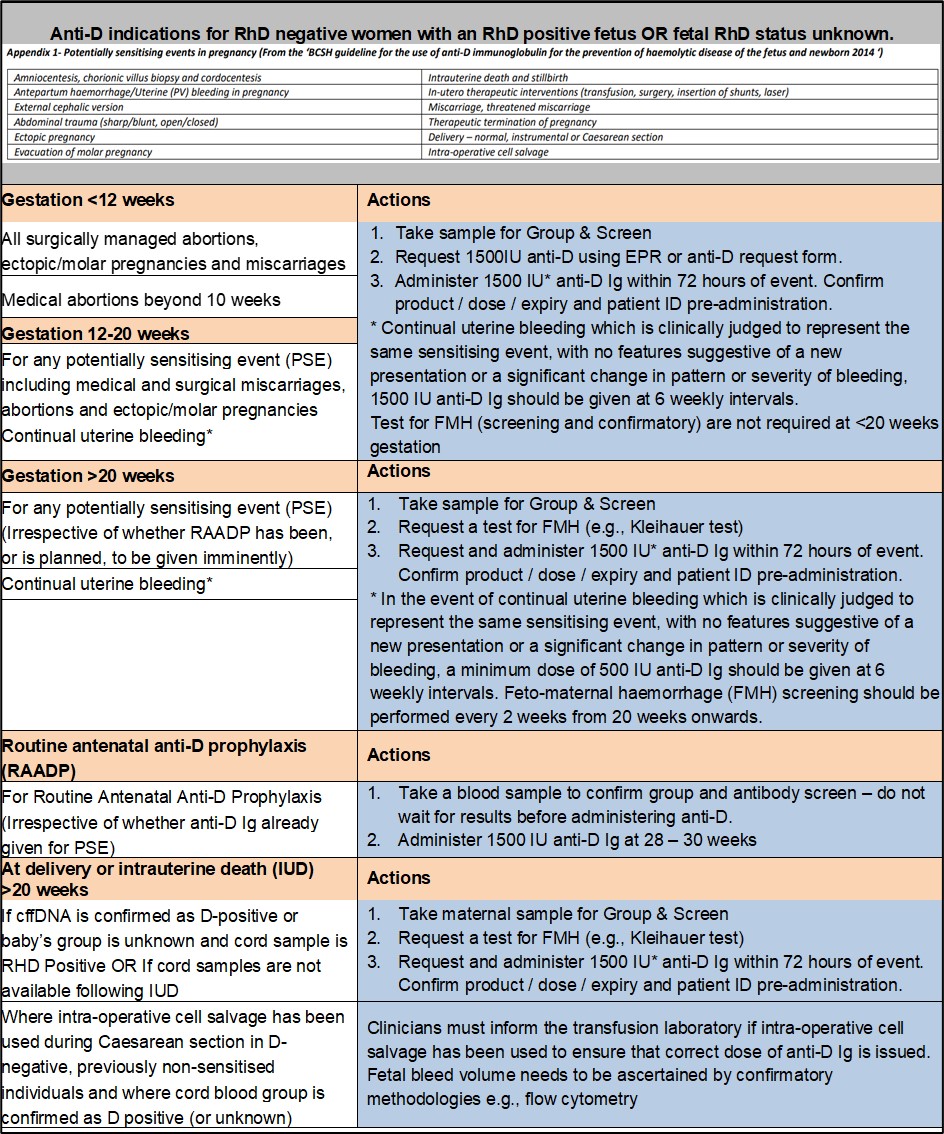
Anti-D is a blood product & as such all aspects of sampling, request, administration & traceability are as outlined in the Blood Transfusion Policy for Adult Patients.
Anti-D is produced from plasma collected from donors across a number of sites in the USA, all of which comply with US Food & Drug Administration standards. The production process includes steps to minimize the risk of viral contamination.
Safety
The CSL Behring Rhophylac patient information leaflet currently states that:
‘When medicines are made from human blood or plasma, certain measures are put in place to prevent infections being passed on to patients. These include:
• Careful selection of blood and plasma donors to make sure those at risk of carrying infections are excluded,
• The testing of each donation and pools of plasma for signs of virus/infections,
• The inclusion of steps in the processing of the blood or plasma that can inactivate or remove viruses.
Despite these measures, when medicines prepared from human blood or plasma are administered, the possibility of passing on infection cannot be totally excluded. This also applies to any unknown or emerging viruses or other types of infections.
The measures taken are considered effective for enveloped viruses such as human immunodeficiency virus (HIV, the AIDS virus), hepatitis B virus and hepatitis C virus.
The measures taken may be of limited value against non-enveloped viruses such as hepatitis A virus and parvovirus B19.
Immunoglobulins have not been associated with hepatitis A or parvovirus B19 infections, possibly because the antibodies against these infections, which are contained in the product, are protective.’
https://www.medicines.org.uk/emc/product/6791/pil
Storage
Anti-D is usually kept in a refrigerator at 2-8ºC until ready for use, but it has been confirmed by CSL Behring that Rhophylac is stable at room temperature for up to four days if stored at 8-250C. It is the responsibility of the GP surgery or ward to ensure that the anti-D is correctly stored as soon as it is received. The drug fridge should be correctly maintained & monitored as appropriate for a drug fridge. In the event that an alternative product is supplied please check the product insert for storage times. Fridges used for anti-D storage should be checked daily and any unused anti-D returned to the laboratory ASAP.
Contingency plan for management of Anti-D stock crises
Supplier stock crises have necessitated the creation of a contingency plan in case of failure of stock. In the event of a failure of stock the Transfusion Laboratory will supply an alternative. The Head of Midwifery will be consulted & advised of the option that will be used & will be responsible for ensuring staff are aware of this change. The TP team will support the midwifery department with this temporary change in practice.