1.0 Introduction:
Pain management following lower limb amputation in vasculopaths is challenging. These patients present with combinations of pre-existing ischaemic limb pain, peripheral neuropathic pain and develop acute postoperative pain in addition following the amputation. Effective acute pain management possibly prevents the transition to and /or lessens the intensity of chronic pain, conditions like stump pain, neuroma pain and phantom limb pain. Multimodal analgesia remains the cornerstone in the pain management following surgery by taking advantage of the different mechanisms of actions of the drugs and hence reducing side effects. Regional anaesthesia is one of the most effective techniques in pain management which produces targeted pain relief with very little central side effects. Peripheral regional nerve catheters (PNC) inserted into the sciatic and femoral nerves has numerous advantages in providing good pain relief, hence reducing the need and side effects of opiates. PNCs when compared with central neuraxial techniques (epidural analgesia) confers reduced motor weakness in the opposite leg so patients can mobilize early, and reduced side effects like hypotension and need for urinary catheterization. PNCs when inserted surgically into the sciatic nerve under direct vision can save time and improve theatre efficiency.
Aim of the guideline:
The guideline aims to optimise and standardise the pain management in patients undergoing lower limb amputation by targeting the preoperative, intraoperative and postoperative phases.
1.1 Preoperative phase
1.1.1 Vascular team to optimise pain and involve Inpatient/acute pain team early.
1.1.2 At decision for amputation:
1.1.3 Commence anti-neuropathic agents preoperatively. Start and titrate gabapentin as per BNF.
1.1.4 If unable to tolerate gabapentin use pregabalin instead as per BNF after discussion with the pain team.
1.1.5 Caution reduce dose of anti-neuropathic agents and opioids (if commenced), as per BNF in the elderly and in patients with impaired renal function.
1.1.6 Paracetamol regularly QDS (reduce dose in those weighing 50kg or less)
1.1.7 If already on above drugs, pain team to advise pre-operative optimisation
1.2 Intra-operative phase
1.2.1 Prior to insertion of these catheters, adhere to the trust WHO Surgical safety Checklist, Stop before you block policy, LocSIPP for invasive procedures and the FHFT infection prevention and control policies and Anticoagulation guidelines. Consent for block should be documented. The person inserting the block will only mark the block site if the block is the only procedure taking place at that time (for example if the block is being inserted prior to or after surgery. Where block is being inserted concurrently with surgery the surgeon will mark the operation site).
1.2.2 For Above Knee Amputation or Through Knee Amputation:
1.2.2.1The best practise recommendation is to insert a Femoral nerve catheter (ideally before incision) and a surgically inserted Sciatic nerve catheter.
1.2.2.2 If there are situations where a femoral nerve catheter cannot be sited due to technical issues or contraindications, consider as a second line a lumbar Epidural catheter which is followed by a surgically inserted Sciatic catheter. Aim to take down the Epidural catheter down post operatively as soon as possible when the sciatic catheter has been established. Caution: epidurals should not be inserted in therapeutically anticoagulated patients. Follow trust guidelines on and Neuraxial anaesthesia and Anticoagulation.
1.2.3 For Below Knee Amputation:
1.2.3.1The best practise recommendation is to insert a sciatic nerve catheter (Surgically inserted if able to reach bifurcation) OR (Anaesthetist inserted popliteal or subgluteal sciatic catheter)
1.2.3.2 If there are situations where the sciatic nerve catheter cannot be sited due to technical issues or contraindications, consider as a second line a lumbar Epidural catheter. Caution: epidurals should not be inserted in therapeutically anticoagulated patients
(See attached appendix- a quick summary on technical guidance for anaesthetists)
1.2.4 For complex chronic pain patients follow trust Guidelines for the management of acute on chronic pain in surgical patients
1.3 Postoperative phase
1.3.1 All prescriptions for infusion/PCRA of local anaesthetics via these pain catheters must be done on the drug chart keeping in mind the maximum recommended dosages. In patients having 2 peripheral catheters, only one infusion pump should be used, hence use either a splitter device or connect one catheter to the infusion/PCRA and the other catheter is manually bolused. (Follow the trust guidelines on continuous regional analgesia infusion/PCRA).
1.3.2 Follow the trust guidelines on regional analgesia/PCRA for the recommended maximum duration of the catheters & infusions/PCRA, frequency of vital signs/pain and pump observations, monitoring for local signs of infection and signs of systemic LA toxicity.
1.3.3 All patients will need regular Inpatient/acute pain team input in their management
1.3.4 If appropriate, on the third postoperative day, consider commencing systemic long acting oral opioid (for example morphine sulfate modified release at low doses (caution in the elderly and in patients with renal, hepatic, cardiac or respiratory impairment) with the aim to remove the pain catheters by the fourth postoperative day. If a patient has impaired renal function or has significant side effects from long acting morphine sulfate, discuss with acute pain team and consider low dose oral oxycodone modified release. (See flow chart below)
1.3.5 Catheters can be left for longer duration on an individual basis weighing the risk benefits after discussion with the Inpatient/acute pain team.
1.3.6 Follow the trust guidelines for neuraxial anaesthesia & anticoagulation when removing pain catheters.
1.3.7 Some complex patients with acute on chronic pain as a last resort may need IV Lidocaine infusion. Stop regional analgesia local anaesthetic infusion/PCRA for 4 hours prior to commencing IV Lidocaine infusion. Follow trust guidelines on IV Lidocaine infusion for acute pain.
Appendix-1 Amputation analgesia: Technical Guidance Summary for Anaesthetists
Kit to use:
Anaesthetist inserted catheters:
Femoral: Braun Contiplex or Pajunk Nanoline (50mm Sets)
Sciatic: Braun Contiplex or Pajunk Nanoline/Sonocurl (100mm Sets)
Surgically inserted sciatic catheters:
Portex Epidural Kit
Choice of technique
If an Epidural/CSE was inserted as part of Anaesthetic plan, continue with the Epidural postoperatively. But insist on a surgically inserted sciatic catheter for postoperative management.
BEST PRACTICE would be to insert Peripheral Nerve catheters.
Best Regional analgesia plans:
Above knee amputation (AKA) or Through Knee amputation (TKA):
Options 1: Femoral catheter (Anaesthetist) + Sciatic catheter (Surgically inserted)
Option 2: Epidural + Sciatic catheter (Surgically inserted)
Below Knee Amputation (BKA):
Options 1: Sciatic catheter (Surgically inserted if able to reach bifurcation) else Anaesthetist inserted popliteal or midthigh/subgluteal sciatic catheter)
Option 2: Epidural + Sciatic catheter (Surgically inserted)
Option 3: Only epidural
Post op pain PRESCRIPTION: (Aide memoire)
Infusion guidelines:
Femoral catheter (AKA)- Infusion 0.125% Bupivacaine @ 1-10mls/hr
Sciatic catheter:
- AKA: 10 ml bolus 0.25% Bupivacaine 12-24 hrly (Prescribe on the PRN side for 112 Bleep Holder),
- BKA: infusion 0.125% Bupivacaine at 1-10mls/hr
If Epidural inserted:
For AKA/TKA - continue infusion for 3 days, sciatic catheter can be used after Epidural removed either as bolus or Infusion.
For BKA: Epidural can be discontinued post op and Sciatic infusion commenced
PCRA guidelines:
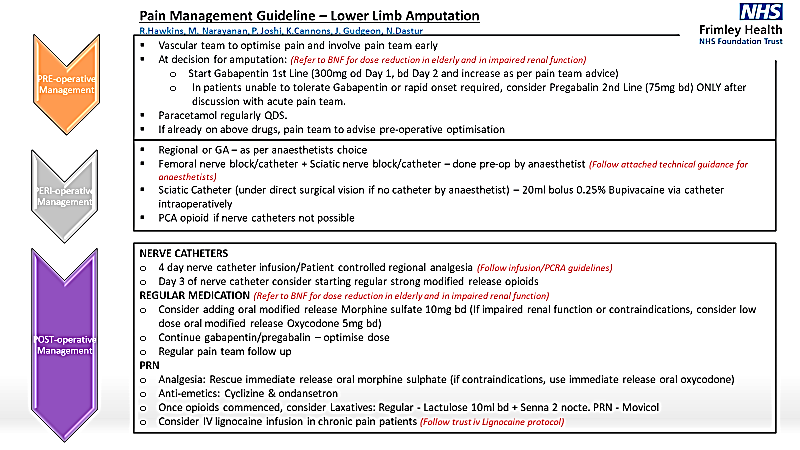
Appendix 2: Single page guideline

Full version control record
This guideline has been registered with the trust. However, clinical guidelines are guidelines only. The interpretation and application of clinical guidelines will remain the responsibility of the individual clinician. If in doubt contact a senior colleague or expert. Caution is advised when using guidelines after the review date. This guideline is for use in Frimley Health Trust hospitals only. Any use outside this location will not be supported by the Trust and will be at the risk of the individual using it.
Version Control Sheet
Related Documents