6.1 Handover to recovery staff in PACU as standard and complete the Trust’s post operative care pathway for patients following spinal anaesthesia observation Epi flowsheet.
6.2 After the return of normal motor and sensory function, patients should initially mobilise under direct supervision. The ability of a patient to straight leg raise against resistance provides a pragmatic indication that a safe level of motor power for mobilisation is likely to have returned.
6.3 All patients must have voided urine prior to discharge to prevent unplanned admissions due to urinary retention.
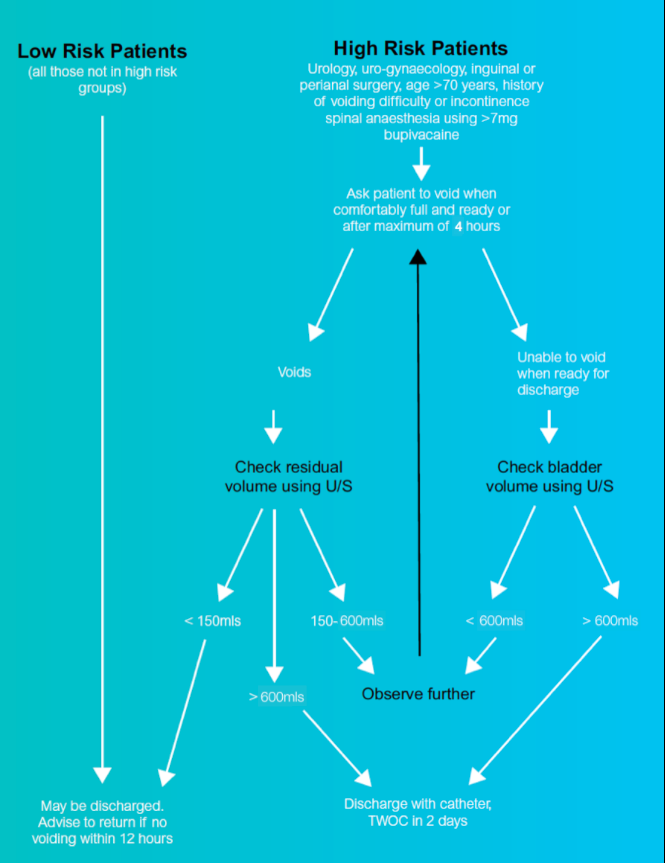
6.4 If a “high risk” patient (age >70, hernia/urological surgery, spinal opioids, previous history of prostate problems) has not voided bladder within 4 hours post procedure, a bladder scan should be performed. Urinary catheterisation should be undertaken should the bladder volume exceed 600ml (see Appendix 1).
6.5 Cases of post-operative urinary retention should undergo bladder scan and be catheterised under the care of the relevant surgical team should the bladder volume exceed 600ml. If otherwise well, patients could be discharged with catheter and return for trial without catheter (TWOC) the following day. In some circumstances, when TWOC services can’t be easily accessed, the patient will have to be admitted for an overnight stay and TWOC performed the following morning. The regional fellow should be informed of any cases of POUR for audit purposes (Appendix 1).
6.6 Patients should be educated as to whom they should contact should they suffer a complication of spinal anaesthesia such as post-dural puncture headache, post-operative urinary retention, or suspected nerve injury. They should receive a copy of the Spinal Anaesthesia for Day Surgery leaflet detailing this on discharge.
6.7 The initial point of contact for any complications in normal working hours will be the day stay unit. Out of hours, patients with an urgent complication post day surgery should present via the Emergency Department and be referred to the relevant on call teams.
6.8 Cases of suspected post-dural puncture headache should be managed as per Trust guideline “Dural puncture and post-dural puncture headache”. The starred anaesthetic consultant will coordinate management, but the patient may require admission under their responsible surgical team in order to facilitate their ongoing care.
6.9 If neurological injury post spinal anaesthesia is suspected, please refer to the Trust’s post operative care pathway following spinal anaesthesia observation flowsheet in Epic.
6.10 Patients with red flag symptoms such as progressive weakness or severe back pain should be admitted urgently via the Emergency Department. The relevant teams plus the starred anaesthetic consultant should be informed.