Key Points
-
BCIS can have serious consequences including death
-
Patients can be risk stratified
-
MDT discussion should take place for each patient
-
There are anaesthetic and surgical factors that can minimise the risk of BCIS
-
Discusses use of bone cement in fractured neck of femur hemiarthroplasty
This is a controlled document. If you are using a printed copy, check it against the guidelines site to ensure you are using the latest edition. Print copies must be destroyed after use.
Abbreviations
Summary - Deciding on the use of cement
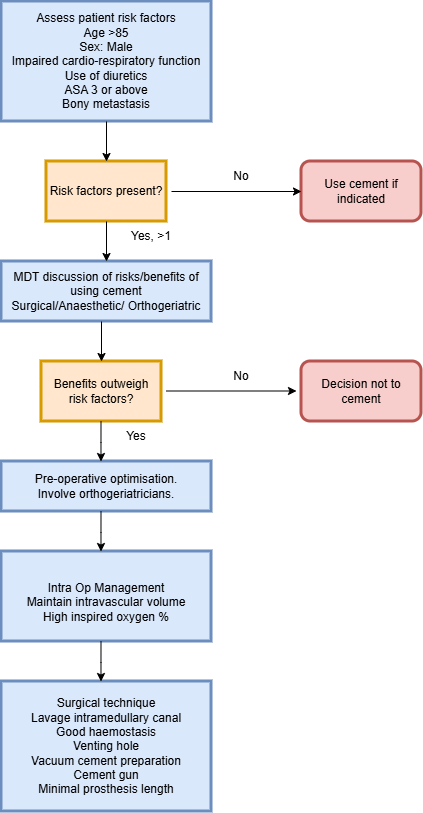
1. Introduction
This guideline has been written to inform clinicians about and highlight the risk of bone cement implantation syndrome in patients deemed to be at high risk, and avoid the cardio-respiratory compromise associated with the disease. This guideline is designed to assist in the decision making regarding the use of bone cement in arthroplasty.
Overview
Bone Cement Implantation Syndrome (BCIS) is a well-recognised and serious complication of any surgery involving bone cement, typically hip arthroplasty1.
It is characterised by hypoxia, hypotension, arrhythmias and potentially cardiac arrest2. The syndrome ranges from relatively mild to fatal, and a scale of I to III has been proposed to quantify severity2;
-
Grade I: moderate hypoxia or hypotension (saturation level <94% and/or systolic BP drop of >20%).
-
Grade II: severe hypoxia or hypotension (peripheral saturation <88% and/or systolic BP drop of >40% or loss of consciousness).
-
Grade III: Cardiovascular collapse resulting in cardio-pulmonary resuscitation.
The incidence of BCIS has been quoted as high as 28%1 for fractured neck of femur surgery utilising cement. The National Reporting and Learning System (NRLS) has collected data demonstrating significant morbidity and mortality from BCIS; 1 in 2900 hemiarthroplasties, with cement insertion resulted in BCIS causing death or severe harm4.
Evaluation and Reduction of Clinical Risk
NICE has advised the use of cemented prosthesis as they have been shown to have improved long term viability5. The benefits of a potentially longer lasting prosthesis should be weighed against the risk to the patient of using bone cement.
Risk reduction can be achieved through good patient selection as well as altering the technical factors relating to anaesthesia and surgery.
2. Risk Factors
Risk factors can be separated into two groups:
1. patient
2. surgical
2.1 Patient risk factors
-
ASA grade 3 or 4.
-
Advanced age (>85 years old) or poor pre-existing functional reserve.
-
Impaired cardio-respiratory function.
-
Male sex.
-
Pulmonary hypertension.
-
Osteoporosis
-
Bony metastases,
-
Concomitant hip fractures particularly pathological and inter-trochanteric fractures3,7.
have all been shown to contribute to, and increase, the risk of BCIS.
An increased risk has also been documented in patients prescribed beta-blockers, ACE inhibitors, diuretics, warfarin1. The AAGBI places particular emphasis on those prescribed diuretic therapy. Intra-operative use of Un-fractioned heparin does not prevent but was found to paradoxically increase the risk of BCIS.8
2.2 Surgical Risk Factors
-
Use of a long-stem femoral component2,3,9,10
-
Previously Un-instrumented femoral canal (revision surgeries has less risk of developing BCIS)2,7,10
-
BCIS has also reported in uncemented protheses and shoulder arthroplasty, although is generally less severe11
3. Prevention of BCIS
3.1 Anaesthetic risk reduction
Preoperative
-
Anaesthetic risk reduction should focus on effective pre-assessment, and optimisation before and during anaesthesia. It is recommended that senior anaesthetists are involved in the management of these patients.
-
A pre-operative discussion between the anaesthetic, ortho-geriatric and surgical teams regarding the risk: benefit ratio of the use of un-cemented compared to cemented arthroplasty.
-
Discuss the potential risk of BCIS at the WHO checklist and formulate a plan should BCIS arise6.
Intra-operative
-
No benefit of general anaesthesia over neuraxial techniques for prevention of BCIS6.
-
If providing general anaesthesia – avoid nitrous oxide in patients deemed to be of high risk. Monitor for a sudden drop in end tidal CO2.
-
The maintenance of normo-volaemia and normotension (within 20% of baseline systolic pressure) with the use of high fractional inspired oxygen concentration have been recommended both before and during bone cement insertion.
-
Prepare vasopressors (metaraminol/ephedrine) in case of haemodynamic compromise.
-
Consider invasive arterial monitoring for those with >1 risk factor.
-
Consider intraoperative cardiac output monitoring if available and appropriate in high-risk cases1.
3.2 Surgical risk reduction
Inform the anaesthetist that you are about to insert cement – ensure anaesthetic colleagues have heard information.
There are a number of surgical approaches that may reduce the incidence of BCIS:
-
Medullary lavage - using a pressurised lavage system
-
Wash and dry the femoral canal.
-
Good haemostasis.
-
Use distal suction catheter tip on top of intramedullary plug.
-
Use a cement gun in retrograde fashion on top of plug and pull catheter out as soon as it is blocked with cement.
-
Do not use excessive manual pressure or pressurisation devices.
-
An increased incidence of BCIS has been reported with longer prosthesis length - beware long stem prostheses.
-
Consider un-cemented prosthesis for those deemed to be high risk.
-
Drilling a venting hole in the distal femoral shaft.3,9,10