Key Points
-
To help identify high risk obstetric patients who need referral to a high risk obstetric anaesthetic clinic
-
To guide obstetricians, GPs and midwives throughout the referral process including referral criteria and clinic logistics
This is a controlled document. If you are using a printed copy, check it against the guidelines site to ensure you are using the latest edition.
Print copies must be destroyed after use.
Abbreviations
1. Aim of Guideline
To streamline the referral process into the high risk obstetric anaesthetic clinic, ensuring that all women are assessed appropriately and optimised during the perinatal period.
2. Background
2.1 The Saving Mothers’ Lives 2006-2008 document explicitly states that most recommendations to reduce maternal morbidity and mortality require a multidisciplinary approach1.
Timely anaesthetic antenatal assessment should therefore be available to all potentially high-risk mothers to enable planning for the safe provision of anaesthesia, as per the OAA/AAGBI Guidelines for Obstetric Anaesthetic Services 2013 document2.
3. Methods for referral
3.1 A referral to the High Risk Obstetric Anaesthetic Clinic should be made via Epic as soon as a high-risk patient has been identified. This can be found via the search bar under the Orders tab; outpatient referral to “High-Risk Anaesthetic Clinic (HRAC) Obstetrics”.
3.2 Referrals can be made only by Obstetricians and Midwives (see referral criteria, section 4.1).
3.3 If a high-risk patient is admitted prior to their clinic appointment and is identified on an ‘emergency’ basis, then the on-call labour ward anaesthetist can be contacted via bleep #4490 at WPH, #5112 at FPH.
3.4 If a timely High Risk Obstetric Anaesthetic Clinic appointment is unavailable, an ad hoc appointment will be arranged by the antenatal clinic with the anaesthetic department at WPH, and by the anaesthetic department at FPH.
4. Referral Criteria
4.1 Referrals are accepted from midwives or obstetricians depending on the indication according to the list below. The list is not exhaustive and referrals from consultant obstetricians for other indications are welcomed. Referrers can bleep the duty obstetric anaesthetic consultant (FPH #5591, weekdays 0730h-1930h) or duty obstetric anaesthetist (WPH #4490) to discuss any cases for which they are uncertain about the need for referral.
Midwife OR Obstetrician Referrals
Anaesthetic indications
History of difficult or failed intubation
Anaphylaxis to anaesthetic drugs
Suxamethonium apnoea
Malignant hyperthermia
Previous traumatic or failed regional anaesthesia
Significant complications after neuraxial block (e.g. dural tap, unresolved nerve damage)
Cardiovascular disease – ensure cardiology assessment up to date
Congenital or acquired structural heart disease
Brugada syndrome or other channelopathy
Aortic disease e.g. Marfan’s
DO NOT refer women with POTS, murmurs with a normal echo, well-controlled arrhythmia, or women for whom cardiological input during pregnancy is not required
Obesity
BMI > 50
BMI > 40 with significant respiratory or cardiovascular comorbidity
All women with BMI > 40, whether requiring referral or not, should be given “Anaesthetic information for pregnant women with a high body mass index (BMI)” leaflet.
An up-to-date weight should be measured at 28 weeks and if her BMI crosses the 50 threshold, then she can be referred.
Spinal problems
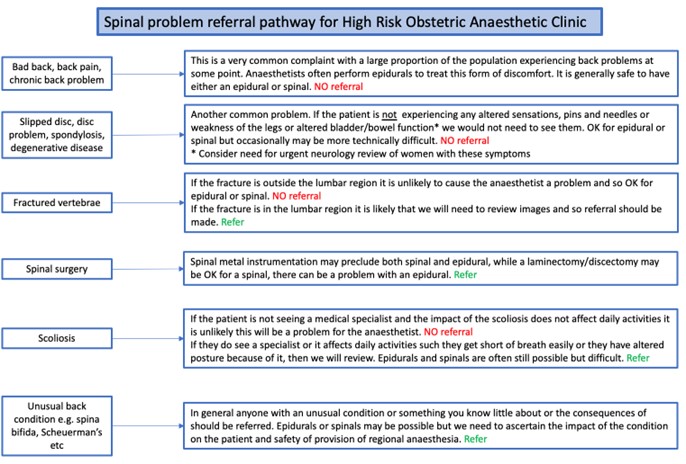
Please confirm you are referring for a spinal problem for which referral has been indicated by the “Spinal Problem Referral Pathway for High Risk Obstetric Anaesthetic Clinic” (see section 4.3).
Consultant Obstetrician ONLY to Refer
-
Severe respiratory disease (please ensure up to date with respiratory physician assessment)
-
Significant neuromuscular disorders such as myasthenia gravis, musculodystrophy, multiple sclerosis (with significant neurological impairment or impact on speech or swallow - do NOT refer for well-controlled/stable MS or epilepsy)
-
Severe endocrine disease (e.g. Cushing’s, Addison’s, phaeochromocytoma)
-
Rheumatological disease if it impacts on mouth opening, cervical or lumbar spine movement
-
Active or past history of cancer with clear implications for anaesthetic management
Haematological issues
-
Bleeding disorders that may impact on safe provision of spinal or epidural - please ensure that assessment by shared haematology and obstetric clinic has taken place
-
Women taking LMWH should NOT be referred but should be given “Anaesthetic information for pregnant women taking low molecular weight heparin (LMWH) injections” leaflet and “Remifentanil PCA” leaflet
-
Women who decline blood products (including Jehovah’s Witnesses) should be referred to the shared haematology and obstetric clinic – a copy of the clinic letter should be sent to the anaesthetic department but referral to the High Risk Obstetric Anaesthetic Clinic is NOT required.
4.2 All referrals are triaged, and some returned with advice if a clinic appointment is not warranted. At FPH, the triaging anaesthetist will order an appointment by searching for HRAC-OBS APPT Request. At WPH, a clinic appointment will be booked by the Lead Antenatal Midwife in priority order, and any unclear referrals will be discussed with the duty obstetric anaesthetic consultant.
4.3 Before making a referral to clinic for a patient with a back issue, referrers are asked to check whether it is necessary, according to the following advice:
5. The Clinic
5.1 Clinics are led by a Consultant Obstetric Anaesthetist. A senior registrar may also be present.
5.2 Assessment and examination will be based on the reason for referral. A management plan will be discussed with the patient +/- their partner, including a plan for analgesia and anaesthesia, as required. Information leaflets and useful websites may be offered to the patient.
5.3 At WPH, the agreed plan and associated discussion will be documented on Epic. Documentation is filed as an “anaesthetic opinion” after accessing the HRAC-Obs tab, and a pre-assessment form (as per any surgery) should be filled in under anaesthetic plan. At FPH, the outcome is documented in a letter.
5.4 Consideration must be given to whether patients with certain medical conditions, e.g. severe valvular disease or severe cardiomyopathy, are deemed appropriate to deliver at the DGH site; multidisciplinary consultant-led discussions should take place to ascertain the safest plan for delivery.
5.5 A Maternal Medicine MDT occurs every other Monday held on the FPH site. Referrals for discussion are made to Maternal Admin Support Team.
References
1. CEMACH. (2006-2008) Saving Mothers’ Lives. Public Health Agency. Available at: https://www.publichealth.hscni.net/publications/saving-mothers-lives-2006-2008 (Accessed: 11 September 2024)
2. Association of Anaesthetists (2013) OAA/AAGBI Guidelines for Obstetric Anaesthetic Services. Available at: https://anaesthetists.org/Portals/0/PDFs/Guidelines%20PDFs/Guideline_obstetric_anaesthetic_services_2013_final.pdf (Accessed: 11 September 2024)
Full version control record
This guideline has been registered with the trust. However, clinical guidelines are guidelines only. The interpretation and application of clinical guidelines will remain the responsibility of the individual clinician. If in doubt, contact a senior colleague or expert. Caution is advised when using guidelines after the review date.
This guideline is for use in Frimley Health Trust hospitals only. Any use outside this location will not be supported by the Trust and will be at the risk of the individual using it.
Version Control Sheet