Key Points
There are three stages in the management of perioperative dental injury, summarised below.
Preoperative
-
Identify patients at high risk of dental injury, examine teeth and record any dental issues before general anaesthesia.
-
Refer patients presenting for non-urgent surgery to their dentist for optimisation of oral health.
-
Counsel patients that dental injury is a possibility and document accordingly.
Intraoperative
-
Avoidance of general anaesthesia in suitable high-risk patients.
-
Airway management by most experienced anaesthetist in high-risk patients.
-
Consider the use of bite blocks.
Management following injury
If dental injury occurs:
-
Do not handle the root surface.
-
Locate tooth/tooth fragments.
-
Replace tooth in non-immunocompromised patients.
-
If unable to replace teeth, store in sterile saline or milk.
-
Inform the patient of the injury. Apologise but do not admit liability. Refer patient to their usual dental practitioner. At the Heatherwood and Wexham Park sites, refer the patient to the maxillofacial surgeons.
-
Document this discussion in the patient record.
This is a controlled document. If you are using a printed copy, check it against the guidelines site to ensure you are using the latest edition. Print copies must be destroyed after use.
Pre-existing Dental Abnormalities and Type of Resulting Injury
-
With healthy teeth the most common injury are fractures during difficult laryngoscopy or insertion, manipulation or removal of any airway or suction device.
-
With prosthesis or dental restoration, the usual injury is a loosening of the prosthesis or a deterioration of the restoration material
-
With periodontal disease the common injury is tooth subluxations or dislocations
-
Mandibular teeth can be damaged from biting the oropharyngeal airway, tracheal device or a supraglottic device
Preoperative Assessment and Documentation
-
Adults have 32 permanent teeth (8 per quadrant: 2 incisors, 1 canine, 2 premolars, 3 molars). Children have 20 primary teeth (5 per quadrant: 2 incisors, 1 canine, 2 molars)
-
Record any dental issues found before anaesthesia
-
Use a simple diagram of the Universal Number system illustrated in figure 1
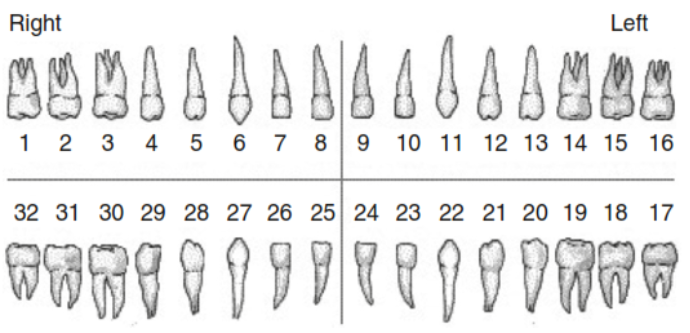
Figure 1: Universal Numbering System
-
Identify risk factors and plan accordingly
-
Inform the patient that dental injury is a known risk of general anaesthesia
-
Record the discussion and consent in the notes
-
For high-risk patients: consider the use of regional techniques if appropriate or consider a more senior anaesthetist to do the intubation.
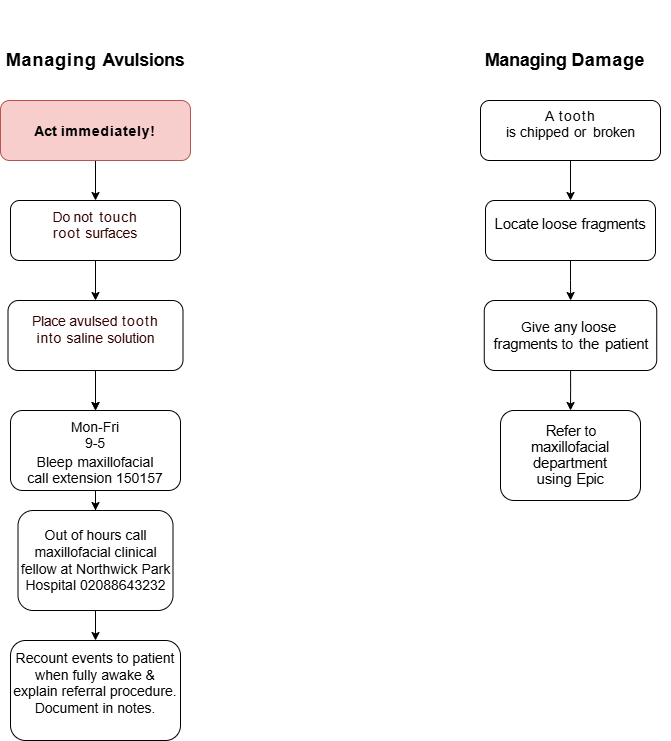
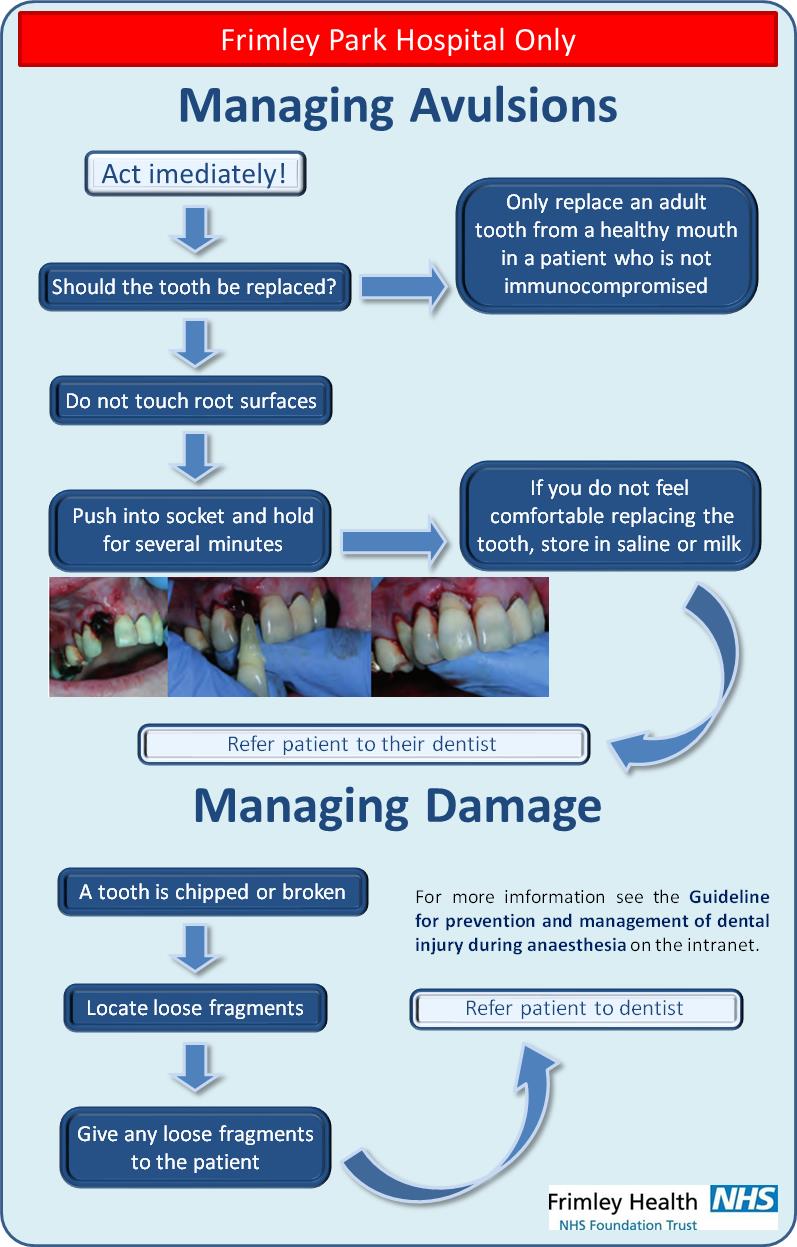
Managing dental injury (see Appendix A and B)
-
Account for all fragments of teeth
a. A chest x-ray be necessary if aspiration is suspected
b. Most dental fragments pass harmlessly through the gut, but larger fragments may need surgical or endoscopic removal
-
Tooth avulsion
a. Reimplant immediately if not immunocompromised
b. If reimplantation is not possible, store tooth in sterile saline or milk
c. Do not reimplant avulsed primary teeth in children
-
Refer appropriately:
a. Heatherwood and Wexham Park Hospitals: contact maxillofacial team (Appendix B)
b. Frimley Park Hospital: refer patient to their dentist (note that Frimley Health NHS Foundation Trust does not routinely cover treatment costs for dental injuries linked to anaesthesia)
c. Provide the patient with an information leaflet (can be found in post procedure communication in Epic– see related comments)
-
Inform and document
a. Tell the patient once suitably awake
b. Offer an apology and explanation and record this in the notes, provide written documentation if needed
Appendix A - Managing Dental Injury (Frimley Park)
Appendix B – Managing Dental Injury (Heatherwood & Wexham Park)